
As the war involving Iran becomes increasingly dominated by the country’s chokehold on the Strait of Hormuz and the record highs of oil prices creating the biggest energy disruption in history, the question of the US-Israeli end goals behind the military action against Iran is strategically falling more and more off the radar.

Since January, the US and Israeli justifications for the war have ranged from incoherent to contradictory. Donald Trump’s early encouragement of Iranians to “take over their institutions” because “help is on its way”, later gave way to national security arguments and nuclear talk when the war began. Israel, meanwhile, keeps pushing more and more frantically for ‘regime change’ as the weeks pass with no clear win in sight.

Against this backdrop of smoke and mirrors, one concept has increasingly been used by analysts and social media users to explain the potential objective behind US-Israeli moves: the “balkanisation” of Iran. The term gained traction particularly after reports of the CIA mobilising and arming Kurdish groups to fight against the Ayatollah regime. But what do the Balkans have to do with Iran? And how realistic is such a scenario for a country with more than 2,500 years of unified presence?

‘Balkanisation’: where the term comes from

Balkanisation refers to the fragmentation of a country or region into several smaller, often ethnically homogeneous states. Today the term is often used to describe the disintegration of multiethnic states into competing political entities, frequently accompanied by civil wars, ethnic violence, and external intervention. In these situations, differences in ethnicity, religion or culture become weaponised by outside powers who pursue their own strategic interests.

The word itself originates from the Balkan Wars of 1912–1913. By the early twentieth century, four Balkan nation states – Bulgaria, Greece, Montenegro and Serbia – had gained independence from the Ottoman Empire. However, large populations belonging to these ethnic groups still remained under Ottoman rule. In 1912, these countries united to form the Balkan League and launched the First Balkan War against the Ottoman Empire. The conflict ended with the Treaty of London, negotiated with the involvement of the European Great Powers: Russia, Britain, France and Germany.

The alliance soon collapsed. Dissatisfied with its share of the newly conquered territory, Bulgaria attacked its former allies just a year later, triggering the Second Balkan War. The chaos that ensued redrew the map of the region once again, with significant territorial modifications resulting both from the Treaty of Bucharest.

The ethnic cleansing, violence and nationalist rivalries unleashed during these conflicts foreshadowed a long-term instability that followed the region all through the 20th century, and let the term balkanisation enter our vocabulary. Many contemporary readers also associate “balkanisation” more directly with the breakup of Yugoslavia in the 1990s. Its violent disintegration into several independent countries, accompanied by ethnic conflict and war, reinforced the term’s modern meaning as a process of fragmentation marked by instability and violence.
Iran: A diverse but historically unified state

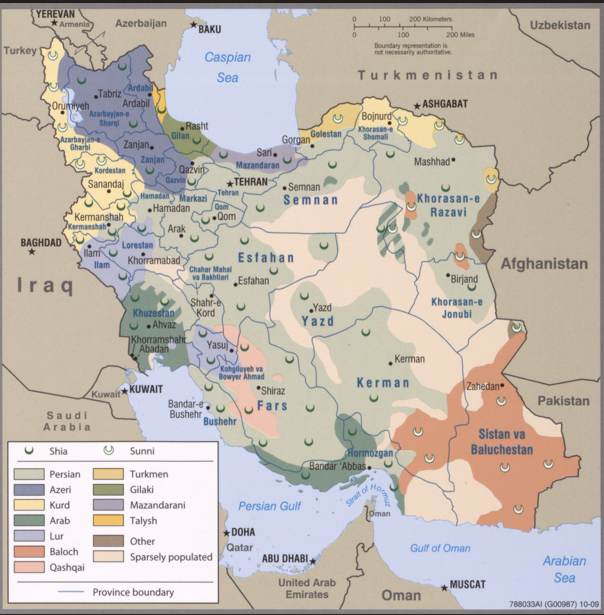
Fast forward to today; Iran, with a population of 90 million, is one of the most ethnically and religiously diverse countries in West Asia. Ethnic Persians form the majority of the population, but significant minorities include Azerbaijanis, Kurds, Lurs, Baloch, Arabs and Turkmen. While most Iranians are Shia Muslim, some ethnic minorities — particularly Kurds and Baloch — are predominantly Sunni, and small Christian communities also exist.

Iranian governments throughout history have often struggled with minority rights and regional autonomy, and some groups have faced repression under various regimes such as Kurds and Balochs. Yet Iran has also long presented its multicultural identity as a source of strength. Together with China, it is one of the two oldest civilisations in the world that have endured continuously as unified states, possessing one of the most ancient and uninterrupted systems of governance in existence.

While the ethnic and religious diversity presents management challenges for the state, it constitutes a profound source of strength through its cultural, historical, and social cohesion. The imagery of Persepolis, where delegations from across the Persian Empire were depicted bringing tribute to the king, is often cited as a symbol of this historical diversity under a unified political system. For many Iranians, the country’s long civilisational continuity has created a strong sense of national identity that transcends ethnic differences.

Map of Iran showing ethnic and religious distribution by region

Map showing the ethnic and religious distribution of Iran. The country’s diversity lies at the centre of debates over its potential fragmentation. Source: United States Central Intelligence Agency Cartography Center / Library of Congress, available via Wikimedia Commons.

Why balkanisation is used in discussions about Iran

The assassination of Ayatollah Ali Khamenei and the resulting power vacuum has already shaken the country’s political order, with groups of Iranian society already pitting themselves against each other, wanting very different things. Civil society groups, youth movements and women’s rights activists are seeking to build a rule-of-law based political system. Ethnic minority groups – Kurdish, Balochi, Azerbaijani and others – are advocating greater autonomy or decentralisation. Monarchist supporters are attempting to promote the restoration of the royal system, while elements within the Islamic Revolutionary Guard Corps (IRGC) are increasingly behaving more autonomously, positioning themselves as independent power centres. As Anne Applebaum, staff writer at The Atlantic notes, these competing visions could deepen internal divisions if the central state weakens.

The idea that Iran could be intentionally destabilised along ethnic lines is not new, but it has resurfaced particularly after the CIA’s mobilisation of Kurdish groups against the Iranian regime and through recent media, policy and academic discussions. Iranian professor at the University of Tehran Foad Izadi pointed to recent remarks by Donald Trump suggesting that Iran’s territorial integrity will change after the war, interpreting them as indicative of plans to divide the country. A recent Jerusalem Post editorial called for a “Middle East coalition for Iran’s partition” and proposed “security guarantees to Sunni, Kurdish and Balochi minority regions willing to break away. Meanwhile Eldar Mamedov, Latvian diplomat and former senior foreign policy adviser in the European Parliament, has argued that certain think tanks and policy actors in Washington are increasingly “promoting the balkanisation of Iran”. 

Academic perspectives have also contributed to this debate. Iranologist Shapour Suren-Pahlav, working at the School of Oriental and African Studies (SOAS) at the University of London, has suggested that the insistence of “US intelligence and policy circles, Israeli security apparatuses including Mossad and pro-Israeli lobbying groups across the West” towards Iranian federalism is “a coded term, a political shorthand for the balkanisation of Iran”. 

The scenario is reinforced by the absence of a clear political roadmap for a post-conflict Iran, with Washington offering little indication of what would follow beyond destabilisation. US Secretary of State Marco Rubio acknowledged during congressional testimony that the United States does not know who might replace the current leadership, and did not identify a preferred successor (Atlantic Council article). Jonathan Panikoff, a former US deputy national intelligence officer, has suggested the strategy may simply be to remove the leadership and allow internal power struggles to unfold, hoping the resulting instability weakens Iran’s regional influence.

Whether Iran could actually fragment along ethnic lines remains highly contested. The country’s strong national identity, centralised institutions and long history of territorial continuity make such a scenario far from inevitable. Iran is neither Yugoslavia nor a newly emergent nation-state, like the ones that took part in the Balkan wars. These countries were not historically cohesive nations; they were created following the disintegration and partition of empires, as in the case of Iraq and Syria, which emerged from the Ottoman realm under British and French control. Yet the increasing use of the term “balkanisation” about Iran reflects the fear that external pressure combined with internal divisions could push a diverse but historically unified state into prolonged instability. The current moment shows that balkanisation is far from history; it’s a playbook as prevalent today as it was in the Balkan and Yugoslavia wars that reshaped Europe.

Written by

Shape the conversation

Do you have anything to add to this story? Any ideas for interviews or angles we should explore? Let us know if you’d like to write a follow-up, a counterpoint, or share a similar story.