



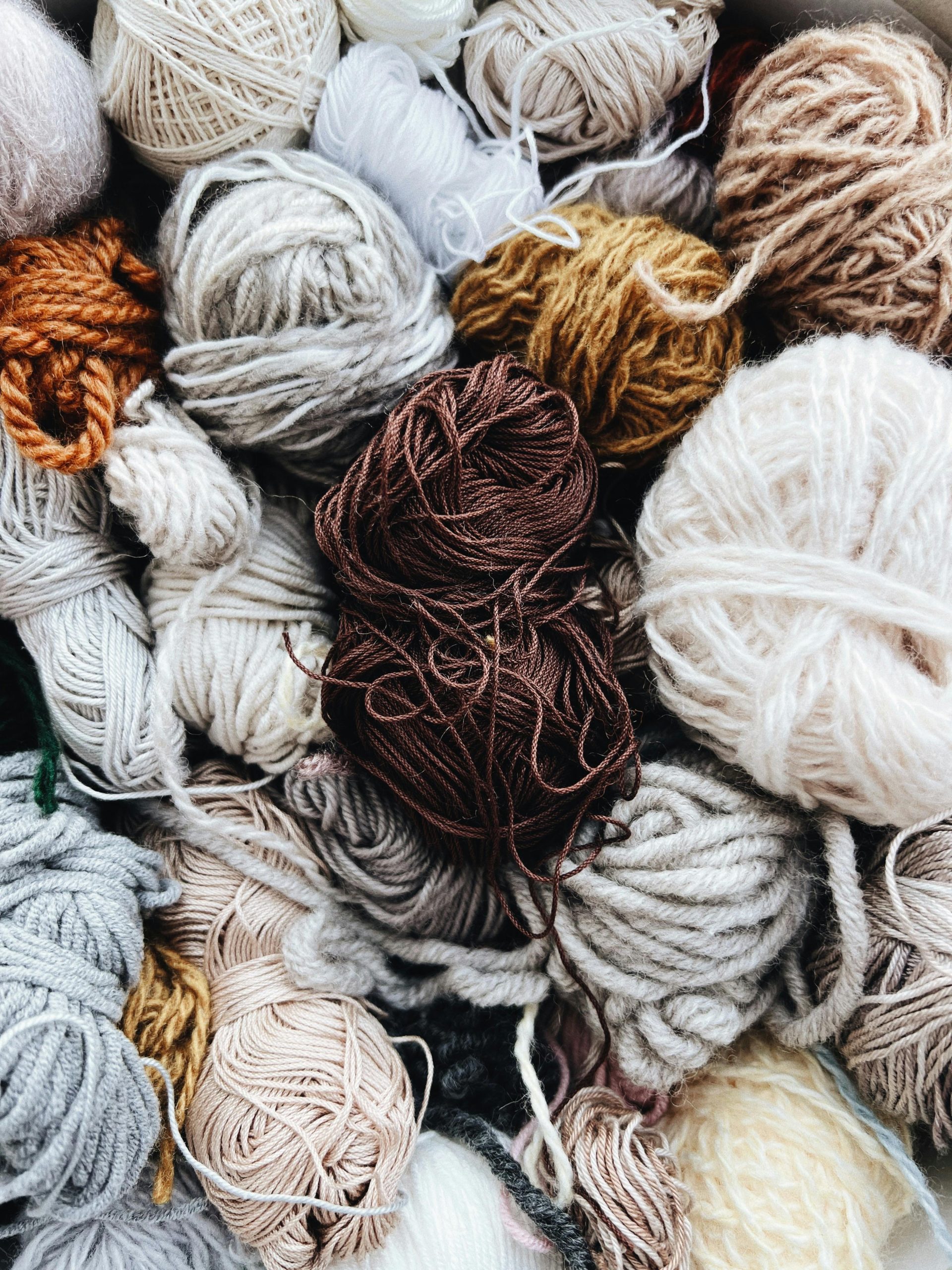
Source: Elina Nova, Pexels.com. https://www.pexels.com/de-de/foto/balle-stillleben-faden-garn-14162242/
Twisted into yarns and then made into woven, knitted or bonded fabrics: Fibers are what textiles are made of. These thin, long and flexible structures found in plants and animals form the backbone of the fashion and textile industry. Therefore, their sustainability is crucial both for our environment and the industry’s survival.
Under these conditions we are first looking at the kind of fiber that currently dominates the industry: the synthetic fibre.
Synthetic fibres are textile fibers that are man-made and produced “entirely from chemical substances”, according to Britannica. Some of the most common among these are polyester, nylon and acrylic. After world war second, synthetic fibers became popular as a cheaper alternative to natural fibers. Nowadays, their advantages have made them especially significant in the fast fashion industry.
Fast fashion and the key role of synthetic fibers
In today’s world, there is a strong tendency toward fast fashion: Trends appear and are consumed more frequently, many clothes are bought and worn for only a season and therefore produced inferiorly. According to the European Parliament, the consume of textiles in the EU was 19 kg on average per person in 2022 (+2 kg compared to 2019), while 12kg of clothing per person are thrown away every year. In Germany, for example, 40% of purchased clothes is never worn or only worn rarely.
And without synthetic fibers, fast fashion would not exist. As customers shall continue buying, new and cheap products must be for sale constantly. This need is perfectly met by synthetic fibers, which are cheaper and more easily available than natural materials, while also not being dependent on seasons.
Besides their advantages for a system like fast fashion, synthetic fibers are also liked for being easy to launder, wrinkle free, and for their durability. Durability may sound positive at first, but at the end of the textile life cycle, it means that they will take way longer to biodegrade compared to natural fibers. Like other plastics, it can take decades, even centuries.
Synthetic fibres: Impact on the environment and human health
The three pillars of sustainability – economic, social, environmental- are all severely effected by the consequences of today’s clothing and textile supply chains.
Synthetic fibers – dominating the world’s textile market – being made from fossil fuels makes this market “one of the biggest climate offenders with a terrible carbon footprint,” as the WWF says (transl. by author). In 2015, it produced more CO2 equivalents than all international flights and shipping combined.
And while they are easy to launder, the laundering of synthetic fibers has already caused enormous amounts of microplastic in lakes and oceans (35% of microplastic in the world oceans comes from synthetic textile fibers, according to IUCN). That has created severe consequences for marine and human life. Nowadays, plastic microfibers released from synthetic clothing have become ubiquitous in our environment, appearing for example in our drinking water and food products.
Are natural fibres like cotton a safe alternative?
However, synthetic fibers are not the only ones with negative environmental and health impacts. A plant’s ability to bind and store CO2 significantly reduces the CO2 emissions of natural fibers, but that does not directly make it a safe, sustainable alternative.
The category of natural fibers is dominated by cotton as the most important raw material. Cotton needs an especially high amount of water in its production, and chemicals are needed, as well. The production also creates a lot of carbon dioxide through its energy consumption. The anti-social labour conditions for laborers, such as inadequate health protection, must also be taken into account.
Animal-based textile production is recourse-intensive, as well, “including water, land, and energy, alongside the emission of greenhouse gases and pollutants” (Challa & Thakkar, 2019)*. Sheep wool, the most widely used animal fibre in the fashion and textile industry, illustrates this issue clearly. While wool is renewable and biodegradable, sheep farming produces substantial greenhouse gas emissions. Moreover, unethical conditions for animals in wool production, criticized by activist organizations like PETA, should be considered.
More sustainable options
Despite their recourse consumption and emissions, natural fibers still play a key role in sustainable fashion due to being biodegradable as well as affordable. To change today’s resource-intensive clothing and textile industry’s CO2 footprint (which is responsible for 3 to 10 percent of global carbon dioxide emissions), textil innovations are being developed. The following list of sustainable materials for textile production is mainly based on the list created by Tawiah et al.
Organic Cotton: It is often being recommended to look for certified organic cotton instead, as its water consumption and chemical use is significantly lower. Also: The usually high use of pesticides whilst producing cotton is forbidden in the production of organic cotton.
Hemp, Bamboo: their environmental benefits lie in their rapid growing, and also, that they do not require use of pesticides.
Lyocell: the raw material is cellulose from wood pulp, its closed-loop process reduces chemical waste.
Piñatex: There is a special focus on alternatives for leather, as livestock farming is responsible for about 14,5% of todays greenhouse gas emissions. Piñatex is a vegan leather made from pineapple waste. Less water and no harmful chemicals (/ecologically toxic to wildlife) are required.
While only 1% of clothes are recycled into new clothes, recycling and reusing takes away waste that would end in environmental problems.
Recycled Wool: can be recycled both before and after consumer use.
Recycled polyester: It is obtained from already consumed polyester.
Econyl: Made from recycled nylon.
Fibers to reuse
The fashion industry consumes enormous amounts of natural resources while simultaneously producing enormous amounts of waste. Different types of fibers contribute to this problem in different ways and to varying degrees. However, addressing these challenges goes beyond the question of what we wear—it also concerns how and how long we wear our clothes. As already stated, recycling is a powerful method, and so is upcycling, repairing and secondhand. In other words, following the principles of a circular economy: Thinking in cycles, using a smaller amount of clothes for a longer time to reduce the amount of waste, textiles produced – and recourses used.
*Cited via a secondary source:
Challa, K. R., & Thakkar, M. (2019). Environmental impacts of animal-based textile materials. Environmental Sustainability 2(3), 157-169, cited after: https://www.researchgate.net/publication/382886083_THREADS_OF_CONTROVERSY_SUSTAINABILITY_AND_ETHICS_IN_ANIMAL-BASED_TEXTILE_INDUSTRIES
Remaining sources:
https://www.bbcearth.com/news/six-fashion-materials-that-could-help-save-the-planet
https://www.bbcearth.com/news/5-fashion-materials-you-didnt-realise-were-bad-for-wildlife
https://www.bbc.co.uk/bitesize/guides/zmbyb82/revision/4
https://www.abc.net.au/news/2025-12-27/what-fibres-and-fabrics-to-wear-in-summer/105981546
https://www.mdpi.com/1996-1944/15/14/4790
https://satheejee.iitk.ac.in/article/chemistry/synthetic-fibres-and-natural-fibres/
https://pmc.ncbi.nlm.nih.gov/articles/PMC6123651/
https://www.quarks.de/umwelt/kleidung-so-macht-sie-unsere-umwelt-kaputt/
https://textileexchange.org/knowledge-center/reports/materials-market-report-2024/
https://link.springer.com/chapter/10.1007/978-981-95-0469-5_3
https://www.tandfonline.com/doi/full/10.1080/15440478.2025.2462218#d1e182
https://www.tandfonline.com/doi/epdf/10.1080/15440478.2025.2462218?needAccess=true
https://journals.sagepub.com/doi/10.1177/24723444231201443
https://www.mdpi.com/2079-6439/13/2/14
https://www.greenpeace.de/engagieren/nachhaltiger-leben/robust-umwelt
https://doi.org/10.1016/B978-0-08-102041-8.00008-1
https://pmc.ncbi.nlm.nih.gov/articles/PMC6123651/
https://www.tandfonline.com/doi/full/10.1080/15440478.2025.2462218#abstract
https://www.peta.de/themen/wolle/
https://www.guinnessworldrecords.com/world-records/100843-most-widely-used-animal-fibre