
Tell EU stories, develop your journalism skills, and make your voice heard!

In Antananarivo, the revolution didn’t start with a manifesto; it started with a ‘Battery Low’ notification. In September 2025, when the Madagascar government cut the power for 12 hours a day, they didn’t just turn off the lights—they disconnected an entire generation from their livelihoods, their communities, and their futures. But as the city went dark, the screens stayed lit. Within 21 days, a leaderless army of Gen Z ‘pirates,’ coordinated via encrypted Discord servers and fueled by a collective refusal to live in the dark, did what no political party could: they forced a president to flee.
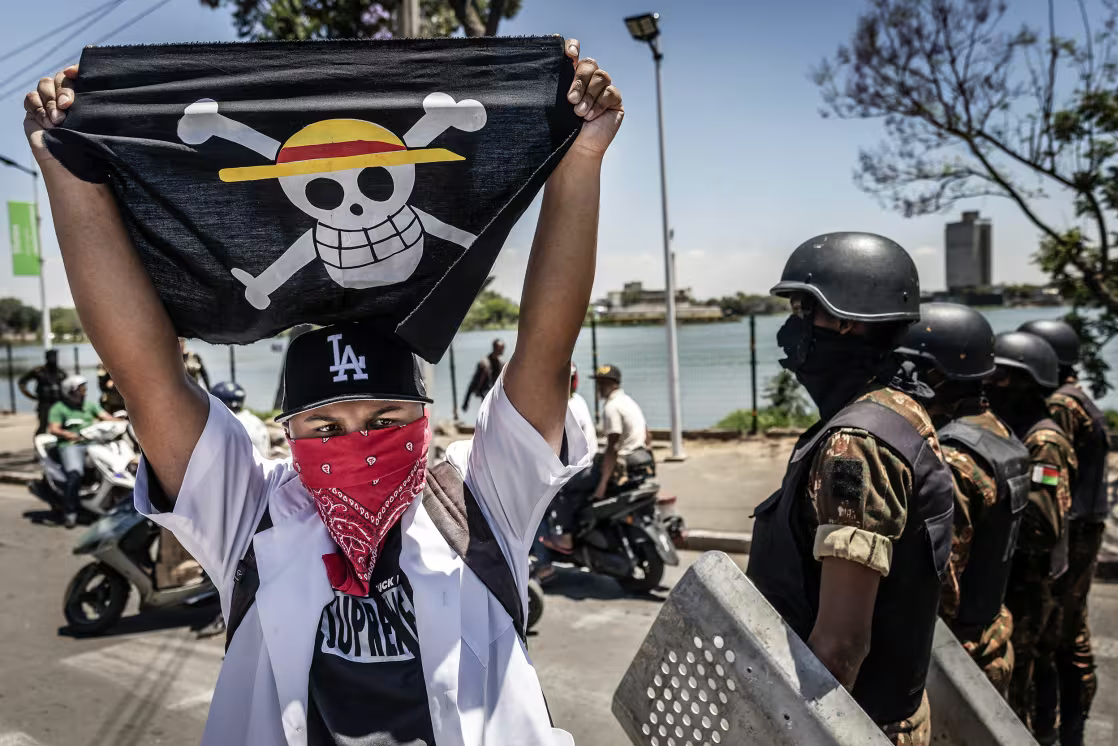
Last October in Antananarivo, Madagascar, a demonstrator carried a flag with the insignia of the well-known Japanese manga “One Piece,” a symbol used by Gen Z protest movements across the globe.

The regime’s fatal mistake was a failure of imagination. While the Ministry of Communication scrambled to sever the fiber-optic cables and kill the cellular towers—a digital ‘Buster Call’ intended to isolate and silence the capital—the youth simply went dark. They didn’t need the state’s internet to talk. Using Bluetooth mesh networks, the protesters turned every smartphone on the Avenue de l’Indépendance into a relay station, creating a sprawling, invisible web of data that the police couldn’t track or tap. Orders to move, medical alerts, and real-time videos of the front lines hopped from phone to phone like a digital virus. The old guard was fighting a war of radio waves and checkpoints, but the ‘Will of Z’ was playing a game of peer-to-peer survival, proving that you can’t cut the head off a movement that exists everywhere at once.


From Pixels to Pavement

The revolution didn’t just live in the mesh networks; it bled into the very architecture of Antananarivo. By day three, the “X” mark—the iconic symbol of silent solidarity from the Alabasta arc—began appearing on the forearms of students, street vendors, and even disillusioned civil servants. It was a visual handshake, a way to identify an ally in a crowd without saying a word. When the police moved in with tear gas, the protesters didn’t scatter in chaos; they moved with a synchronised fluidity that suggested a hive mind. Using real-time “heat maps” generated by their offline apps, they navigated the labyrinthine alleys of the capital like a crew that had been studying the charts for years, always staying one step ahead of the heavy-booted “Marine” patrols.

As the sun dipped behind the hills of the High City, the atmosphere shifted from protest to a defiant festival of the oppressed. The government’s attempt to “starve them in the dark” backfired spectacularly as thousands of phone flashlights turned the Avenue de l’Indépendance into a sea of artificial stars. They weren’t just chanting for lower bread prices or a change in leadership; they were singing “Binks’ Sake” in Malagasy, a song of lost sailors and the dawn of a new day. In that moment, the 16-year regime realised their mistake: they weren’t fighting a political party with a platform they could debate. They were fighting a mythology—a generation that had decided that “freedom” wasn’t a policy, but a birthright they were finally ready to claim.

The Dawn of a New Era

The fall of the 16-year regime in Antananarivo wasn’t just a local political shift; it was a proof of concept for the 21st century. As the first light of a new administration rises over the Avenue de l’Indépendance, the “Will of Z” has left behind a blueprint for digital-native resistance that no firewall can contain. The government’s mistake was treating the Straw Hat as a joke, failing to realise that for a generation raised on stories of liberation against impossible odds, fiction is often the most potent fuel for reality. They tried to fight a decentralised cloud with iron bars, and in doing so, they only proved that ideas—much like the legendary treasure itself—cannot be un-found once the world has seen where they are hidden.

What happened in Madagascar is a signal flare to every “World Government” currently hoarding resources in the dark: the “Great Pirate Era” of activism has arrived. Power no longer flows solely from the top down through state-controlled media or physical intimidation; it now surges from the bottom up through mesh networks and shared mythologies. As the youth of Antananarivo fold up their flags and begin the hard work of rebuilding a nation, they do so with the knowledge that they didn’t just topple a government—they rewrote the rules of the game. The “Dawn” isn’t just a metaphor anymore; it’s a recorded history, encrypted and distributed, waiting for the next spark to catch.

Shape the conversation

Do you have anything to add to this story? Any ideas for interviews or angles we should explore? Let us know if you’d like to write a follow-up, a counterpoint, or share a similar story.