


Despite being booted out of office in 2018 by mass protests following the murder of journalist Jan Kuciak, who had been investigating businessmen close to Slovak politicians, Fico returned to office, winning elections in 2023 – often repeating Kremlin talking points and putting emphasis on Slovakia looking further than the West in foreign policy matters.
Since his return, he has introduced legal reforms that lessen the criminal justice system to prosecute his allies, reduced the state’s anti-corruption watchdog’s power, replaced Slovakia’s public broadcaster with a government-controlled organisation, and curbed the right to protest.
This style of governance was only escalated after an assassination attempt was made against Fico in May 2024, when he was shot multiple times. While he recovered, the prime minister claimed that the incident was linked to George Soros and had invoked it several times against protesters, trying to draw parallels between opposition against the government and the violent attack.
Naturally, his activities have seen condemnation from the EU and protests in the streets of Slovakian cities, including regular marches in Bratislava, with a large part of the protest being fuelled by young people. One of the largest waves of protests in 2025 marked the 36th anniversary of the Velvet Revolution on November 17th.
On November 15th, a video of Fico visiting a school went viral after a section of students openly protested him, dressed in black, raising the Ukrainian flag, and jangling keys, just as the student protesters did during the Velvet Revolution. The open insubordination was too much for the Prime Minister, who could be heard shouting, “Go and fight in Ukraine.”
Source: APT YoutTube channel
This coincided with a “chalk wave,” a week-long protest that spread across the country, where people left anti-government or pro-democracy messages on walls, pavements, and roads using chalk.
Even with a steady stream of public opposition, Fico has continued to hollow out state institutions that could act as a threat to his consolidation of power. December 9th, the government’s coalition voted to axe the country’s Watchdog agency, in what the opposition called “an act of revenge”.
“I had thought this was a revenge bill by [Interior Minister and Hlas party leader] Matus Sutaj Estok and [Smer MP] Tibor Gaspar, but in fact it is a law of shame for the coalition,” Zuzana Stevulova, an opposition MP from the Progressive Slovakia party, said before the vote.
The law is set to take effect on January 1, 2026, though experts say it will most likely end up before the Constitutional Court.
Although the Fico government is making no indication that it will change its current trajectory, polling data from Politico shows that, for now, there has been a big shift in the electorate. Since September 2024, the popularity of Fico’s party Smer has dropped precipitously from 24 points to 18, falling below rivals Progressive Slovakia, which has consistently polled around 23 points for over a year.
The government’s stance on Ukraine might be what puts it at odds with other EU members, but in terms of key reasons that Slovaks are frustrated, the economy plays a much bigger role.
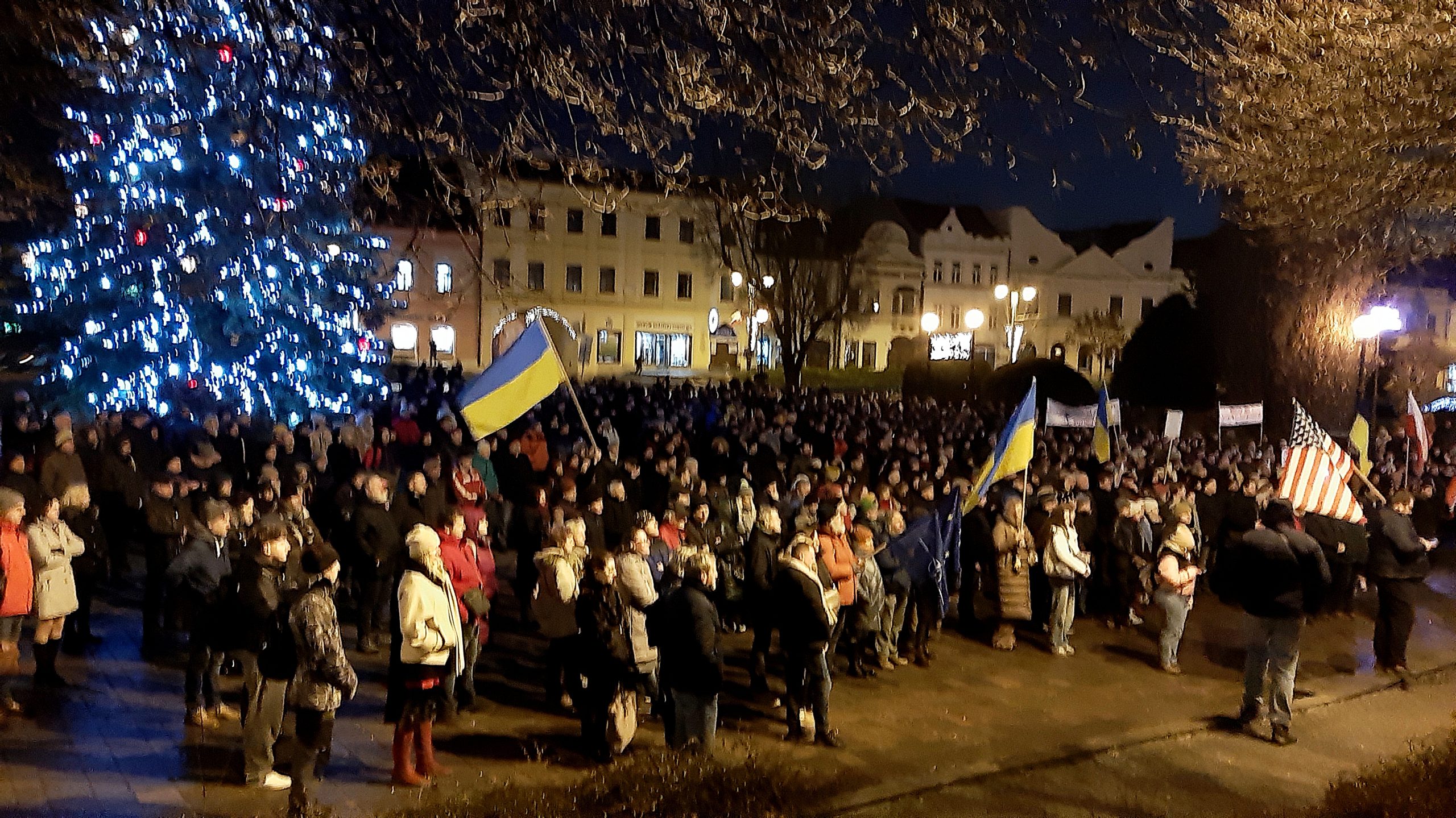
Protests have erupted throughout Fico’s time in office. Credit: Wiki Commons
The current administration aims to cut €2.7bn from the 2026 budget deficit, largely by slashing public sector salaries and jobs and cutting social benefits. Critics have argued that the plans insulate Fico’s businessman allies and will hit ordinary people the hardest.
Inflation is also a concern for many working- and middle-class Slovaks who have already felt the squeeze of years of rising living costs. A study conducted by The Economist, which ranks the best and worst performing economies in the Organisation for Economic Co-operation and Development (OECD), found that Slovakia was the worst of the 36 countries measured.
Slovakia’s core inflation — which excludes volatile items such as food and energy — stood at 3.2 percent, the third worst of any country on the list. The country’s GDP is expected to grow by 0.9 percent this year, well below neighbouring Czechia (2.8 percent) and Poland (3 percent).
Fico’s agenda is clearly not for everyone, Smer aren’t politically dead in the water and could turn the tide before the next election in 2027. Many in the EU, including a large number of young Slovaks, will wait with bated breath for what comes next.