



If there is one thing the EU seems to excel at, it is producing legislation in astounding quantities. Countless directives and regulations make up a complex constellation of rights and obligations for its citizens and companies. However, its latest Omnibus package is of a very different nature: with it, the Union legislates precisely to simplify its regulatory scene.
What can explain this change of tune? Although it is hard to say for certain, the change in the Commission’s attitude seems to reflect a broader trend among European citizens. Slowly but steadily, a sense of tiredness seems to have taken over. A fatigue that has a name. Two, to be more concrete; regulatory and climate fatigue merging into a very dangerous combination.
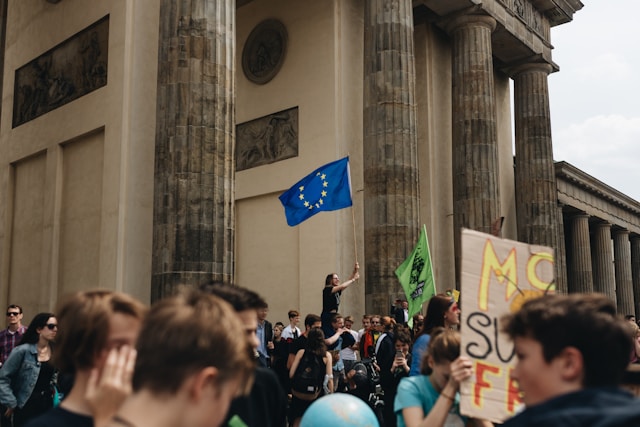
Image by Nico Roicke. Source: Unsplash.com
Omnibus proposals – Simplification at the cost of protection?
But first things first: what exactly are the Omnibus proposals? In early 2025, the European Commission presented its ten Omnibus proposal packages. The rationale was straightforward: modifying already-in-place legislation in order to simplify would not only save billions of euros in administrative costs and boost competitiveness but also improve efficiency and reduce the regulatory burden on companies. The packages touch upon a wide range of topics from digitalization to agriculture or defence, its most well-known one (and arguably one of the most controversial one) being the Omnibus I package on Sustainability. Barely a month ago, the Council of the EU gave its final green light to these amendments.
Still, not everybody sees these packages in such a favourable light. Detractors have harshly criticized these measures as sacrificing high levels of protection for the sake of simplification. Particularly regarding the Sustainability Omnibus I package, the relaxation of sustainability reporting requirements for companies has caused a stir. In words of Faustine Bas-Defossez, a director of the European Environmental Bureau, “it is now clear that ‘simplification’ is just a Trojan horse for aggressive deregulation.” Disagreements over these measures were quick to rise even within the ranks of EU officials. Staying in line with ancient myth allegories, “Ursula von der Leyen is unravelling at night what was woven during the day” said S&D MEP Thomas Pellerin-Carlin last July, referencing Penelope’s trickery in The Odyssey.
Beyond the institutional splits, the Omnibus proposals answer to a broader, numbing trend among Europeans: the exhaustion arising from a constant cycle of policy which seems to lead nowhere.
Regulatory meets climate fatigue
Regulation and the Union have always come hand in hand. Perceived as excessively bureaucratic, the very source of its power has also constituted the most effective ammunition for its critics. Particularly in these last two decades, Brussels has always seemed to have a new regulation for every challenge encountered. The global pandemic, energy crises, and the invasion of Ukraine did nothing but intensify this trend. Now, as Trump’s tariff threats turn into a regular occurrence and the war in the Middle East looms close to the European continent, European inability to respond with strong, tangible actions becomes painfully apparent.
In this context of bureaucratic saturation, regulatory fatigue seems to have taken over all of us. European citizens are increasingly exhausted facing a never-ending body of legislative requirements and policies that only serve to alienate us from the distant “EU bubble”. In this sense, the EU’s sudden push for simplification may not be sudden at all, but rather a response to an intensifying tendency to disengage with European decision-making as a way to cope with this tiredness.
In the context of environmental and climate ambitions, these worries acquire a new shade. In the last decade, eco or climate fatigue has been a recurrent issue well beyond Europe. The initial enthusiasm that accompanied the sustainability movement has worn down and given way to feelings of skepticism, pessimism, or even worse: plain indifference. That is what years of greenwashing and initiatives without seemingly concrete results do to a person; lost the initial momentum, we are left with massive amounts of information and no energy left to engage with them.
In the European Union, climate and regulation fatigue have merged into a threatening combination. Once a champion of the green transformation, Europe seems to have fallen out of love with climate. Other more pressing priorities are put forward when asked about this uncomfortable topic: energy prices, wars breaking out, geopolitical tensions, etc. This, combined with the general disengagement arising from regulatory exhaustion, results in the EU’s quiet lowering of its green ambitions under the banner of efficiency and simplification.
Fatigue among the EU youth: From activism to apathy?
In no demographic has this shift been more apparent than among the European youth. Painful as it may be to admit it, the myth that young people may not engage much with politics is starting to look alarmingly similar to reality. Here, also, climate and regulatory fatigue constitute powerful, dangerous parties. Take the European Parliament elections: in 2019, in the mists of a strong surge of climate protests across Europe, participation of EU citizens under 25 rose to a historic 42%. Indeed, these were the days of school walk-outs in the name of climate, Greta Thunberg’s Fridays for Future, terms like “green transition” or “carbon emissions” on everyone’s lips. However, five years later, the 2024 EP elections witnessed a disappointing descent to 36% voter turnout among citizens under 25.
Why did this happen? Did climate activism simply stop being trendy? Or did we get tired of one initiative being replaced by another without seeing results? Numbed, from all this overflow of news, legislation, policies? Again, more pressing concerns get in the way of our ambitions: just as the EU focuses on other priorities, it is hard to ask a young adult to dedicate all their energy to save the planet when they cannot even secure a roof over their heads.
What is the takeaway, then? Is there a way out of this overwhelming sense of fatigue? Whether there is, and whether that solution necessarily passes through a simplification that casts doubts on safeguarding high levels of protection, is hard to say. After all, if the answer was simple, we would not be caught in this dizzying overregulation-and-retreat dance.