


Do you have anything to add to this story? Any ideas for interviews or angles we should explore? Let us know if you’d like to write a follow-up, a counterpoint, or share a similar story.
The Oscars: Maths and Stats

Major awards predicting the acting categories at the Oscars
Predicting the Oscars often relies on the outcomes of the preceding movie awards. I compiled the winners in the acting categories of the four major awards, Critics’ Choice, BAFTA, Golden Globes, and the Screen Actors Guild (SAG) awards and plotted the results in a bar chart. First, it’s essential to understand the composition of the voting bodies at the awards: the Golden Globes are voted on by international entertainment journalists, the BAFTAs by professionals working in the UK screen industries, the Critics’ Choice by film critics, and the SAG Awards by fellow actors within the SAG-AFTRA union. Based on the bar chart, the SAG Awards appear to be the strongest predictor across all acting categories, with over 71% match with the Oscars winners. This is likely due to the overlap between the voting bodies of the SAG Awards and the Academy members. The Golden Globes rank as the second most reliable predictor with a high 77% match in the Best Actress category. A positive trend is observed in the BAFTA Best Actress category, with 12 of its winners over the last 15 years going on to triumph at the Oscars. Similarly, the Critics’ Choice Awards have shown high accuracy in predicting the supporting categories, with 12 Supporting Actor and 13 Supporting Actress winners matching the Oscars results over the last 15 editions.
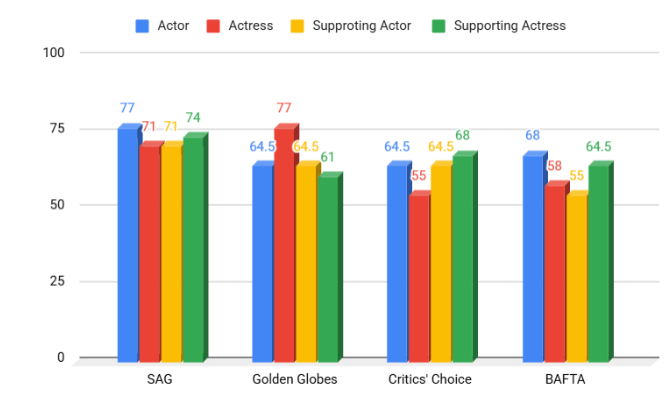
The data covers movies released from 1995 up until now. The Golden Globes Best Actor and Best Actress categories combine the winners in both Drama and Comedy or Musical.
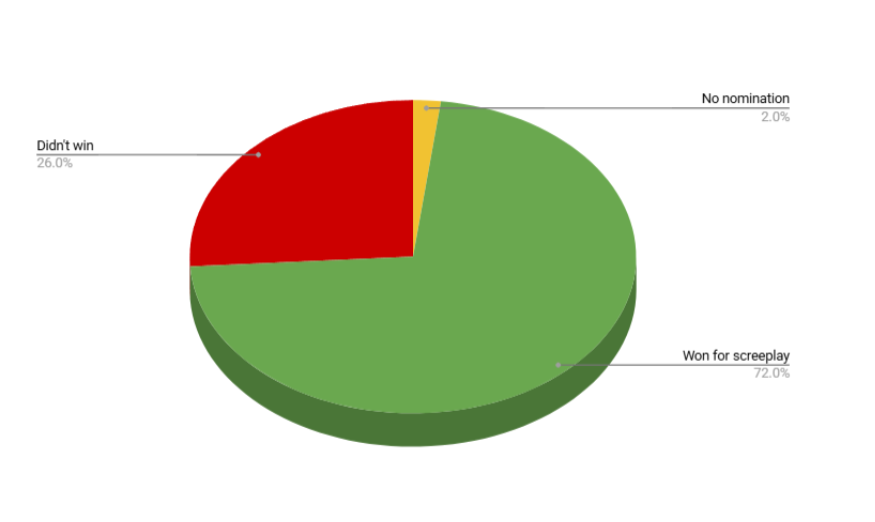
Green: Best Picture winners who also won a Screenplay Oscar
Red: Best picture winners who didn’t win for Screenplay
Yellow: Best Picture winners who weren’t nominated for Screenplay
Trends and patterns
It’s a known fact that a movie is only as good as its screenplay. Winning either Best Original Screenplay or Best Adapted Screenplay remains one of the best indicators for a Best Picture win. I analyzed Best Picture winners over the past 50 years and their performance in the Screenplay categories. The results, shown in the pie chart, support the claim, as 72% of Best Picture winners also won for Screenplay, while only 26% did not. The only Best Picture winner in the past 50 years that didn’t even receive a nomination for a Screenplay category is Titanic.
In the 25-year history of the Best Animated Feature category, 60% of winners have also received at least one nomination in other Oscars categories, most commonly for Original Score, Screenplay, Original Song, or Sound. The most recent example came at this year’s ceremony, when KPop Demon Hunters also won for Best Original Song. This pattern highlights how animated films that perform well in other categories have a higher chance of winning an Oscar.
Does the release date of a movie matter in the Best Picture race?
If you tried to prepare for the awards season 2-3 months in advance, you would notice that the predicted contenders have not been released yet. I collected all Best Picture winners and the month of their official release and summarized the results in a bar chart. The results showed that more than half of the Best Picture winners were released in October (13), November (20), and December (21). The eligibility period for Academy Awards consideration is a full calendar year. Then why do studios deliberately push the theatrical releases of their best shots towards the end of the year?
A type of cognitive bias called the recency bias suggests that a person favors events that happened most recently. Therefore, Academy members, who watch hundreds of movies, would most likely vote for the movies they saw last. Strong critics’ reviews and positive audience response during the holiday movie season create a media buzz momentum which could further influence the voters’ choices. A marketing strategy studios use is to release their Oscars contenders around the start of the awards season, so that their movies are still in theaters to attract audiences once the nominations are announced. Furthermore, the summer release window is traditionally dominated by blockbusters that prioritize box office success over the Oscars competition, which explains why fewer Best Picture winners are released in the summer.
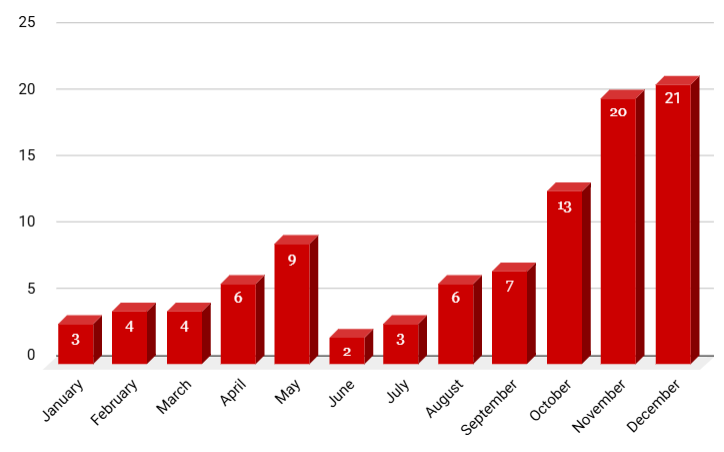
Best Picture winners and the month of their theatrical release
A movie’s release date can make a big difference, as seen with Dune and Dune: Part Two. Despite Dune: Part Two earning $300 million more at the box office and receiving a higher IMDb rating, it disappointed at the Oscars. The sequel won only 2 of its 5 nominations, while the first movie swept the awards season by winning 6 Oscars from 10 nominations. One possible explanation is the release date. Dune: Part Two was released in early March, long before the Oscars season hype, whereas Dune premiered during the peak of the awards season in late October.

The cast of CODA (Best Picture of 2021) after winning SAG Ensemble
Image Credit: Getty Images
SAG Ensemble and Best Picture
The Actor Awards for Outstanding Performance by a Cast in a Motion Picture, better known as the SAG Ensemble Award, is one of the strongest predictors of Best Picture. Since the category was introduced in 1995, nearly every Best Picture winner has received a SAG Ensemble nomination. Only two movies, Green Book (2018) and Nomadland (2020), have won Best Picture without that recognition. The correlation between these two categories from different award shows comes down to the composition of voters. The Academy awards members are divided into 19 branches representing different categories, with the actors branch being the largest, 12.7 % of all voters, the majority of whom are also SAG voters. Since Best Picture is the only award voted on by the entire Academy, strong actor performances boost a movie’s chances for Best Picture.
Written by
©2026 PulseZ. Design & developed by Matrix Internet Opens in a new tab