Tell EU stories, develop your journalism skills, and make your voice heard!

Flashback to 6 January 2001: the 49th Four Hills Tournament in Bischofshofen, Austria. Polish ski jumper Adam Małysz took the crown, sending his country into a frenzy later called Małyszomania. But Austrian fans were also buzzing about a 15-year-old named Manuel Fettner. In just his second World Cup appearance, the Vienna-born teen finished fifth – a jaw-dropping result for someone barely in his teens.

Experts were buzzing. Could Fettner be the next Andreas Goldberger? A new Austrian ski jumping star? The stage was set – but the story didn’t unfold as expected.

Living in the Shadow

In Austria, ski jumping is serious business. And even the most talented athletes can get lost in the crowd. Fettner spent years overshadowed by his superstar teammates: Thomas Morgenstern, Gregor Schlierenzauer, Andreas Kofler, Martin Koch, and Wolfgang Loitzl – the “Super Eagles” dominating every team competition.

Without a guaranteed spot on the World Cup team, Fettner fought it out in the Continental Cup, Austria’s second-tier series, where he became the most decorated competitor in its history.

It wasn’t until 2011, at 26, that he reached a World Cup podium – ironically, in the same Bischofshofen where he’d first made headlines ten years before. Still, the breakthrough he longed for didn’t come immediately. For the next two years, he bounced between competitions, chasing a success that seemed just out of reach.

Paul-Ausserleitner-Schanze ski jumping hill in Bischofshofen, Austria / Picture: junafani (CC BY-SA 3.0) via Wikimedia Commons

The Unforgettable “Detached Ski” Moment

In January 2013, Bischofshofen was not as lucky for Fettner as in 2001 and 2011. In the qualifications, he fell and injured his elbow, the only serious injury in his career. Though he was forced to skip a couple of competitions, he was able to return a few weeks later and was chosen to the Austria team for the World Ski Championships in Predazzo – the first time in his career. 

Surprisingly, in the training sessions before the individual competitions, Fettner occupied top positions, placing him among the medal favourites. Ultimately, he didn’t win any individual medals, but his good performance was rewarded with a place in the Austrian team for the team competition.

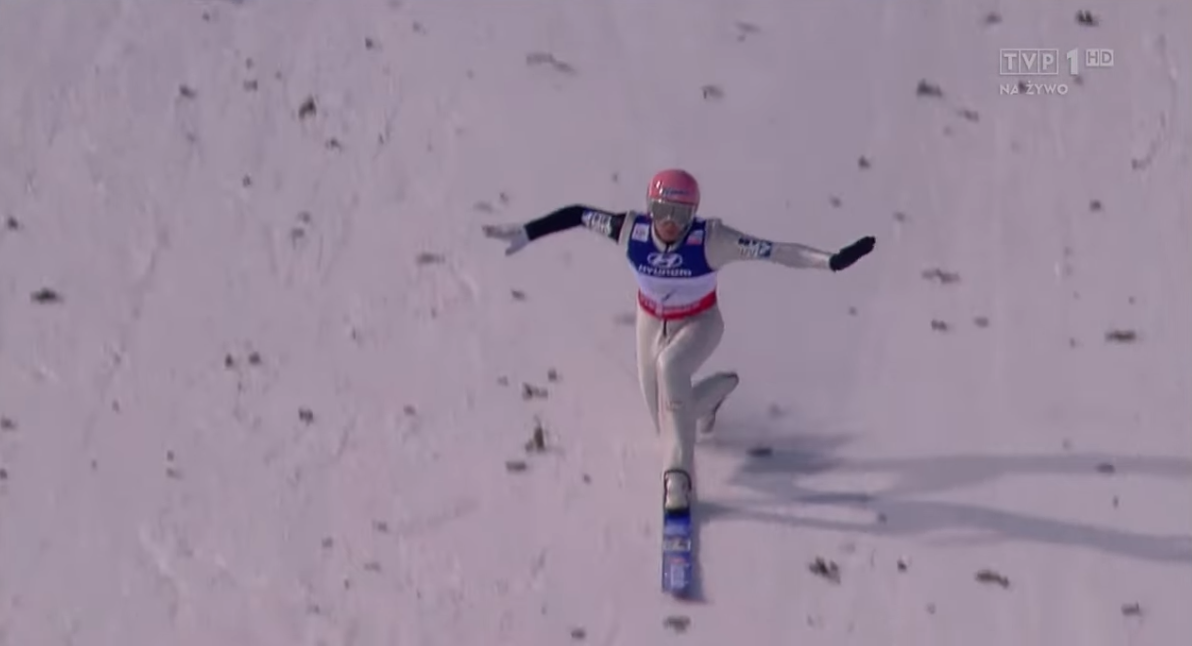
In the team event, he was supposed to be the “safe pick” – jump well, don’t mess up. But the unexpected happened: in the second round, Fettner’s ski detached immediately after his landing.

Still, somehow he stayed balanced, gliding to the fall line and avoiding having lots of points deducted. The Austrian coach, Alexander Pointner, tipped his hat in disbelief. Rivals rushed over to congratulate him.

Austria took gold. And while his teammates’ jumps were better, it was Fettner who stole the show. That day, he became an unlikely hero.

Manuel Fettner after his ski got detached in the team event, Val di Fiemme 2013 World Ski Championships / Broadcast: TVP1

Resilience Over Glory: The Long Road Back

The detached ski moment might have been a highlight, but Fettner’s career was a rollercoaster. He won some World Cup podiums and some team medals, but missed some major events like the Sochi 2014 Olympics or the 2015 World Championships in Falun. 

Unlike his strong competitors who eventually faded, he consistently remained among the top five or six ski jumpers despite emerging new generations. However, he was never ranked higher than fourth on the Austrian team.

His worst moments, though, came around 2020, when his performance was so poor that he decided to take a break for several months. During this time, he was expelled from the national team, which deprived him of state financing for his equipment, training, and individual competitions.

By 2020, things hit rock bottom. Poor results forced a break, and he was expelled from the national team, losing public funding for equipment and training. Retirement felt like a tempting escape.

After a summer of thinking, he made the gutsy decision to keep going. And it was the right call.

Manuel Fettner / Picture: Bjoertvedt (CC BY-SA 3.0) via Wikimedia Commons

Olympic Glory at 36

By 2022, Fettner was in peak shape – but so were his teammates. Coach Andreas Widhölzl faced a tough choice selecting the Olympic team. He picked Fettner, along with four younger jumpers. Few expected the veteran to shine.

Then the games began. In the first training session in Zhangjiakou, Fettner was first. In the following sessions, he remained in the top group. He stayed calm, confident, and precise. As he later recalled, only then had he realised that a medal was possible.

“From day one in the National Ski Jumping Center in Zhangjiakou there was an aura around Manuel Fettner. Rarely had anyone performed so confidently, had known so exactly what to do and at the same time remained so relaxed,” Die Presse wrote.

When the competition ended, Fettner had done it – he won silver, Austria’s first individual Olympic ski jumping medal since 2010.

“I’m honestly pretty speechless, I don’t know how to give an interview now,” he told the Austrian national broadcaster ORF.

At the medal ceremony, he had tears in his eyes as the Austrian flag was raised alongside the Japanese and Polish flags.

“I am overjoyed. It was a cool way with lots of ups and downs,” Fettner said, reflecting on his long journey.

His teammates were just as moved. A lot more accomplished Stefan Kraft, still searching for his own Olympic medal, admitted he was “almost more happy” with Fettner’s achievement than if it had been his own.

“He deserves it like no other,” he said.

Despite the setback in the mixed team event the following day – where their female teammate Daniela Iraschko-Stolz was disqualified, costing both Fettner and Kraft another potential medal – the Austrian team, spearheaded by Fettner, achieved further success. 

They went on to secure the gold medal in the team competition after Fettner narrowly defeated Slovenian star Peter Prevc on the final jump.

“Incredible what happened the last two weeks for myself. Didn’t expect it to come home as the Olympic champion, and individual medallist. Unbelievable,” Fettner said after the competition.

Missed Olympics, But Never Out

If you didn’t follow the latest Milan–Cortina Olympics, you might be wondering: how did Fettner do? Did he manage to grab another medal?

The short answer: no. He didn’t even make Austria’s Olympic team – despite being in top form, just like he was in Beijing 2022. The culprit? The International Olympic Committee cut male athlete quotas for gender equality and cost reasons. Austria could only bring four jumpers instead of five, and Fettner’s four higher-ranked teammates got the nod – even though he was performing better than some of them.

For Fettner, that had to sting. Not only had he announced he’d retire after the season, but the ski jumping events were held in Predazzo – the very place where he first made his mark at the 2013 World Championships.

The Austrian team didn’t repeat their 2022 magic. No individual medals were won. They did take gold in the new “super team” event, but the expectations has been higher.

After missing the Olympics, one goal still remained for Fettner: a World Cup victory. In January, in Zakopane, Poland, he was really close, but he ultimately finished third.

With a few competitions left before the World Cup finale, he still has a shot. And if his career has taught us anything, it’s that he never gives up.

Don’t Quit Before Your Moment

Manuel Fettner’s journey shows that success isn’t always about being the fastest or the most talented – it’s about never giving up, even when the odds are stacked against you. He spent years in the shadows, faced setbacks and disappointments, yet he kept showing up and improving. 

For young people, his story is a reminder that persistence, patience, and resilience often matter more than instant glory. Dreams don’t always happen on schedule. You may think that if you try hard for ages, and this doesn’t bring results, it’s better to give up.

But think again. It took over twenty years for Fettner, who first participated in the World Cup in the age of 15, to reach Olympic Glory, there is a high change that the best is still ahead of you.

Shape the conversation

Do you have anything to add to this story? Any ideas for interviews or angles we should explore? Let us know if you’d like to write a follow-up, a counterpoint, or share a similar story.