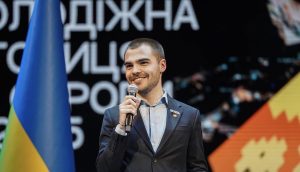
Rareș Voicu addressing the 2025 European Youth Capital ceremony in Lviv. Source: Instagram.


When Rareș Voicu felt injustice “in his chest” at 14, he didn’t know it was activism yet. Eight years later, moving from Romania to Brussels and now as European Youth Forum president, he’s working to ban unpaid internships, pushing voting at 16 and sounding alarms on youth org raids from Serbia to Turkey. For PulseZ, we talk about recent policy wins, political red flags and what should count as a wakeup call to Europe’s democracy.

What motivates you and your work?

I’m a passionate activist for young people’s rights and that’s been my life for almost a decade. It’s covered most of my childhood, teenage years and now my adult life. It might sound corny, but fighting for what felt right has always been at the heart of everything I do.

It didn’t come from some grand philosophical quest for justice. Back when I was 14 or 15, it was much more concrete. In high school, my classmates got graded not on what they knew, but on their behaviour. Students over 18 weren’t allowed to leave campus outside breaks, even though the law said they could. These were rights we had, even sometimes explicitly protected, that just weren’t being honoured. That sense of injustice never sat right with me; I felt it right here in my chest. Eventually I realised there’s a name for turning that feeling into action: activism. Sometimes it’s energising, sometimes overwhelming, but it’s always what drives me forward.


As president of the EYF, how does this role compare to your days as a grassroots activist?

I come straight out of the school students’ movement, having started in my high school in Romania, then nationally, and at European level with OBESSU. This included protests, petitions, sitting down with policymakers, presenting our demands. The EYF is in line with that: we’re mission and value-driven, and our member organisations, including national youth councils and groups representing young people right across Europe, set those priorities. Then we run with them.

The real difference at this scale is the diversity of opinions on the same issues. A common misconception is that we only cover the EU, but we follow the Council of Europe’s definition of Europe, so our scope is much broader. Perspectives can clash spectacularly, so the most challenging and rewarding part of my job is building consensus, making sure the Forum’s work captures that full spectrum, opening new doors for young voices and never pulling up the ladder behind us.


Why is it crucial to include young people in a meaningful, inclusive way?

Look at what happens when we don’t. The logic seems so obvious: decisions made today in closed rooms will shape the lives of children, teens and young adults not just now, but for decades. And yet we’re the generations with the least input on how those policies get shaped or how long they last.

When you feel those policies hitting your life and you’re unhappy, but you also know you had zero say in them, disconnection sets in. You tune out from democratic processes, institutions, politicians. That vacuum is where extremists thrive, promising “real democracy” to people who’ve never felt included. Our research at the EYF backs it up: in the last European Parliament (EP), more MEPs were named Martin than were under 30. The good news is that young people have the appetite and the willingness to be part of and create spaces where they can participate in decision-making processes.


In the 2019-2024 period, the number of MEPs younger than 30 was equal to the number of parliamentarians named Martin: six each. Young people were the most under-represented age group in the hemicycle, according to the European Youth Forum.

Many consultations feel tokenistic. Where has youth participation actually shifted policy?

We have strict standards for what counts as meaningful, and we only join processes that meet them or could with the right push. Take banning unpaid internships: we’ve campaigned on it for over a decade. Two years ago, the EP called on the Commission for a directive and recommendation to make it EU-wide law. None of that happens without our earlier win suing Belgium at the European Committee of Social Rights. We argued no state should allow unpaid labour just because someone’s young, and they ruled in our favour. That victory fuelled a major advocacy push, centring real stories from young people continent-wide. Ask any room of young professionals: almost everyone’s done an unpaid internship. It’s systemic.


Walk us through what “meaningful” participation looks like in practice. How do you make it standard?

Every process, European, national or local, needs four clear things upfront: purpose (why your time and input?), timeline and commitment, the info you need to contribute effectively, and expected outcomes or follow-up. Institutions should get those right from the start, or it’s not meaningful.

We’ve codified this in the EU Youth Test, our 2022 proposal from the European Year of Youth. It’s an impact assessment tool for every EU policy: does it harm young people, and how do we fix that before adoption? Involve youth organisations, experts across fields like health, defence or culture, from drafting to impact analysis and mitigation, to post-adoption monitoring. The European Economic and Social Committee adopted it first; the Commission is rolling it out as Year of Youth follow-up. Get it wrong, though, and you lose youth for good. That’s how trust erodes.

Given the alarming low level of political participation, in 2018, the Inter-Parliamentary Union agreed and recommended a target of 15 percent of MEPs under 30, with a 50-50 gender parity for youth representation in parliaments around the world. These global targets are to be achieved by 2035.

On a bigger scale, where is the democratic space for youth organisations shrinking most? 

The past years have been brutal with arrests, harassment or groups facing closure from funding squeezes. In Serbia, the National Youth Council had offices raided and staff intimidated by police over international work. Turkey saw young activists jailed on similar pretexts. In Croatia, the government’s building parallel structures to “represent” youth, which is code for narrative control and silencing dissent.

USAID cuts gutted civil society in the Eastern Partnership and Western Balkans, hitting youth groups hard. These spaces often shelter watchdogs, independent young journalists and teach democracy hands-on. Also, funding often brings “scrutiny” that feels more like intimidation (for example, our European elections turnout work was branded as “EU propaganda”). There are attacks from inside and out the EU, and youth orgs suffer most with fewest resources to bounce back. This is both a youth problem and democracy’s warning light.


If you could ask young people across Europe one question to help you lead the EYF better, what would it be?

Our structure gives us solid intel on pains via our members, but I’d love direct takes on this: where do you see your community, country, Europe, world in the years ahead? How do you want this continent to look, and what should it stand for?

Think affordable living, rights without prison risk for speaking out, a future worth hoping for. Data shows this is the first generation doubting it’ll do better than parents, or that our kids will have it easier than us. When you think about how humanity has progressed and the fact that moving forward has always, with some caveats, meant doing better, the fact that young people today don’t have that understanding is incredibly alarming. So, bonus question: how do you want that future built, and what role will you play?

Sources on youth rights and participation:

European Youth Forum (2022) There are as many Martins in the European Parliament as MEPs under 30. Articles and Publications.

Inter-Parliamentary Union IPU (2021) Youth participation in national parliaments. Report.


Shape the conversation

Do you have anything to add to this story? Any ideas for interviews or angles we should explore? Let us know if you’d like to write a follow-up, a counterpoint, or share a similar story.