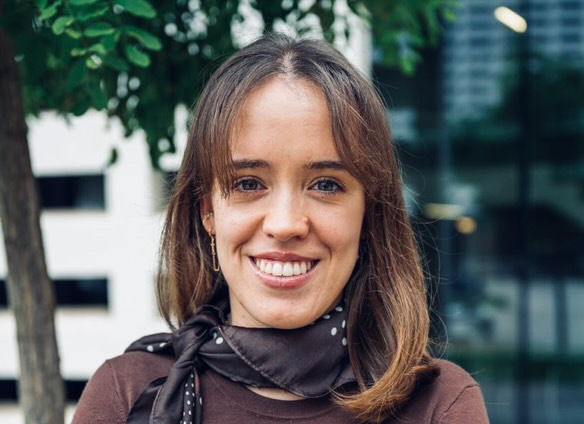
With the 2025 European Day of Persons with Disabilities around the corner, we spoke to Diana about how her journey shifted from personal reflection on identity to powerful advocacy. She shines a light on the gap between political wins, like the European Disability Card, and the everyday struggles people with a disability face dealing with confusing, patchy systems. By fighting for equal, standardised support in universities and challenging the usual “victim” story, Diana is helping make sure accessibility isn’t seen as a favour but a basic right everyone should have.

For those who may only know you digitally as “outside the norm”, who is Diana Reis beyond the social media handle?

I’m a young person from a small village with just 200 inhabitants, so growing up, I rarely saw people like me except in hospitals or physiotherapy settings. That made me question why people with a disability are only visible in such places. Being a person with a disability myself, often the only one around, I wanted to explore this more. At first, I researched other social issues like gender equality and feminism before disability. My first blog, the early days of feeling outside the norm, was my way to understand myself and the world.


As an advocate for disability rights, what feeds your need to understand the world around you?

I have cerebral palsy, a congenital condition which makes me feel different from others. I have long felt I don’t fit in anywhere. For example, I don’t use assistive equipment like a wheelchair regularly, as I only used one after surgery; but even then, I was often not seen as “disabled enough” or as “non-disabled” either. Physically, I am different, but socially I noticed people treated me differently too, and I wanted to understand why. It took me on a journey from personal reflection to realising that disability and ableism are structural issues, far beyond just my own experience.


Your activism is about building a new norm for disability rights. What could it look like?

Awareness of prejudice against people with a disability is still growing, like how feminism has changed over time. Now people are more open to learning, but a risk of “bubbles” and disconnection from broader society exists. Disability has always been part of life, yet society keeps these people in limited spaces with little room to challenge that. Sometimes, people with disabilities themselves accept and internalise this view. Change takes strong, ongoing political and social commitment. For example, many students leave universities because campuses aren’t accessible enough. Fixing this won’t happen quickly, but it’s a crucial step for real inclusion.

“Instead of real policies, disability often gets presented like a performance. That’s because fighting ableism isn’t yet a shared, organised movement, like racism or sexism have become. There’s still a lot of work to build that new kind of fight.”
What makes you feel empowered or victimised?

I feel both empowered and victimised, depending on how society interacts with me. A lot of times, I’m the only person with a disability around and that can make things awkward. Some see it as empowering, but it’s also lonely.

Being the “first” person with a disability in a space can feel like a win and a heavy burden. Once, during volunteering, I couldn’t join a 3km walk. The organisers told everyone that someone would stay back with me, and they said it out loud in front of everyone. That made me feel like a victim.

Then what really empowers me is knowing the problem isn’t me, but society’s lack of support and understanding. That’s why I started my blog: to share my feelings and connect with others. Knowing I’m not alone gives me strength. Seeing more people with disabilities in places of power, like Parliament, would help even more.


You seem at peace and confident in who you are despite these challenges.

I’m no superhero, which means I don’t like pain or being slow. I wish I could move faster, like walk across campus in 5 minutes, but it takes me 15. That’s okay. I’ve learned to accept it, and that acceptance is empowering. The problem isn’t what I can or can’t do, it’s how people react. How others respond isn’t up to me.

What could speed up breaking down ableism?

For a long time, people with disabilities had to hide their realities to fit in. Now, more voices are sharing their stories online and taking up physical space. This visibility could be a game changer, but the real conversation starts in politics. Right now, disability isn’t a top priority.

Most people still avoid talking about disability, even though we all will face it one day as we get older. Politicians sometimes use disability for photo ops, posing with people with disabilities to trigger an emotional response. But often, this is just a show and a way to hide deep-rooted ableism behind superficial sympathy.

Instead of real policies, disability often gets presented like a performance. That’s because fighting ableism isn’t yet a shared, organised movement, like racism or sexism have become. There’s still a lot of work to build that new kind of fight.


How do you feel about political receptivity when cameras aren’t rolling?

Tokenism bothers me. Even when laws are made, persons with disabilities are not given a voice. Politicians use them for optics, not inclusion in real policymaking. This shouldn’t be the case. A person with a disability in politics should symbolise real inclusion, but that mindset isn’t there yet. After political campaigns end, disability issues often fade again.

I get that accessibility costs money and resources, which makes politicians hesitant. They wrongly think accessibility only benefits a small number of people with disabilities, ignoring others like pregnant women, the elderly, or people with temporary impairments. Society treats disability as a problem within individuals, instead of a systemic social issue.


According to the European Commission, fewer persons with disabilities attain a tertiary degree than
persons without disabilities: 29.4% compared to 43.8% (Eurostat, 2022)
Tell us about your inclusive higher education project in Portugal. What gaps are you addressing?

United Nations data consistently shows that students with disabilities drop out of school more often than others. To fight this, we are pushing for a national statute for students with disabilities in higher education in Portugal, similar to the “working student” statute.

Right now, each college makes its own rules, which leads to disparities. In Portugal there are admission quotas, so there should be at least one student with a disability in every university. But we know that support for those students is inadequate and that students fear backlash if they assert their rights, which deters them from complaining.

We also consider displaced students with disabilities who face heightened barriers: transport options are limited and adapted accommodation is scarce in a country with a severe housing crisis. Issues like Braille or sign language interpretation are also neglected.


How do you see the change from victim to empowered student?

Right now, students with disabilities have to figure out a confusing system all by themselves. They often rely on teachers or staff being nice to get the help they need. If we had one clear law for all universities, with schools required to make the right adjustments for each student, that would give students real power.

It doesn’t make sense to let students with disabilities in through quotas and then leave them to struggle alone. Without proper help, many drop out. The law shouldn’t make students feel different or stuck. It should see them as capable people with unique needs that deserve to be met.


What progress have you made towards inclusion in higher education?

Our project has been going for about a year now. First, we mapped out the different university rules about disability support. We also made a guide for students starting university. It explains key steps like how to apply for scholarships. Surprisingly, many didn’t even know about quotas for students with disabilities.

Now, we’re preparing a new guide with examples of good and bad practices from at least three colleges. In the future, we want to look at the whole country and create a detailed map of students with disabilities in higher education, considering things like age, gender, and if they belong to other minority groups. We know inclusion isn’t one-size-fits-all.

According to the European Commission, in 2023, a Eurobarometer survey revealed that 54% of
people with disabilities feel discriminated against.
How do you see the EU’s role in disability rights?

I want to work on and write my masters thesis on disability rights in the EU. But many people say it’s something each EU Member State should handle on its own. This idea is surprising but I’ve heard it a lot and it shows in EU policies too.

Take the European Disability Card. It’s a big win because it means my home country recognises my disability. But when I travel to other EU countries, I have to deal with the same paperwork over and over again. That’s tiring.

I advocate for disability support to be the same everywhere in the EU. Right now, rules change from place to place and that’s because different countries see disability differently (some as a medical issue, others as social). Many groups want the European Disability Card to become a strict rule, not just a recommendation, so all countries have to follow it.


How will your identity shape your advocacy and future career?

My disability is a big part of why I’m here today. I believe politics and public policy can make real change, so that’s what I’m studying for my master’s degree. I picked a university that’s all about a pro-European, broad policy view, so I can remind people that disability isn’t just a national issue. It affects more than 100 million people across the EU.

I think taking up space as a student with a disability or young professional is powerful activism. It’s a core part of what I do. I’m getting better at making a difference, but it can be tiring. Being visible and talking about personal issues all the time on social media wears on me. The political world feels tough right now, with extremist views growing. Still, I hold on to hope. Things will change, I just don’t know when.

What gives you hope about disability inclusion and the world?

I’m hopeful because more people with disabilities and policymakers are talking openly and pushing for change. Europe has more disability rights now than ever before. But there are also new political groups trying to roll back progress. For example, some interference from the US shows how fragile things still are.

Disability inclusion isn’t a done deal for everyone in Europe yet. But I believe if we stay positive and keep fighting, we can keep moving forward.

Sources on disability, inclusion and rights in the EU:

Eurostat (2022) Disability: higher risk of poverty or social exclusion.

European Commission (2025) Disability in the EU: facts and figures.


Shape the conversation

Do you have anything to add to this story? Any ideas for interviews or angles we should explore? Let us know if you’d like to write a follow-up, a counterpoint, or share a similar story.