


“No One Is Above the Law”

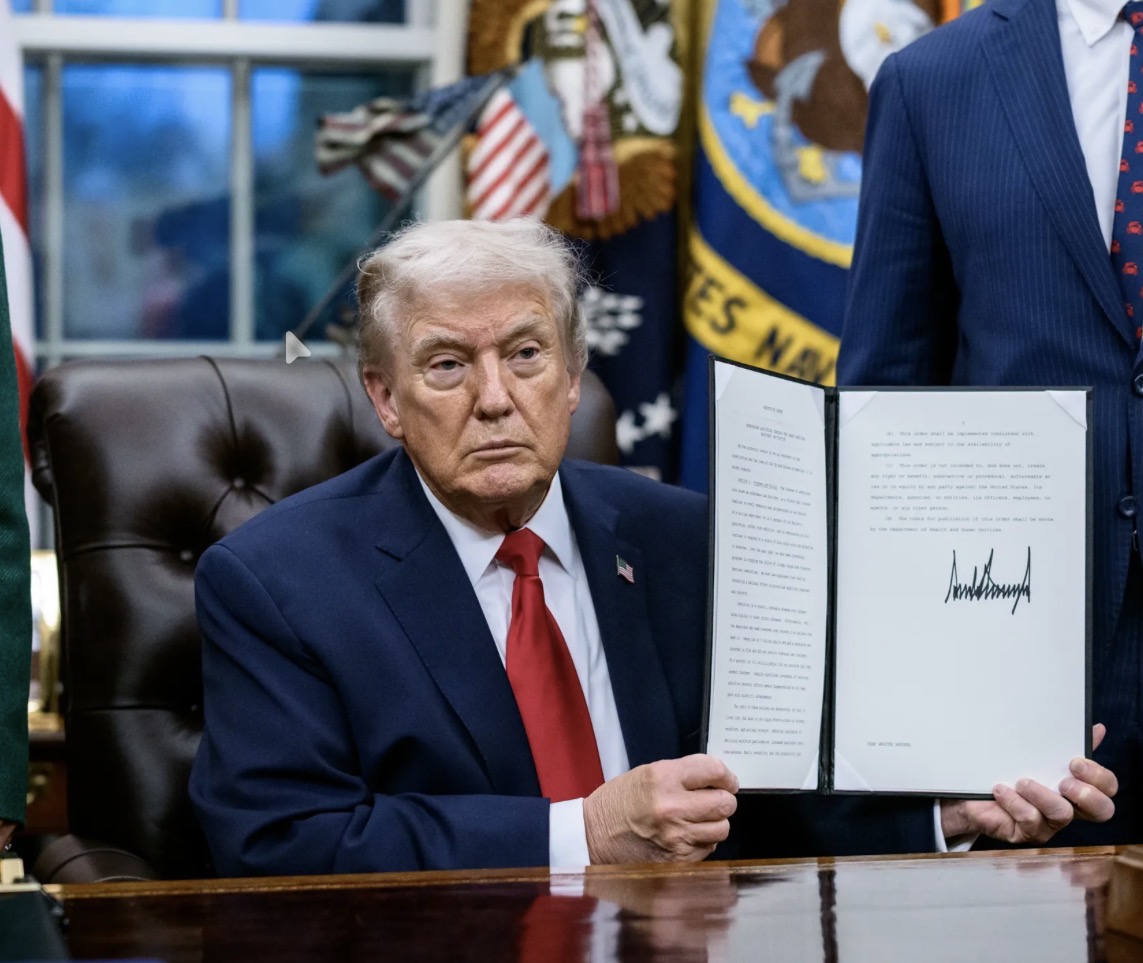
U.S. President Donald Trump holds up a signed executive document while seated at the Resolute Desk in the Oval Office.
As a European observing American politics from the outside, what strikes me most about Donald Trump is not his persona, but the frequency with which strict legal boundaries have been challenged or neglected altogether.
What the Actions of the President Show
Three patterns of Donald Trump’s neglect towards the law that have been observed not only in the last year, but also during his first presidential term are:
- Undermined the role of the Congress: even though the presidential position is said to have executive power, Trump has infiltrated the legislative power of the Congress, systematically weakening it by controlling government spending, regulating commerce and tariffs, authorizing war and military force, and firing leaders of independent agencies that usually cannot be fired by the president himself. Such actions of the president directly oppose the law, as the Article I of the US Constitution explicitly gives Congress primary authority (Constitution Annotated, n.d.).
- Election-related : Several times he’s claimed to be against elections in different circumstances, the latest one being for the mid-term elections, as he’s implied in an interview with Reuters that “[US] shouldn’t even have a [midterm] election,” claiming that it’s putting his party in a vulnerable position. Although it is prohibited by the Constitution under the 22nd Amendment, he has mentioned that he was not joking about getting to a third term, saying that “there are methods which you could do it.”
- Impeachments in his previous term: In the past, Trump was impeached twice (2019 and 2021). The first case was related to him abusing his power by pressuring Ukraine and withholding documents and testimonies from the Congress. However, when the Senate held the trial to decide whether to convict or not Trump, after the House voted to accuse him of misconduct, the Senators alas decided to find him not guilty. Thus, impeachment did not lead to direct removal of the President at that time. Trump had been impeached for the second time by the House of Representatives on January 13, 2021. The House adopted one article of impeachment against Trump: incitement of insurrection, making him the only federal official to be impeached twice. Even though these cases do not show direct action against the Constitution, it’s a presentation of how easily constitutional boundaries that stop one man becoming overpowered can be neglected if he is heavily supported by his party and as the law is treated more like a suggestion rather than a line that should not be crossed.
- Using ICE to deport people and violate their rights: The violent immigration process that the President uses to speed up the deportation process goes directly the Constitution as it neglects the rights of citizens to due process, as it’s clear from the Fifth Amendment that “no person shall be deprived of life, liberty, or property without due process of law.” As agents have forced their way inside people’s home without a judicial warrant (strictly against Fourth Amendment) and killed and assaulted multiple people without having any kind of constitutional immunity or right to do so, Trump’s plan of deportation has not only caused distress, but loss of hope, as Americans observe how easily people of power can neglect the order of the country by simply being in that position (Constitution Annotated, n.d.).
Hopelessness Is Not the Answer
However, hopelessness inevitably leads to inaction, and inaction allows misconduct to persist. American citizens should not stay passive and accept abuses of power, regardless of the office an individual holds. Democratic systems only function when they are actively used — through voting, protest, and freedom of speech — before these tools get weakened or removed.
Law is not an abstract idea. It is defined by the actions of those who uphold it in the present. Even though laws should always be embedded into a political system, they can become meaningless if citizens accept their enforcement to be optional or easily negotiable.
What Citizens Can Do
That is why the ongoing midterm elections matter. Non-republicans controlling the majority of Congress is the basis on which the mechanisms which preserve democracy, such as investigations and impeachment, rely on so that non-party loyalty can be established. If the House has the institutional independence to act, it can impeach the president if he shows abuse of power. If the case goes to trial in front of the Senate, the Senators could vote not only for removal from office but also for disqualification from holding future federal office.
Thus, the elections right now are about more than Democrats versus Republicans. They are about protecting constitutional order and making sure that there’s no chance of concentration of power in a single individual or party.
I urge Americans to cast their ballots with the following thought in mind: to make sure that you as a citizen continue to live in democracy, where the government could act when law is violated. As the United States has such great influence on the world’s economical and political state, that influence comes with great responsibility. And the choices you make now could impact way beyond the national borders.
Written by
Shape the conversation
Do you have anything to add to this story? Any ideas for interviews or angles we should explore? Let us know if you’d like to write a follow-up, a counterpoint, or share a similar story.
©2026 PulseZ. Design & developed by Matrix Internet Opens in a new tab