Five months after one of the largest Gen Z-led protests in recent years, Bulgarians are once again heading to the ballot box. On April 19, 2026, the country will vote for a new government — the eighth parliamentary election since 2021, a tiresome cycle of political instability.

This vote comes at a particularly critical moment for Bulgaria’s national direction and international positioning. Amid ongoing global conflicts and following its entry into the eurozone in January 2026, the country stands at a point where political stability is no longer optional — it is necessary.

A Country in Stagnation

Over the past years, Bulgaria has entered a state of stagnation in multiple areas. The political crisis has extended far beyond parliament, affecting key areas such as the judicial system, delaying essential reforms, and slowing the absorption of EU funds. Most recently, Bulgaria even saw EU funds partially withheld after failing to implement key judicial and anti-corruption reforms, clearly illustrating how political deadlock is now directly translating into economic consequences.

An Endless Election Cycle

Since 2021, multiple parliamentary elections have been held, yet none have produced a stable and lasting government. The pattern that has been repeated across each election is largely the same: no party secures a sufficient majority (121 out of 240 seats), coalition negotiations begin, and ultimately fail due to deep ideological divisions, mutual distrust between parties, and persistent disputes over corruption and judicial reform. The presence of political actors associated with corruption allegations — including individuals sanctioned internationally — has further deepened mistrust between parties and complicated coalition negotiations. Notably, Bulgarian politician Delyan Peevski was sanctioned by the U.S. Department of the Treasury under the Global Magnitsky Act in 2021 for alleged involvement in corruption, influence peddling, and abuse of public institutions.  As a result, negotiations collapse, sending the country back to the polls once again.

As emphasized in an analysis by the Wilson Center, Bulgaria held its seventh parliamentary election since April 2021 in October 2024, with the public already expecting yet another vote shortly after. The results showed little to no significant change in the distribution of power, ultimately repeating the outcomes of previous elections and reinforcing the political fragmentation across parties.

This repetition has not only stalled the government but has also strengthened public apathy and distrust. The same report highlights record-low voter turnout of 34.4% in June 2024, alongside growing concerns about election integrity and vote-buying, further weakening confidence in political institutions. Over time, this has created a self-reinforcing cycle: repeated elections fail to create change, and the lack of change discourages participation, thus, increasing the relative influence of vote-buying practices. 

Aftermath of the Protest

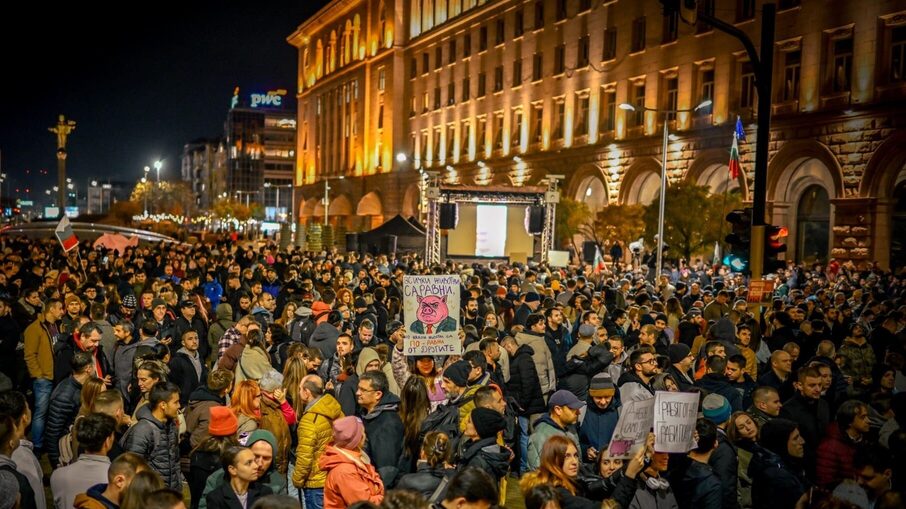
On November 26, 2025, was the first of many protests that took place months before the upcoming elections — the result of the accumulated frustration of Bulgarians with the system. The trigger of the mass showing of government dissatisfaction was the proposed 2026 budget, which faced public opposition due to planned increases in social security contributions and taxes on dividends, intended to support higher public spending. These measures would have added to existing tensions, but beneath them lies the core unresolved problem: judicial reform.  The question of control over the prosecutor’s office has repeatedly undermined coalition governments and created long-standing mistrust between political actors.

A big part of the public anger has been directed toward Delyan Peevski, whose influence in politics has persisted despite the country’s political instability. Although his party does not acquire a dominant share of the votes, it has repeatedly positioned itself as a decisive supporting factor in government formation, in particular, alongside GERB. For example, following the 2024 elections, GERB secured the largest share of votes but fell far short of a majority, requiring external backing to govern. That support came in part from Peevski’s party, which publicly committed to sustaining the government despite not being a formal coalition partner. This pattern — where a party with smaller electoral weight becomes important in coalition arithmetic — has given Peevski far more power and influence than his vote share.  Thus, the political influence in Bulgaria is frequently shown not to be determined by electoral strength, but by the ability to cooperate across party lines, usually behind the scenes, even though in public, they oppose each other.  As a result, while Peevski has become a symbol of corruption, his continued relevance reflects a deeper systemic issue rather than an isolated case.

With the protests, however, something has shifted. The protests have contributed to a noticeable rise in political awareness, particularly among younger people. Demonstrations are no longer focused on a single issue, but span a range of concerns — from domestic violence to judicial injustice and political accountability. What connects them is a growing sense that these issues are not isolated, but part of the same structural problem. This has created a more unified public response to injustice, even if that unity has yet to fully translate into electoral outcomes.

Following this wave of pressure, the Zhelyazkov government resigned, leading once again to the formation of an interim government. This raises an important question: does this change actually remove figures like Peevski from influence? The answer is not so straightforward. His role has often depended less on formal positions and more on his ability to leverage electoral results within coalition negotiations. As long as that structure remains, his influence does not simply disappear. The protests have made the problem visible, but visibility alone does not dismantle it — and this is exactly what is now at stake in the upcoming elections.

Thousands gather in central Sofia to protest against political stagnation and corruption, reflecting growing public frustration with Bulgaria’s ongoing crisis.

A New Player in the Game

A major new development in this election cycle is the political move of Rumen Radev, who, following his resignation, has initiated the creation of his own political project, Progressive Bulgaria. His campaign has already generated significant momentum, with early projections suggesting that the party could secure over 30% of the vote, potentially reshaping the political landscape and pushing smaller parties out of parliament.

The project presents itself as a centre-left, anti-corruption coalition, bringing together formations such as the Our People Movement, the Social Democratic Party, and the Socialdemocrats movement. Its candidate lists include a mix of local politicians, former regional officials, legal professionals, and business figures, alongside more publicly recognisable individuals, reflecting an attempt to appeal to a broad segment of society while also positioning itself as a platform for “new” political faces.

On a basic level, the project combines anti-oligarch rhetoric with positions that suggest a more cautious stance on Bulgaria’s involvement in international conflicts and energy policy. While not explicitly framed in extreme terms, this positioning is often perceived as relatively more open toward Russia, which allows the party to attract voters traditionally aligned with pro-Russian formations such as BSP and Vazrazhdane, while also appealing to pro-European voters who feel unrepresented by the current political options.

This broad appeal, however, also introduces new tension for the future of the party and ambiguity. For many voters, Radev represents the possibility of a decisive break from the existing system. At the same time, his political positioning raises questions about the direction such a break would take. In a context where Bulgaria urgently needs stability, voters are faced with a difficult trade-off: the promise of change versus the uncertainty of its consequences, particularly in terms of foreign policy orientation and coalition formation.

Another defining feature of Radev’s campaign has been his limited public communication. His strategy, often described as a form of “radio silence,” has involved relatively few public appearances and a lack of detailed policy clarification, including on key issues such as funding and governance structure. Instead, his messaging has remained broad, centred around dismantling the “oligarchic model,” leaving much of the interpretation to the voters themselves.

This ambiguity has played a dual role. On one hand, it has generated momentum by allowing different groups to project their expectations onto the project, contributing to renewed political engagement. On the other hand, it raises concerns about transparency and accountability. Without clearly defined policies, it becomes difficult to assess what the party concretely stands for beyond its general positioning against the status quo.

There are also indications that parts of his support base overlap with previously pro-Russian social media networks, including online communities that have shifted their messaging to align with his campaign. This further reinforces the complexity of his voter base, which is not unified in its expectations, but rather connected by dissatisfaction with the current system.

Ultimately, while Radev positions his project as an alternative to what he describes as an “oligarchic” political model, the lack of clarity around its structure, funding, and long-term direction raises an important issue. For voters — specifically younger ones — the challenge is not only to recognise the failures of the current system, but also to critically assess what is being offered as its replacement. The emergence of a new political party may signal movement, but it does not automatically lead to a sustainable structural change.
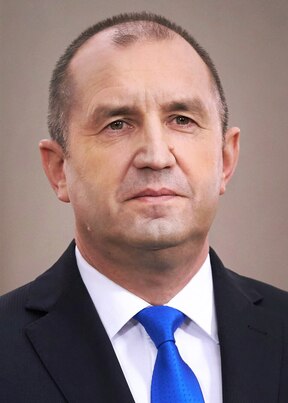
 

Rumen Radev, former president of Bulgaria, emerges as a central figure in the country’s evolving political landscape ahead of the upcoming elections.

The Choice Is Now to Make

Now more than ever, Bulgaria stands at a moment where the formation of a structured and stable government is essential. As global conflicts continue to unfold, the outcome of these elections will not only shape the country internally, but also define how it positions itself externally. This is no longer just a choice about governance — it is also a choice about direction.

At the same time, the question remains whether corruption will persist. The system that has developed over the past years is not built around a single individual, even if one figure has come to symbolize it. It is a network — one that cannot be dismantled simply by removing a single actor, but rather by changing the conditions that allow it to function.

This is where voter participation becomes critical. Reports by OSCE have repeatedly highlighted concerns around vote-buying in Bulgaria, particularly in contexts of low turnout. In such conditions, smaller, controlled voting blocs gain disproportionate influence, allowing parties with limited electoral support to become decisive in government formation.

Increasing voter turnout directly reduces this imbalance. The greater the participation, the less impact these controlled votes have on the final outcome. In this sense, voting is not just a civic duty — it is a mechanism through which the structure of political influence itself can be challenged.

For many, the protests were a way to express dissatisfaction with the system. But without participation in the elections, that dissatisfaction risks remaining symbolic. If the goal is to create change, it must extend beyond the streets and into the ballot box.

Because ultimately, this election is not only about who governs — it is about whether the system that has defined Bulgaria’s political reality over the past years will continue, or begin to change.

Written by

Shape the conversation

Do you have anything to add to this story? Any ideas for interviews or angles we should explore? Let us know if you’d like to write a follow-up, a counterpoint, or share a similar story.