



According to the latest news, the winning party of the Dutch snap elections, social-liberal Democrats 66 party is set to start building a coallition with the CDA. There will be 25 different parties represented in the parliament because od the nature of the country’s voting system.
Even though many people were relieved, that the far-right Party for Freedom (PVV) is set to lose a third of their seats, two other far-right parties made up for his lost votes. At the same time, the Green-Labour alliance (GroenLinks-PvdA) came in signigficantly less popular than expected by the polls. Additionally, Wilder’s feared anti-immigration rhetoric became more mainstream, and almost all big parties made their migration policy more strict.
Now, even from the point of view of Europe, big expectations are set on D66 to form a centrist coalition that will hold. And who is the new likely leader, Rob Jetten? Maybe you saw him online without having a clue, as he became viral with romantic edits of him and his colleague Jesse Klaver of GroenLinks. D66’s campaign focused on housing and education, which was potentially one of the factors that got them from 9 seats in 2023 to the predicted 26 seats in the currently forming cabinet.
On the election night Jetten said, “the results were nothing short of historic, “because we’ve shown not only to the Netherlands but also to the world that it’s possible to beat populist and extreme-right movements.”
Sentiments Before the Elections
The far-right, Farmer–Citizen Movement (BBB) toughened their stance on islam shortly before the election, namely banning people from covering their faces, or limiting calls to prayer. The right-wing liberal VVD (previously led by Mark Rutte, now secretary general of NATO) leader, Dilan Yesilgöz said a coalition with GroenLinks-PvdA is not going to happen with Timmermans as the prime minister.
The last weeks before the election date were also marked with the far-right PVV’s leader Geert Wilders allegedly being on a Belgian terrorist group list and suspended his election campaign for a couple of days. For more than two decades, Wilders lives under protection, in a safe house according to a recent post on the politician’s X.
On the international scene, the Netherlands and Hungary are most recently joining the US in declaring antifa as a terrorist organization. While still in power, Geert Wilders and his Freedom Party (PVV) passed a resolution to add a new label on antifa, following suit. In the European Parliament, PVV joined the new Patriots for Europe group, along with Hungary’s Viktor Orban and Marine Le Pen’s National Rally.
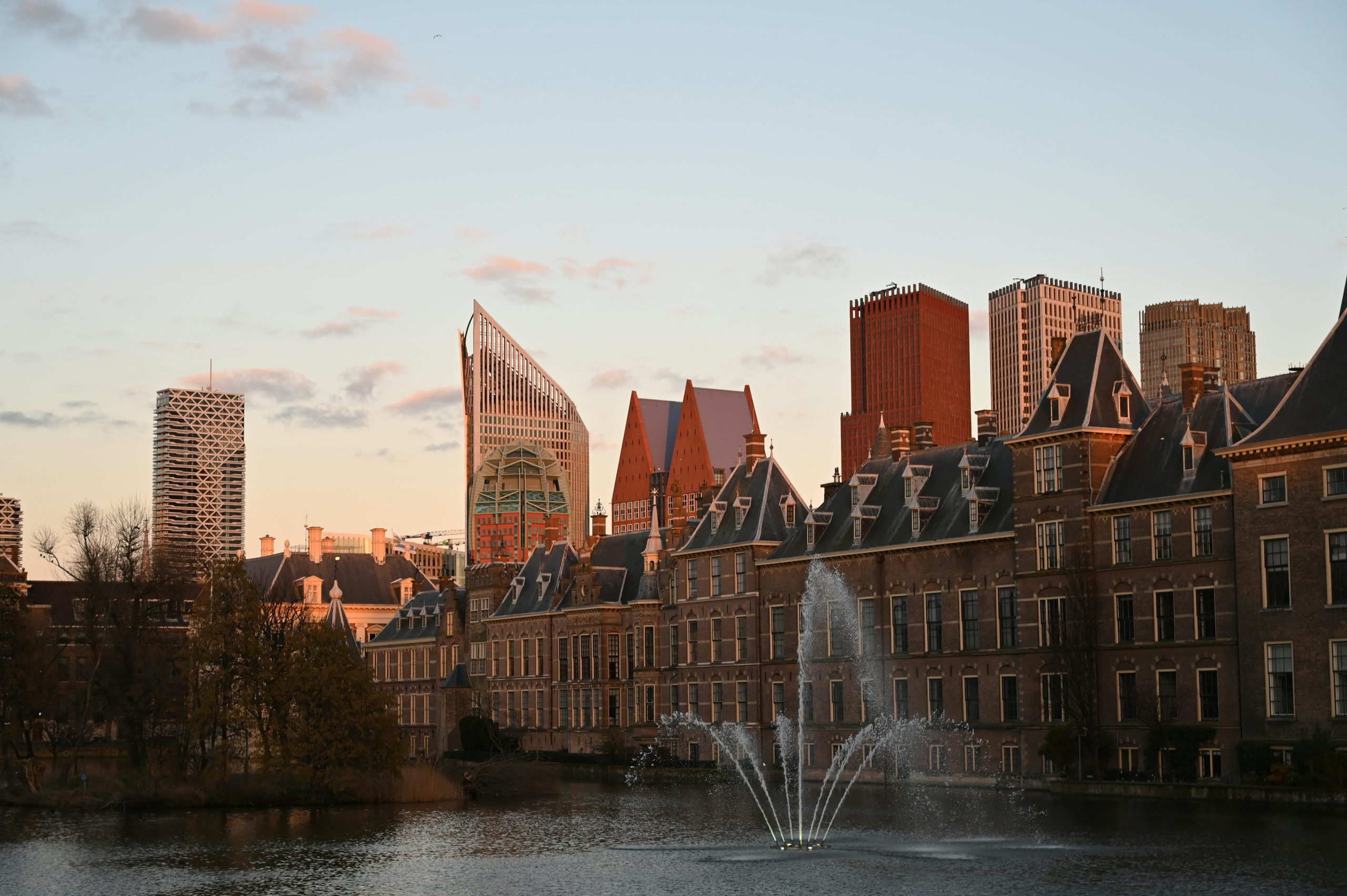
Photo by Jef Van Cleynenbreugel on Unsplash
Plurality or Problems?
An important thing to note is the threshold for making it into the parliament in the Netherlands, which is low compared to other countries – 0.67% which equals to one seat in the House of Representatives. So this means that unlike many countries which have a threshold to enter the parliament defined, the Netherlands uses purely proportional system when allocating seats after the election. This results in a high plurality of parties and representation of voices but also an often fragmented government, and from experience also lengthy processes to form governments – for example the last one took 223 days to form.
This election also shows an increase in voters from abroad, with more than 136 000 Dutch people living abroad registering to vote, compared to the 109 436 that registered for the elections in 2023.
Who is Geert Wilders?
Geert Wilders is one of the most controversial political figures in Europe, because of his notorious racist rhetoric against Islam, comparing it to fascism/Nacizm on multiple occasions. In 2016 he was on a prominent trial for inciting hate and discrimination after asking publicly whether the Dutch citizens want “fewer or more Moroccans” in their country. He also posted a racist post on X, which led to multiple Muslim organisations in the Netherlands to join forces and file a criminal complaint against Geert Wilders.
What Led to the Snap Election
Geert Wilders, of the PVV was the most successful (37 out of 150 seats) in the last parliamentary elections and said that he is set to become the next prime minister back in June. The formation of the government took six months to form in the first place, and ended up in a joint coalition between the populist BBB, centrist New Social Contract (NSC) and VVD. In May 2025,he first presented a strict anti-immigration plan and a week later, he called in a 10 minute meeting to inform the coalition that he is exiting. The Wilders-appointed prime minister, Dick Schoof reacted, “over the past several days, I have repeatedly told the four parliamentary party leaders that, in my view, the collapse of the government was unnecessary and irresponsible.”
Back in June, the Dutch government collapsed as the far-right leader Geert Wilders (PVV), taking on headlines because of his radical anti-Islam rhetoric, has pulled out of the government coalition over disagreements in topics of migration and asylum policy. He said that all of his ministers would leave the government coalition along with him after the other partners in the four party coalition protested his asylum policies as too radical. The prime minister Dick Schoof handed in his resignation back in June, with the government and its ministers still ruling until the new elections coming up on October 29.
The Set Up of the Dutch Constitutional Monarchy and Parliamentary Democracy
The Netherlands is historically a constitutional monarchy, meaning that the monarch is a head of the states, but holds essentially only a representative function. If you ever went to the Netherlands during the famous orange-colored King’s day, you surely know that the current King of the Netherlands is Willem-Alexander who ascended to the throne in 2013 and is married to Queen Maxima.
The Dutch parliament consists of two houses, similar to the Czech Republic which we covered recently; the Eerste Kamer (Senate) and the Tweede Kamer (House of representatives). Legislation can only be passed once approved by both houses.
This election is for the House of Representatives, which approves or rejects bills and should oversee the Senate and as mentioned above consists of 150 members. The Senate, consisting of 75 members, are elected by the provincial councils, so the elections are indirect. Senate also scrutinizes the actions of the House of Representatives, and approves or rejects laws, however cannot amend them. Both houses can debate the Government and submit written questions.