The Erasmus+ Programme in the field of higher education is frequently described as an academic opportunity. Brochures highlight mobility, intercultural exchange, and professional growth. Far less attention is given to what happens when students return home.

For young people from the South Caucasus, the impact of Erasmus does not end with the semester abroad. Interviews with alumni from Azerbaijan, Georgia, and Armenia suggest that mobility reshapes not only academic paths, but also how participants perceive home, responsibility, and belonging after their return.


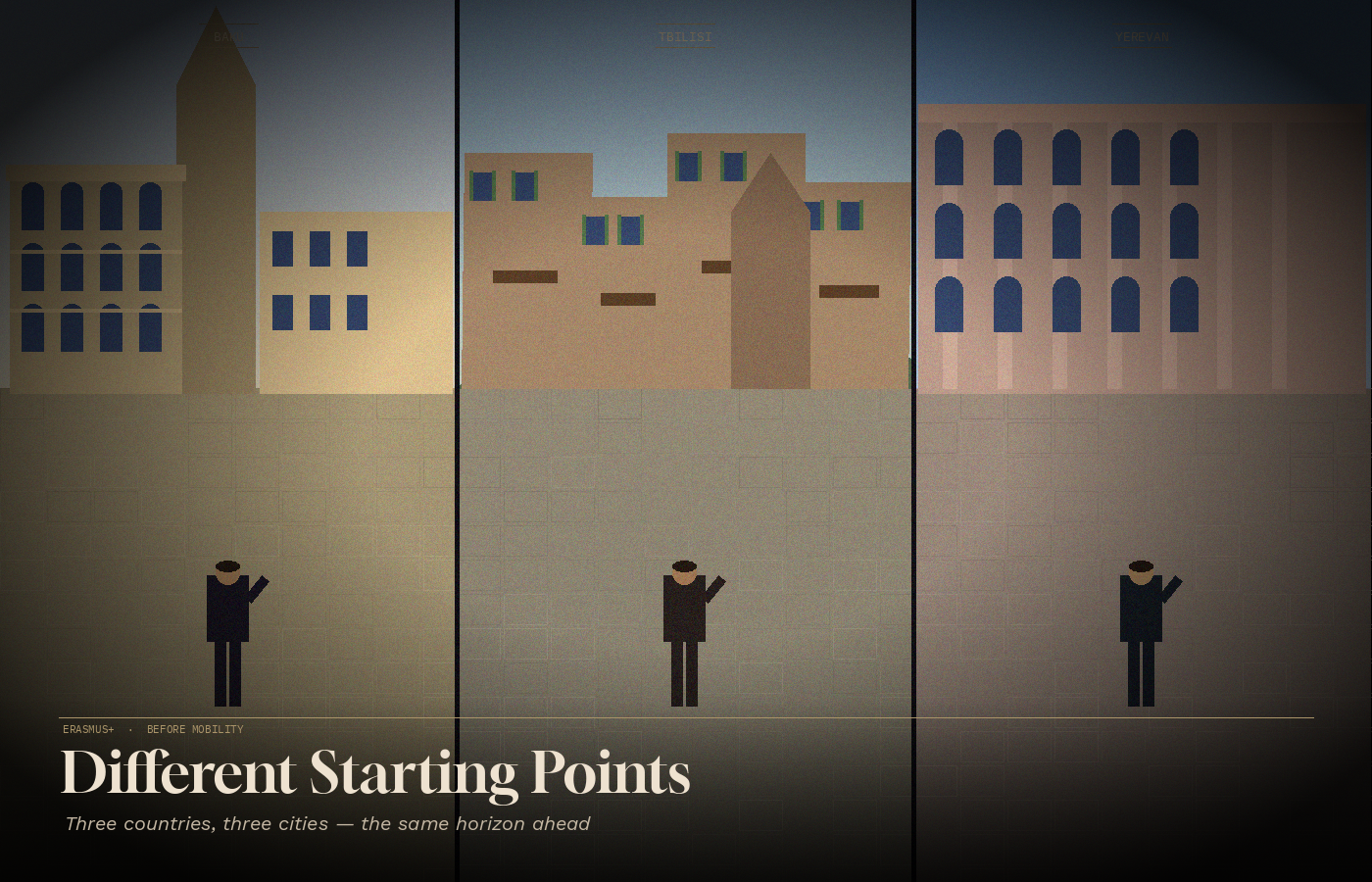
 A triptych of three city scenes side by side — Baku, Tbilisi, Yerevan — each with a lone figure, the same anticipation, three different worlds.

A triptych of three city scenes side by side — Baku, Tbilisi, Yerevan — each with a lone figure, the same anticipation, three different worlds. The image is AI-generated.

Before mobility: Different starting points

Fidan Amirova (name anonymised), a Communication and Digital Media student who spent a semester at Masaryk University in Brno, describes her life in Azerbaijan before Erasmus as tense.

The tension, she says, is difficult to measure but constantly present. It manifests in careful speech, in choosing words depending on context, and in distinguishing between topics that are considered safe and those that are not. Even humour reflects these limits. Jokes about who might be “taken away” appear quickly when someone voices dissatisfaction about politics or the economy.

Although she understood concepts such as censorship and restricted freedom before leaving, she says she had not experienced what freedom felt like in practice. In the Czech Republic, she spoke openly about political and social issues, presented university assignments without self censorship, and discussed Azerbaijan’s internal challenges without lowering her voice or softening her language. Fidan also noticed changes that seemed less political but equally revealing. In Brno, she felt less social pressure about appearance and behaviour. These shifts were subtle, but they accumulated.

When she returned to Baku, Fidan did not experience a sudden ideological awakening. Instead, she began noticing existing structures more clearly. After travelling across several European countries, she was struck by the absence of visible surveillance in everyday spaces. Open university buildings and the lack of security scanners in metro systems stood out to her. The contrast did not change her political awareness, but it sharpened her perception of control at home.

For Sali (name anonymised), a 23 year old Georgian participant who studied at the University of Burgos in Spain during the 2022 to 2023 academic year, the starting point was different. Before Erasmus, she felt that students from the South Caucasus often remain detached from European educational systems. Although opportunities exist, non EU citizens do not enjoy the same access as EU students, particularly in terms of long term career mobility.

Erasmus, Sali says, was both academically valuable and personally relieving. It allowed her to step outside the limitations she felt at home and to test her abilities in a different environment. Experiencing European university systems firsthand made her more aware of the structural gap between EU and non EU students. At the same time, it strengthened her confidence and sense of adaptability.


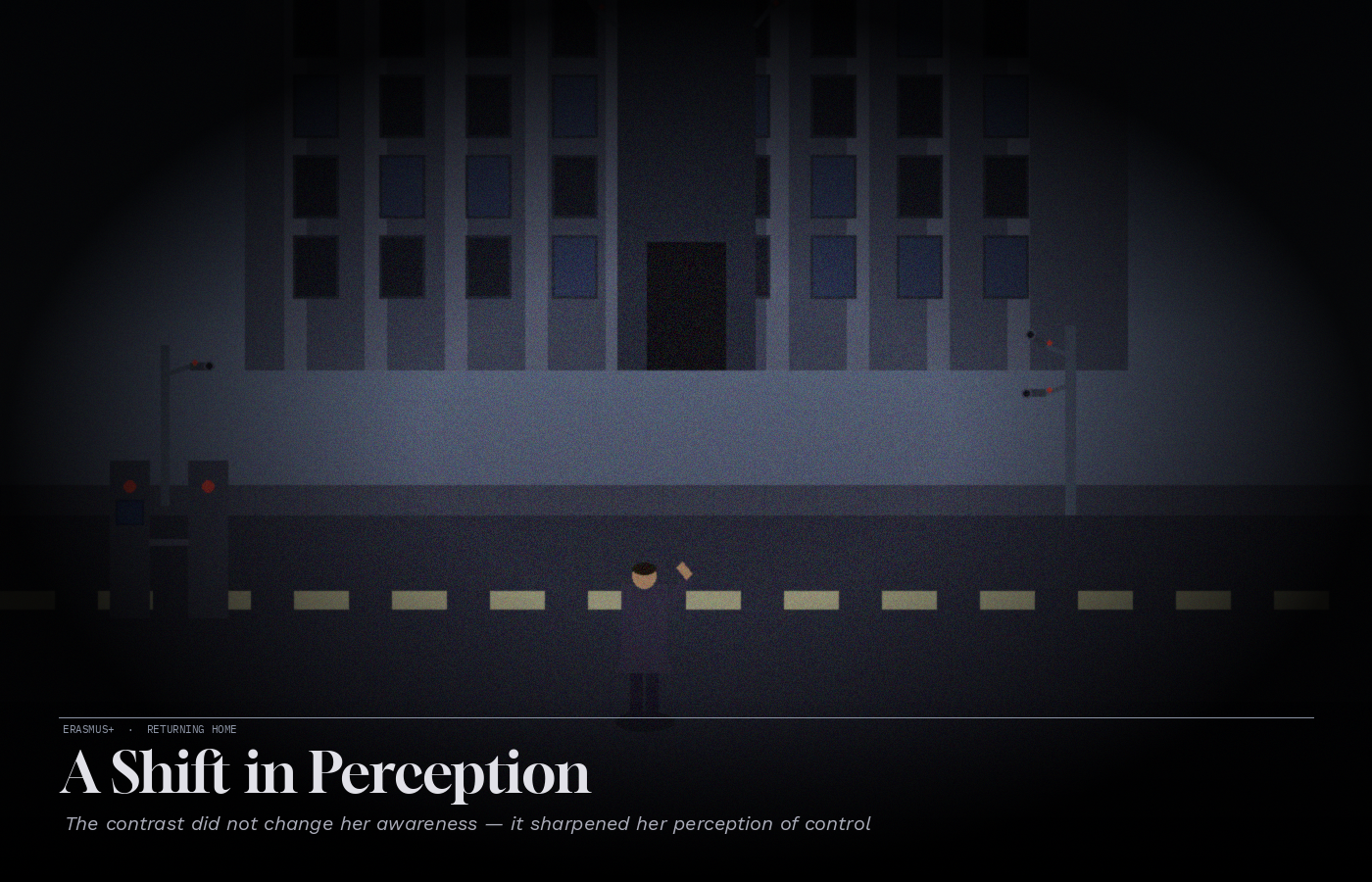
A figure on a grey boulevard looking up at CCTV cameras mounted on a monumental government building — the structures of control, newly visible after time away.

A figure on a grey boulevard looking up at CCTV cameras mounted on a monumental government building — the structures of control, newly visible after time away. The image is AI-generated.

Returning home: A shift in perception

Returning to Georgia was emotionally complex. Familiarity brought comfort, but her perspective had shifted. Sali realised she wanted continued international exposure. The experience eventually motivated her to apply for a master’s degree abroad. Erasmus did not produce disillusionment with home, but it recalibrated her expectations of what was possible.

Shushan Stepanyan, an Armenian professional who completed her Erasmus in Norway in 2023, describes yet another trajectory. In Armenia, she recalls limited international academic opportunities, but she does not characterise her environment as oppressive. During her university years, political demonstrations were common, and students often participated. She does not remember institutional punishment for activism.

For her, Erasmus was not an escape from pressure. It was an encounter with difference. Coming from a largely mono ethnic society, she wanted to experience multicultural environments and independent living. Norway became, in her words, a second home.

When the programme ended, the return was marked by ambivalence. She missed her family and friends in Armenia, but also felt she was leaving part of herself behind in Scandinavia. Living alone for the first time had reshaped Shushan’s daily habits and sense of autonomy. She describes learning to manage everything independently, from household responsibilities to personal decisions. Upon returning, some of these habits stayed with her. Shushan began prioritising physical activity, influenced by the outdoor culture she observed in Norway.


A person seated at a large window at dusk, one hand resting on the sill, looking out at a distant city — caught between the warmth inside and the world beyond.

A person seated at a large window at dusk, one hand resting on the sill, looking out at a distant city — caught between the warmth inside and the world beyond. The image is AI-generated.

Gratitude, guilt, and responsibility

Gratitude appears across all three accounts, though it takes different forms. Amirova describes feeling privileged to have experienced freer public expression. She also feels responsible for sharing what she witnessed, particularly regarding how differently societies can function. Sali speaks of responsibility in terms of making the most of an opportunity not equally accessible to everyone in her region. Stepanyan recalls a more personal form of guilt, related to missing life events at home while she was abroad.


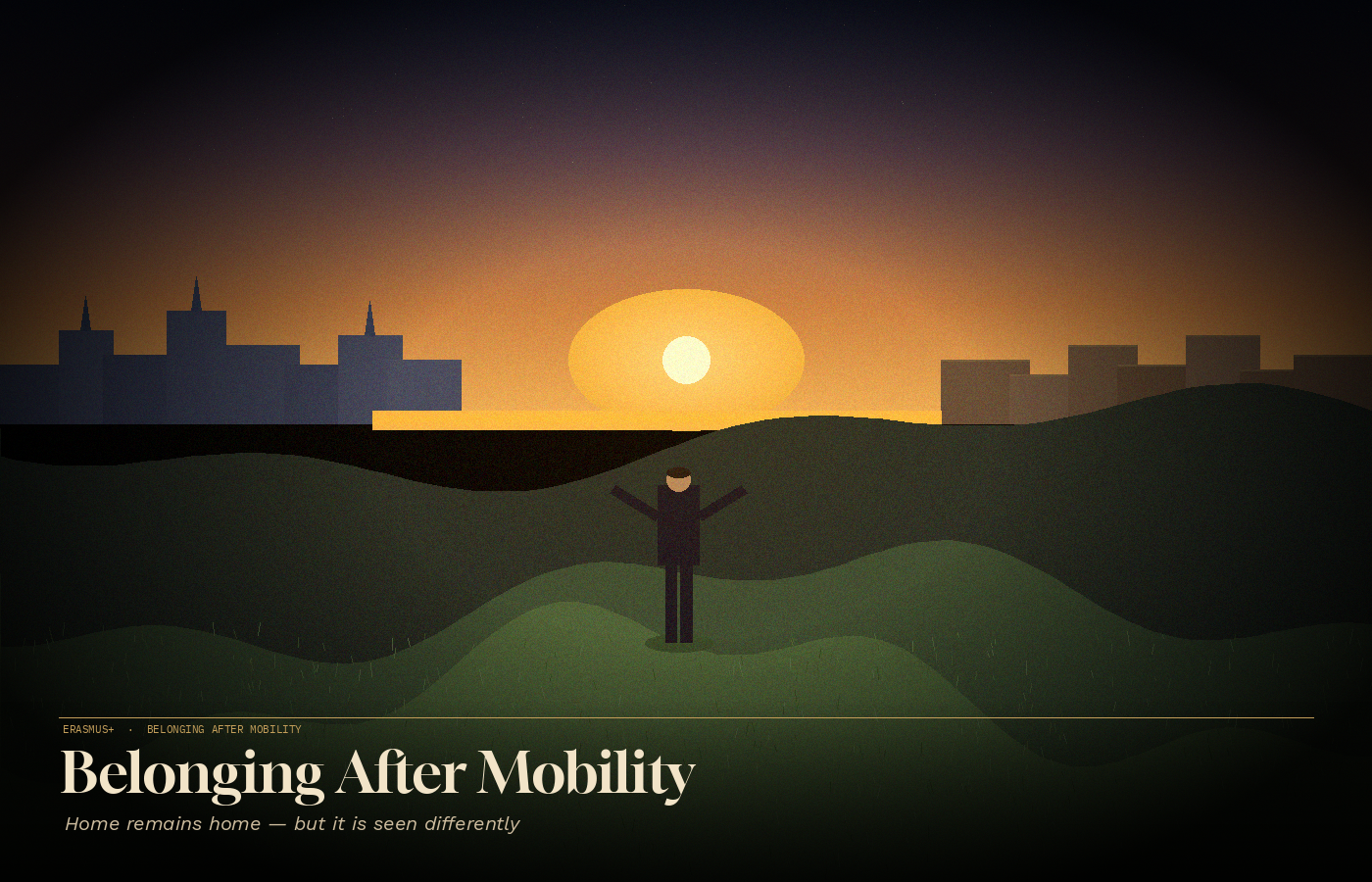
A solitary figure on a hilltop at golden hour, arms slightly open, facing the horizon — two city silhouettes on either side, belonging to both and neither.

A solitary figure on a hilltop at golden hour, arms slightly open, facing the horizon — two city silhouettes on either side, belonging to both and neither. The image is AI-generated.

Belonging after mobility

Belonging, perhaps more than any other dimension, becomes complicated after mobility.

Amirova says the exchange reshaped her cultural self-perception. “After the exchange programme, I realised that I belong to European culture more than I could have imagined,” she explains. Rationally, she believes she could adapt and live comfortably in Europe. Yet the experience did not create a desire to leave Azerbaijan permanently. “I am well aware that the standard of living is better there and that I feel exponentially freer,” she says. “Despite this, I would prefer to stay in Azerbaijan as long as I have the opportunity.”

Her statement reflects a recurring theme among mobility participants: attachment to home can coexist with heightened awareness of structural limitations. Erasmus does not automatically produce emigration ambitions. It can also intensify the desire to stay, even as it sharpens perceptions of constraint.

For Sali, belonging becomes portable. Erasmus made her more comfortable building connections in different environments. Leaving home no longer feels like a rupture, but a transition. Shushan, meanwhile, describes holding two homes simultaneously. Norway represents independence and self discovery. Armenia remains family, language, and history.

Across these experiences, Erasmus does not erase attachment to home. Nor does it uniformly produce alienation. Instead, it alters perception. It changes what beneficiaries notice, what they expect, and what they consider negotiable.

Mobility expands horizons, but it also recalibrates internal standards. After returning, alumni often measure everyday realities against what they experienced abroad. The transformation is not necessarily political. It is perceptual.

For young people from the South Caucasus, Erasmus becomes a reference point. Home remains home, but it is seen differently. Responsibility may deepen, ambitions may shift, and belonging may stretch across borders.

What changes most is not geography, but perspective.


Written by

Shape the conversation

Do you have anything to add to this story? Any ideas for interviews or angles we should explore? Let us know if you’d like to write a follow-up, a counterpoint, or share a similar story.