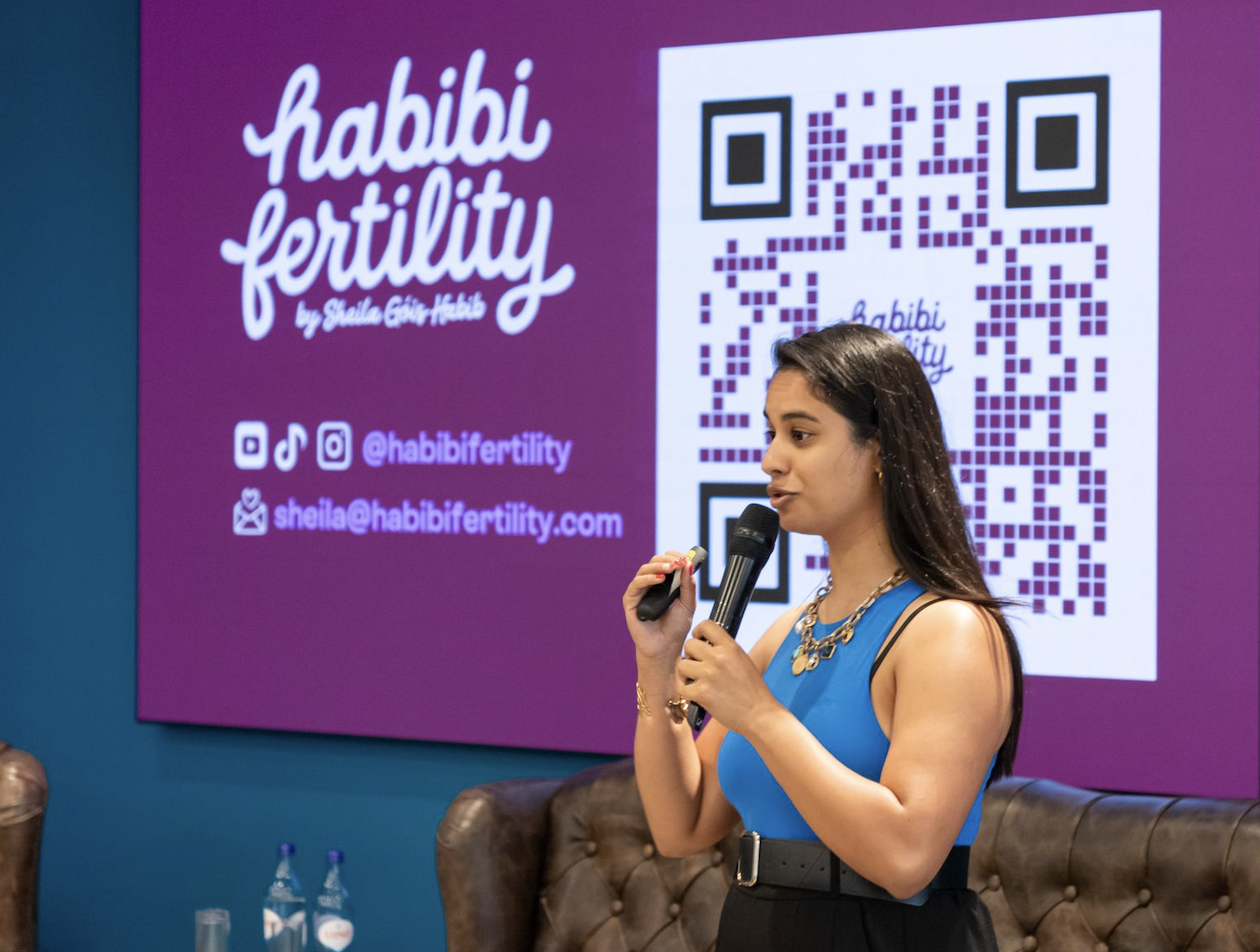
Habibi Fertility was one of the 3 winning finalists of the SEGIE Incubation Programme at Nova SBE Haddad Entrepreneurship Institute.

Habibi Fertility was one of the 3 winning finalists of the SEGIE Incubation Programme at Nova SBE Haddad Entrepreneurship Institute.

Sheila Góis Habib grew up between Portugal and Angola to a South Asian Muslim and Catholic family. For years, her parents’ silence around menstruation, sex and contraception mirrored a broader taboo that affects millions of young people across the world. Today, as a certified menstrual health educator and community founder of Habibi Fertility in Europe, she teaches body literacy as a human right and as a form of freedom no one can take away.

How does your journey in sexual and reproductive health begin?

I come from a South Asian family, half Muslim, half Catholic. From 18 to 28, I lived abroad in Angola, Brussels, Geneva and Lancaster. I studied Human Rights and International Law and really loved that work. I was in feminist peace organisations, at the European Anti-Poverty Network and other places that shaped how I see justice, gender equality and human rights.

But then there’s the personal part. I grew up in a family where menstruation, contraception and sex weren’t discussed. It was very much the idea that sex happens after marriage, not before.


How did those taboos impact you?

I remember vividly when I had my period for the first time. My parents weren’t even home, they were on a business trip. I was scared and confused. I didn’t know anything. I asked my aunt and she basically said, “Use something so you don’t bleed on the mattress.” That was my entire education.

I grew up with this lack of information and slowly realised it wasn’t just me. Other women had the same gaps, especially in my Indian and Muslim communities, but everywhere really. That’s when I decided to create Habibi Fertility with the mission to promote body literacy as a human right.


What does “body literacy” mean in this work?

Body literacy starts with knowing the correct names of its parts. A lot of people don’t know the difference between a vulva and a vagina. They don’t know where the clitoris is. These things sound basic but they’re not common knowledge.

Then it goes deeper into understanding your cycle. Many people don’t know the cycle starts in the brain, or that ovulation is the main event. It implies understanding what hormonal changes mean for your mood, energy and productivity, not just for fertility. Every person is different, so the point should be to become a scientist of yourself: track how you feel in each phase and use that knowledge to live better.

“Teach people how to use [menstrual products] safely, what a healthy cycle looks like. And teach men too. Men should understand menstrual cycles so they can support partners, friends and daughters. It’s an act of care and it’s political.”

For young people wanting to improve their body literacy, what’s the starting point?

It takes about ten minutes a day for three to four cycles. When you go to the toilet, note what you see and how you feel. Track your energy, mood, symptoms, how much you’re menstruating. After three to four cycles, it becomes a habit.

Early education matters too. If we identify menstrual irregularities and treat these early, we won’t wait 8-10 years for a girl to be diagnosed with endometriosis or other conditions. We can empower these people by saying painful periods aren’t normal. Let’s find a doctor who listens.


Where does the taboo around periods come from?

There’s still so much shame. People think menstrual discharge is “dirty,” when actually discharge is your vagina doing its job and self-cleaning. Most of what we see in our underwear is cervical mucus or skin cells, which is completely normal.

We also grow up being told to fear our bodies. We’re told we can get pregnant any day of our cycle, so we have to be constantly on guard. But that’s not true. You’re only fertile for about six days of your cycle. Yet when someone says they use the fertility awareness method, doctors often dismiss it or confuse it with an outdated calendar method, even though they’re completely different things.


There’s also the idea that it’s easier to just take the pill?

Yes. Men have a 24-hour testosterone cycle but women naturally have a 24 to 36-day cycle. Our energy, mood, libido and productivity fluctuate with that cycle, unless the pill suppresses it and we become more “constant” and stable, sometimes with less mood swings.

The pill allows women’s bodies to mimic men’s linear hormonal state and to meet productivity in the way society demands, more focused on output, always on. But we pay a price as we lose touch with our actual cycle and what it’s telling us.

Globally, only about 39% of schools provide menstrual health education, meaning a majority of students receive no structured information on menstruation at school, according to WHO and UNICEF.

What are the biggest misconceptions you’ve come across?

Every month, 1.8 billion people across the world menstruate. Many of these people use a period app regularly. And after your period, an app tells you that you’re fertile, you’re entering the luteal phase, your period comes in X days. But why do so many of us actually trust that over our own body?

If an app says you’re fertile, you think you have to trust it. You hear horror stories: “I only had my period once and got pregnant even after the morning-after pill.” So you stop trusting your body and trust the device instead. That’s the real misconception: that your body isn’t trustworthy.


You’re describing a cycle of distrust. How connected is all this to mental health?

Very closely. I did training recently on this topic and while there aren’t many studies yet, some argue that people who menstruate are more prone to aggravated mental health crises during their menstrual and luteal phases than in other phases.

For instance, premenstrual dysphoric disorder, which is a severe mood disturbance in the luteal phase, is often confused and misdiagnosed for other conditions like bipolar disorder. People get treated for something else when really it’s a luteal-phase issue. The treatment is completely different.


What about people whose cycles do not fit the “traditional” narrative?

There’s this idea that cycles are perfect, but they’re not. No one has the same cycle. Some people have PCOS or other polycystic conditions, which are very common but often undiagnosed. Some people’s cycles are simply different from the “typical” story.

We’re not robots. Everything around you affects your ovulation: travel, time zones, stress, and all of it impacts when you ovulate. Ovulation can happen earlier or later in your cycle, or your body may feel it doesn’t have the right conditions for ovulation and you have breakthrough bleeding instead. We also normalised the 28-day cycle, but normal cycles are anywhere from 24 to 36 days.

Globally, an estimated 500 million people lack access to menstrual products and adequate facilities for menstrual hygiene management, according to the World Bank.

Social media can be an empowering tool but it also spreads misinformation. What worries you most?

Lots of people are talking about menstrual and reproductive issues online with no real knowledge or qualifications. That generates massive misinformation and we lose sensitivity to targeted, personalised information.

There’s dangerous stuff too. Some people say the pill causes infertility, but it doesn’t. The pill has hormonal effects, yes, but there’s no research showing it makes you infertile. Yet these false claims spread and convince young women not to trust contraception.


How do we tackle period poverty without missing the bigger picture?

Free menstrual products are necessary, but not enough. A girl might have pads but be using one for 10 hours straight because no one taught her that’s harmful. In Portugal, we have public schools where girls can’t lock the bathroom door to change pads. In some global majority countries, barriers are worse.

The solution has two parts: distribute products and educate. Teach people how to use them safely, what a healthy cycle looks like. And teach men too. Men should understand menstrual cycles so they can support partners, friends and daughters. It’s an act of care and it’s political.


In what ways does body literacy connect to autonomy in this political environment?

Right now, access to contraception and abortion is being restricted in Hungary, Poland, the United States. On a personal level, as a racialised Portuguese woman with Indian and Muslim origins, I’m very afraid of the way extremism is gaining ground in other countries, and it will get here one way or another.

That’s exactly why body literacy matters. If you know your cycle, when you’re fertile and infertile, that’s power. Politicians can take away access to contraception and abortion, but they can’t take away your knowledge of your own body. Your body belongs to you. Knowledge stays with you forever.

Sources on sexual and reproductive health and rights:

Harvard (2017) Premenstrual dysphoria disorder: It’s biology, not a behavior choice. Harvard Medical School Publishing.

UNICEF (2019) Guidance on Menstrual Health and Hygiene. Programme Division/WASH.

University of Oxford (2024) New study reveals global trends for menstrual tracking app use. Research News and Events.

WHO/UNICEF (2024) Progress on drinking water, sanitation and hygiene in schools 2015-2023: Special focus on menstrual health. Joint Monitoring Programme report.

World Bank (n.d.) Menstrual Health and Hygiene Brief. WASH United.

Shape the conversation

Do you have anything to add to this story? Any ideas for interviews or angles we should explore? Let us know if you’d like to write a follow-up, a counterpoint, or share a similar story.