


“I have a visual disability. Honestly, I regret being born in Romania where the state is more blind than us.”
This is just one of the answers we received following a questionnaire addressed to people evaluated by the commissions of the General Directorate of Social Assistance and Child Protection (DGASPC) from several counties.

Source: Freepik
The state’s attacks on people with disabilities. What happens to a sick person in Romania
The name of the person involved will be Gabriel, he does not want his identity to be disclosed.
In October 2023, Gabriel was diagnosed with lung cancer. The diagnosis came after back pain that could no longer be tolerated. At first, Gabriel was struck by the incompetence of the doctor who sent him home saying that it was a “simple backache.” Gabriel’s insistence on getting a thorough investigation confirmed to the doctor that he actually had a lung tumor, not a simple pain.
A period of medical examinations, visits to several doctors, tests, and a biopsy followed. At the same time, Gabriel went on sick leave, but this time he was also hit by the incompetence of the company he worked for and, implicitly, the state that did not listen to him. The owner of the company that should have paid him the money for his sick leave apologized and said that over time he had not recovered his money from the National Health Insurance House (CNAS), so the sick leave money, money that is due to the patient and that the company he is employed by is obliged to pay, will be returned to Gabriel when the CNAS pays the amounts related to the sick leave to the company. Having found himself in a less pleasant situation in terms of money, Gabriel made a series of complaints to the Territorial Labor Inspectorate of Bucharest (ITM), but also to the CNAS. From ITM’s point of view, Gabriel did not deserve a response to his request, but CNAS sent him back a decision according to which the company he is employed by will be fined.
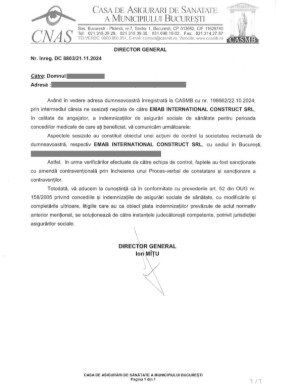
Gabriel is currently retired due to illness, but he has not seen his sick leave money yet, and as for the disability pension allowance, things have not been as they should have been. After submitting the application for this allowance, Gabriel received a paper in the mail telling him that he would be assessed by the commission at home, as he was unable to move. This is where the first problem arose. The gentleman’s documents did not mention that he was unable to move, so a call to the General Directorate of Social Assistance and Child Protection Prahova confirmed that incompetence also affects this institution.
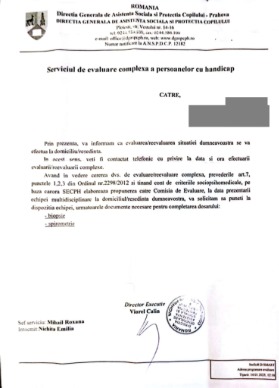
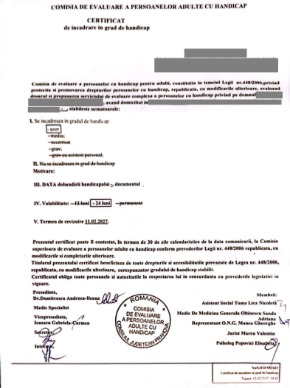
The DGASPC said that in their records, Gabriel is scheduled for the next day at 1:00 PM to be evaluated by the commission. The envelope received at home and the call were at odds, but the person in question went with the idea that it was just a mistake. However, even within the evaluation commission, the emphasis falls on the lack of interest in helping the patient. Arriving in front of the commission, Gabriel is asked by the doctor present if he has ever thought about going to work or if he feels fit to work. Gabriel replied that given his diagnosis, lung cancer with metastases, he would certainly not be able to go to work. Following this question, Gabriel was sent home, and a few days later he received the decision to classify him as disabled, which was of a mild degree, and thus he is not eligible to receive disability benefits. At the same time, within this decision, it was also written that Gabriel would already benefit from an old-age pension, which is completely erroneous, as he was employed at the time. The person involved filed a complaint with the DGASPC Prahova, but has not yet received a response.
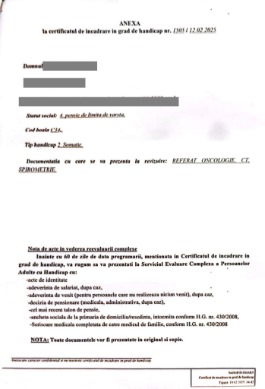
Sources confirmed that Prahova is a leading county in terms of disability benefits, so I wanted to find out more information, starting with a discussion with the people responsible for Social Assistance at a Prahova town hall, but to no avail. The lady in charge of these issues did not want to talk and said that without the mayor’s consent she could not help with anything.
I also tried to contact the DGASPC Prahova to find out details about this case, but I was told that information could not be provided due to confidentiality, and when I tried to ask general questions, I was told that I could find the answers on the internet.
Social Media. Meeting point for people with disabilities
Lately, more and more people with serious conditions are reporting, on online groups, that the degree of disability established by the authorities does not reflect the medical and social reality they live in. In some cases, people unable to work, move around, or care for themselves have received light placements, without the right to a companion or additional benefits.
To verify whether these cases are isolated or signal a systemic problem, we analyzed several online testimonies and distributed a questionnaire to groups for people with disabilities.
By completing the questionnaire, I aimed to find out what degree of disability was granted, how the assessment was conducted before the commission, and whether respondents were aware of cases of corruption in the granting of disability benefits.
These are some of the respondents’ testimonies regarding how the committee’s evaluation was conducted:
“I am blind, and when I turned 18, the commission asked me about my visual field, even though they knew that a completely blind person’s visual field cannot be measured. They forced me to fix my gaze on a point, even though I explained to them that I couldn’t.” (Respondent’s condition: completely blind)
“They call me to the committee every year or two, as if someone has been cured of schizophrenia and we don’t know.” (Respondent’s condition: Paranoid schizophrenia)
“The first time my file was rejected, due to a mistake by the specialist doctor. I had to do it again. In both cases I paid for the consultation, including the file.” (Respondent’s condition: Hearing loss)
“We are constantly treated like servants.” (Respondent’s condition: Severe dementia)
“I went to change my certificate and it wasn’t changed, knowing that my problems had worsened, plus extra medication! They didn’t even look at my file.” (Respondent’s condition: Mental health disorder)
“We were told that they expected it to be worse according to the medical documents submitted. The person in question was asked if he eats alone (he has paresis on the right side), he answered yes. Yes, he can bring the spoon to his mouth, but it is a long way until the food reaches the plate. Someone has to go shopping, cook the food. In short, a terrible experience, we have filed a complaint with the ANPD and are waiting for a response. According to the medical documents, a companion is recommended, he received the accentuated degree without a companion.” (Respondent’s condition: Paresis on the right side, aphasia)
Among the suspicions of corruption reported by respondents, the most frequent concerned cases in which visually impaired employees who were receiving benefits were caught driving cars.
Testimonials captured in screenshots from several Facebook groups for people with disabilities:
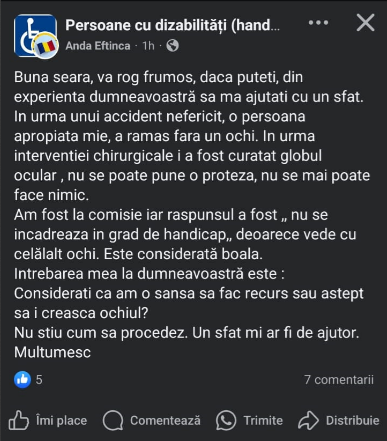
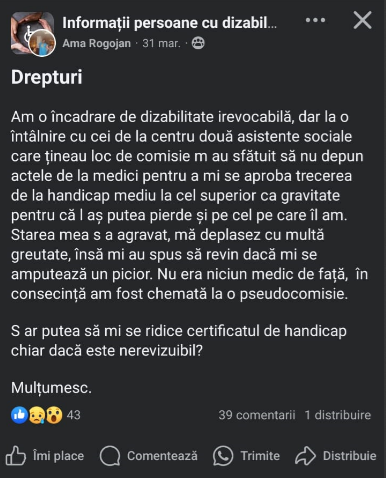
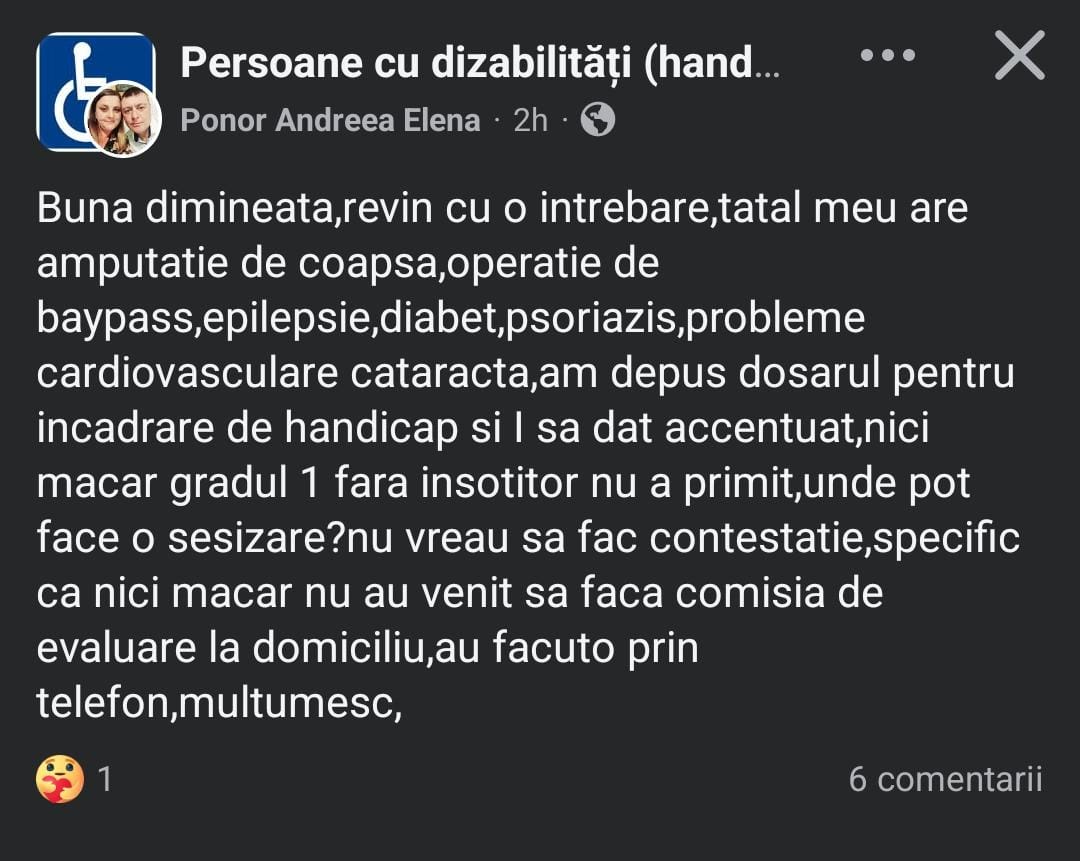
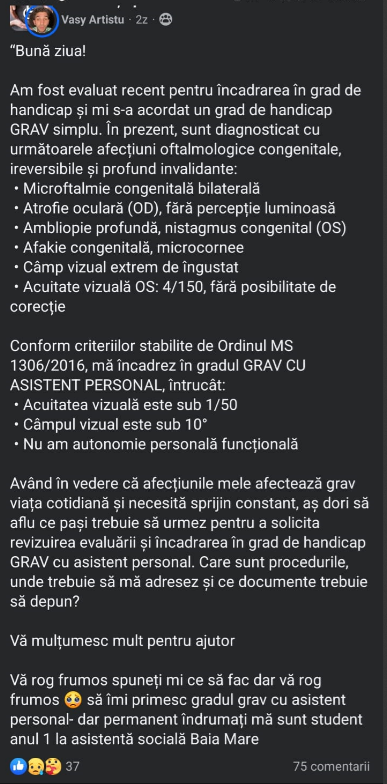
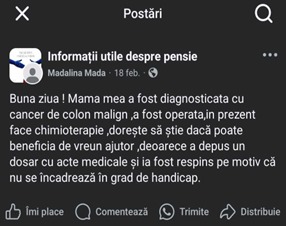
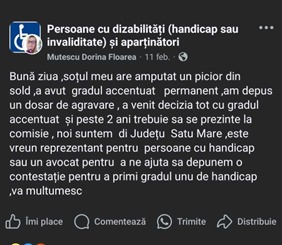
All these testimonies should raise an alarm to the state institutions that deal with these situations. A study conducted by Code for Romania in 2024 indicates that 3.9% of the population has a disability certificate, but the real estimates reach 15% if we add hidden disabilities. 860,000 people live with a disability that the Romanian state does not recognize and fails to minimize by providing correct benefits. Also, people who still receive these benefits benefit from tiny amounts that do not even cover the cost of medicines. The smallest amount that a person with a disability receives in Romania is 80 lei.
What does the law say?
Obtaining a disability pension in Romania involves going through a rigorous legislative process, mainly regulated by Law no. 448/2006 on the protection and promotion of the rights of persons with disabilities and Law no. 263/2010 on the unitary public pension system. This process involves medical, administrative and legal assessments, all aimed at guaranteeing the social protection of persons with disabilities.
The first step is the medical assessment, carried out by the Assessment Commission for Disabled Adults within the General Directorate of Social Assistance and Child Protection (DGASPC). This commission determines the degree of disability (mild, medium, severe or severe) and issues a certificate of disability classification. The required documents include identity documents, medical evidence, a summary medical record and other relevant documents.
If the person is legally able and meets the conditions, he or she can submit an application for a disability pension to the territorial pension house. According to Law no. 263/2010, the disability pension is granted to people who have lost their total or partial capacity for work due to a medical condition. The degree of disability is assessed by a medical commission of the National Public Pension House (CNPP).
After obtaining the pension, persons with a severe disability may benefit, depending on the option, from: a) hiring a personal assistant, b) the monthly allowance provided for by art. 43 of Law no. 448/2006 or c) the companion allowance in the case of those with a severe visual disability. These rights are not cumulative; the beneficiary must opt for it through an application submitted to the DGASPC.
The disability certificate is reviewed periodically, depending on the established degree and the diagnosed condition. The Commission may modify the degree of disability following the reassessment. Rights may also be suspended if the person does not appear for the reassessment or if the medical situation changes significantly.
Between social mission and corruption scandals
In recent years, the General Directorates of Social Assistance and Child Protection (DGASPC) in several counties of the country have become focal points in criminal investigations that have revealed a grim reality, namely that institutions designed to protect the vulnerable have been repeatedly used as instruments of corruption, fraud and systemic abuse. Under the pretext of caring for people with disabilities or protecting minors, dozens of civil servants, directors and collaborators from the private sector have orchestrated illegal schemes that have harmed the state by millions of lei and directly affected the lives of beneficiaries.
In the following, I will present several cases of corruption and administrative abuse that occurred in DGASPC institutions in the country, reported during the period 2022-2025.
DGASPC Tulcea (2022)
A DGASPC Tulcea official, Elena Jufa, and her accomplice, Zoița Stere, were sentenced to suspended prison terms for corruption, by a final sentence of the Constanța Court of Appeal. The two orchestrated an illegal scheme to settle free travel tickets for people with disabilities, between 2009-2013, causing damage of over 500,000 lei. They identified beneficiaries who did not request the tickets, falsified applications and settlements for long routes, without the persons in question having traveled. The DIICOT investigation revealed evidence hidden by Jufa, including 3,000 lei found in her underwear during a search, which she claimed she had for her son’s wedding. After the trial that began in 2019, the two were banned from holding public office.
Source: Ziare.Com
Vaslui DGASPC (2023)
The father of a director from the Vaslui DGASPC received a certificate of blindness, although he drives his car daily and admitted that he has no vision problems. The certificate, issued with the support of his daughter, who holds a management position in the department responsible for such approvals, ensures the man a monthly allowance of approximately 1,800 lei, exemptions from local taxes and a free parking space.
Source: 7Media.ro
DGASPC Vaslui (2024) CONTINUED
On the morning of October 23, police officers from Vaslui raided the headquarters of the General Directorate of Social Assistance and Child Protection (DGASPC) in Vaslui, as well as a medical clinic in the city. The investigation focused on how several disability classification certificates were issued, with serious suspicions of forgery and abuse of office. The raids took place more than a year after the local press had reported possible fraud. The journalists presented the case of a man who, although officially listed as blind, was caught driving cars. It was later discovered that he was the father of the head of the Adult Persons with Disabilities Assessment Service within the Vaslui DGASPC, the service responsible for recommendations regarding disability classification.
The institution’s director, Dragoș Cazacu, also came to the attention of investigators, who obtained a disability certificate after being appointed to the position. Cazacu stated that he had complied with all legal conditions, and his diagnosis had been confirmed by several doctors. In parallel, questions were raised regarding the fact that over 50 employees of the DGASPC Vaslui, including management, also held such certificates. Investigators seized several documents, both from the DGASPC headquarters and from the medical clinic involved, where suspicious documents were identified that were allegedly used in the disability files. The police opened a criminal case and began investigations for abuse of office, intellectual forgery and use of forgery.
In addition to administrative suspicions, the case also had some political connection. Dragoș Cazacu is known to be close to the former president of the Vaslui County Council, Dumitru Buzatu, who was caught red-handed by the DNA after receiving a bag with 1.25 million lei. Cazacu witnessed this event, being with Buzatu fishing. Cazacu’s wife also holds a public position, being the head of the Procurement Service within the Vaslui County Council.
Source: HotNews.ro
Vaslui DGASPC (2023)
DNA Iași prosecutors detained Nechita Constantin, an employee of the Vaslui DGASPC, for 24 hours, accused of continuous influence peddling. During 2019-2022, he allegedly received 95,700 lei and 8,700 euros from 23 people, promising to influence civil servants for employment, maternity assistant certificates, family placements, approvals of disability files and disability pensions. On November 15, 2023, Nechita is to be presented to the Vaslui Court for 30 days of preventive arrest. Another 22 people are being investigated for influence peddling, and prosecutors conducted searches in 25 locations in Vaslui and Galați counties, with the support of the General Anticorruption Directorate.
Source: News from Romania.ro
UPDATE (2025)
While Nechita Constantin’s case is stalling, Oana Ramona Rotaru, one of his clients, was sentenced to one year and four months of suspended prison, with community service obligations and supervision by the Vaslui Probation Service. Nechita, who is free, also had the consent of the Huși Diocese to raise funds through the NGO “Cantina Oamenilor cu disabilității medici și finanțiali”, but the money found at her home raises questions about its destination.
Source: New Weather
Vaslui DGASPC (2024)
Two minors under the supervision of the Vaslui DGASPC were repeatedly caught dancing as entertainers in a local club, one of them even posting a video on Facebook, which was later deleted. One of the girls was until recently accommodated in the Emergency Reception Center for Abused, Neglected and Exploited Children within the Vaslui Community Services Complex No. 2, and the other lives in a DGASPC apartment. Although the supervisors were reportedly aware of the girls’ activities, no action was taken. The Vaslui DGASPC notified the Police, which was the only legally permitted action, according to the institution’s spokesperson.
Source: Liberty
DGASPC Ilfov (2023)
Andrei Răzvan Țicu, head of the Case Management and Monitoring Service for Social Services for Adults with Disabilities in DGASPC Ilfov, was detained by DIICOT in the Voluntari nursing homes case, where the elderly lived in unsanitary conditions, were not fed, cared for and were exploited through unpaid labor. Țicu is suspected of having covered up the irregularities at the Armonia Center, signing a document in February 2023 that attested to compliance with the conditions, contrary to reality. He owns an impressive fortune, with 18 plots of land, four houses, two apartments, three cars and bank accounts, most of which were inherited in 2021. He also reported substantial income from sports betting, accumulating almost 500,000 lei in three years. The Bucharest Court ordered the preventive arrest of Țicu and three other defendants, and another DGASPC employee, Mihaela Popa Bianca, was placed under house arrest.
Source: Fanatic
DGASPC Maramureș (2024)
DNA prosecutors have indicted Alina-Angela Coste-Mădăras, former director general of the DGASPC Maramureș, for abuse of office assimilated to corruption crimes in a continuous form, and Dorina-Rozalia Curteanu, former deputy director general, for complicity. Between March and October 2022, the two allegedly illegally approved payments worth 932,207 lei to a private association in Mureș for social services intended for people with disabilities, although these were not provided in accordance with the law. The association took in 24-26 people in a location without a license, health or security permits, with non-compliant conditions. Controls in June and August 2022 revealed serious deficiencies, and two people died due to poor conditions and unqualified staff. However, Coste-Mădăras, with Curteanu’s support, continued the payments, causing a damage of 932,207 lei to DGASPC Maramureș and an undue benefit to the association.
Source: G4Media.ro
DGASPC Bihor (2025)
Prosecutors from the Bihor Prosecutor’s Office have charged Călin Puia, head of the DGASPC Bihor, and Mihai Mudura, director of Andromi Com from Nojorid, with embezzlement, after causing damage of over 184,000 lei. The investigation began following revelations by the Bihoreanul newspaper in December 2023, which showed that, instead of 7.6 tons of bison meat donated by Eurobuffalo from Salonta for centers for children and adults with disabilities, Andromi Com delivered only 1,547 kg of pork meat and sausages, much cheaper. Puia, accused of complicity, is also targeted by an administrative investigation by the Bihor County Council, which confirmed the damage and charged him with the amount of 184,552 lei.
Source: BIHOREANUL
DGASPC Ialomița (2025)
Inspectors from the Monitoring Council discovered illegal practices at a social center in Slobozia, subordinate to the DGASPC Ialomița, where children were tied with rope, immobilized in bed and insufficiently fed. An internal procedure from 2022, approved by the general director Paul Marcu, allowed for the “behavior control” of minors, although the law prohibits such practices in centers for minors. Marcu claims that he signed the document without knowing the details, citing a “leak” and lack of time to check all the materials, he also states that the recommendation came from the head of the center. The Ialomița County Council has launched an internal investigation, targeting several employees, including a woman who claimed to have connections in politics. Monica Dumitrescu, an inspector from the Monitoring Council, confirmed that the procedure is illegal, as the application of restraint is only allowed in mental health, under medical supervision, not in social centers.
Source: Digi24
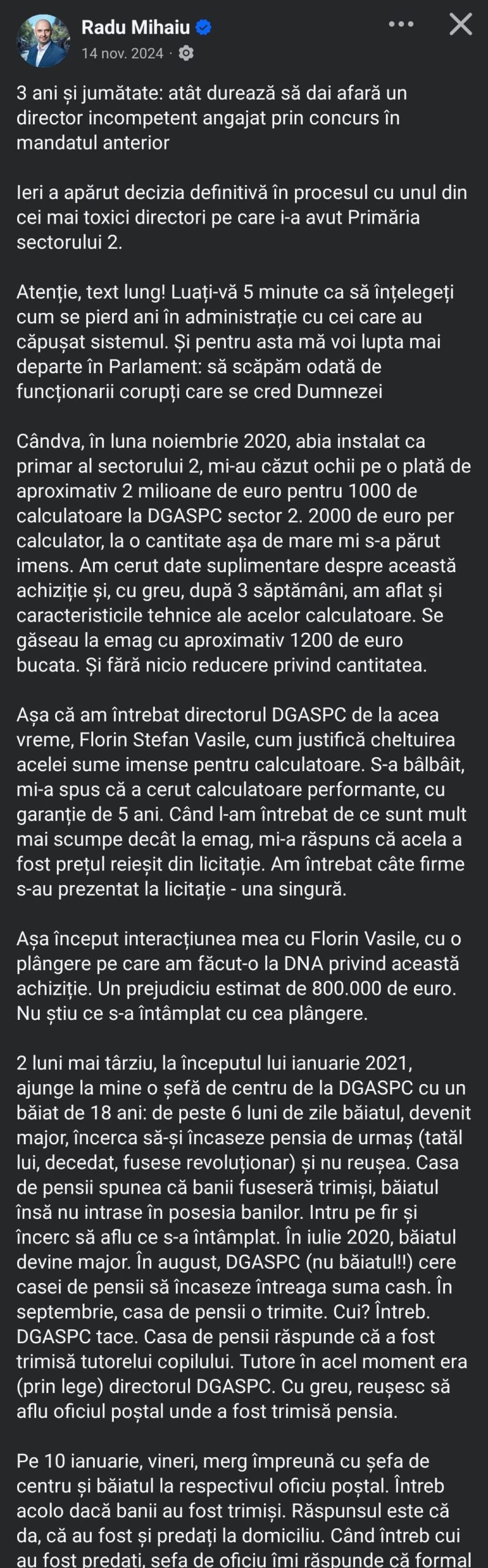
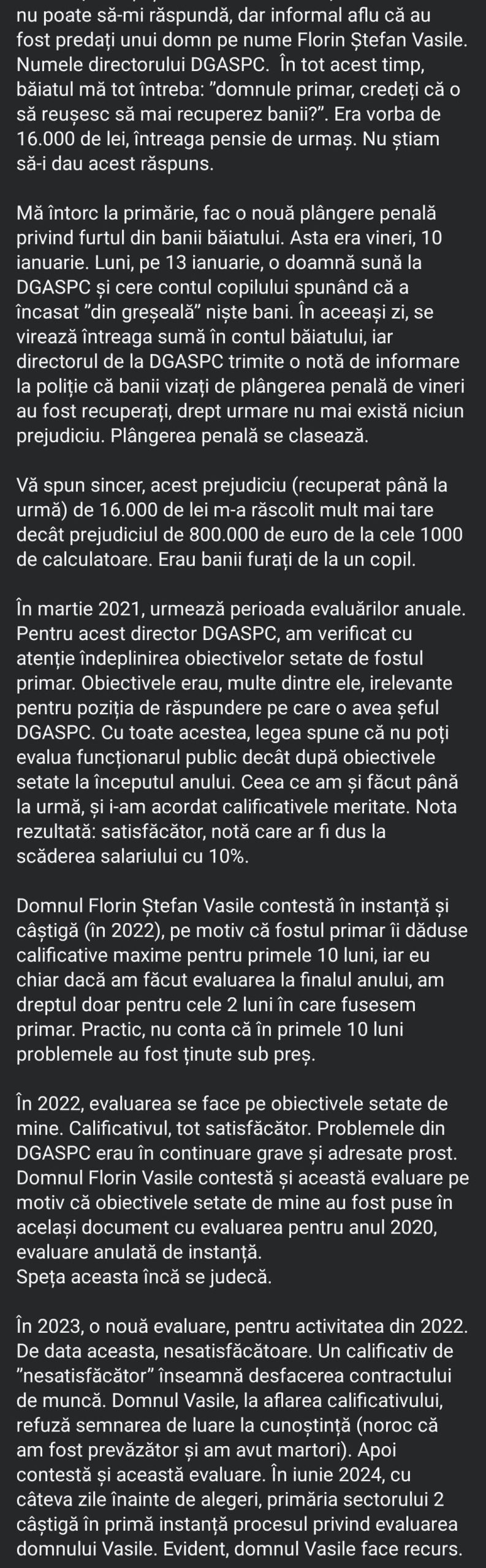
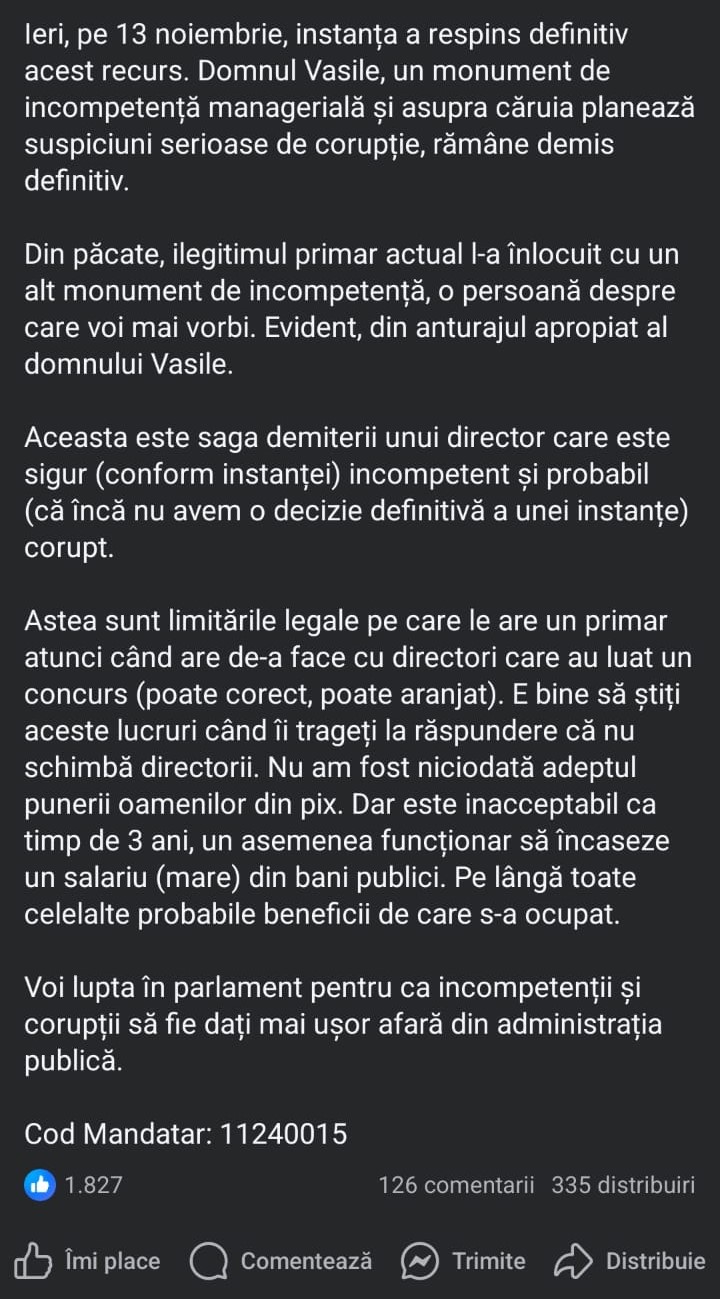
DGASPC Sector 2 (2024) – The course of revealing the corruption acts of Florin Ștefan – Vasile, director of DGASPC sector 2
The post from the Facebook page of Radu Mihaiu, former mayor of sector 2:
The Romanian social assistance system, largely managed by the General Directorates of Social Assistance and Child Protection (DGASPC), is deeply affected by corruption, incompetence and abuses, which compromise the protection of the most vulnerable categories. The cases reported in the counties of Romania reveal the same pattern: fraudulently issued disability certificates, embezzlement, unjustified payments to private entities, inhumane conditions in social centers and illegal practices. Moreover, the testimonies of victims who face superficial assessments, excessive bureaucracy and denial of benefits highlight a clear lack of empathy and professionalism. Although investigations by the DNA, DIICOT and other institutions have led to convictions and searches, the slow pace of justice and the protection of corrupt officials, highlighted in this article, perpetuate the prejudices. These scandals highlight the urgent need for legislative and administrative reform to eliminate corruption, streamline assessment processes and ensure real protection of beneficiaries, in accordance with fundamental rights.