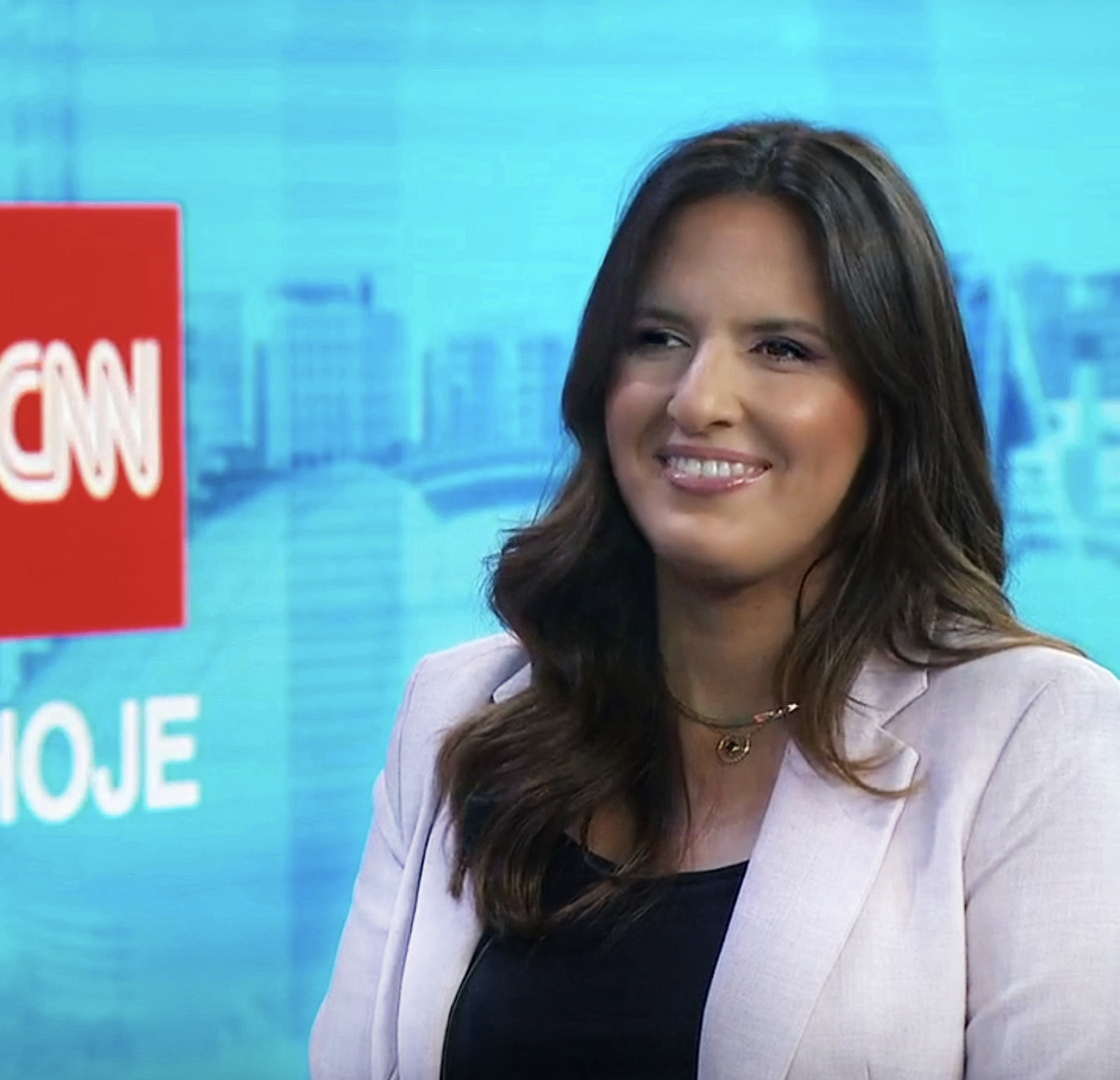
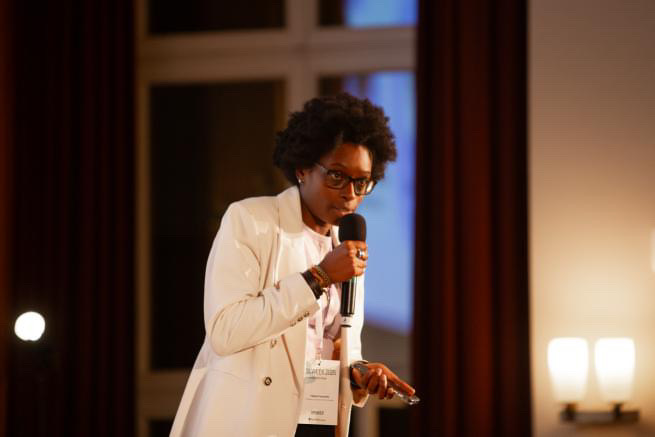
Fabiana Fernandes speaking at the Better Politics Foundation in Berlin, Germany.

Fabiana Fernandes speaking at the Better Politics Foundation in Germany.


Fabiana Fernandes is an agricultural engineer turned leadership trainer who now heads the Próxima Geração Academy in Portugal, a non‑partisan school for the next generation of public‑minded leaders.

Drawing on her path through a male‑dominated agronomy course, student politics and scouting, she works with young people from big cities and rural areas to help them become citizens who listen and keep others at the centre of decisions.

PulseZ spoke to Fabiana because her work sits exactly where many young Europeans feel the gap today: they are interested in politics, but distrust institutions and do not see leaders who truly represent them.

How do you relate your childhood to your career?

I would say my mother transformed my way of looking at the world in a very positive way. She made me someone passionate about people‑oriented politics. In my house we always talked openly about these issues, so from the moment I had a question and then looked for a solution with others that, to me, was politics.

Then agricultural engineering came into my life by chance. I actually wanted to go into the health field, but then realised I liked the food production side of things and the connection to the land, largely because of my family in the interior of Portugal. Agronomy appeared as a way of keeping that close connection.


Where does your sociopolitical awareness come from?

The agricultural engineering course is very male‑oriented. That was my first big challenge in terms of gender equality: entering a world of study and work that is mostly dominated by men. It shaped my academic path. When you look at large‑scale production and at the big public names in agronomy, they are often men leading farms, in production or research centres.

But during my studies I realised there are many women working in this area. Here’s an example: when I entered university in 2011, the student association was celebrating its 100th anniversary, and there had never been a woman president. I became the first. That change of cycle made me see how important it is to create spaces where we think there is no room for others to lead.


For young people who want to participate in public life, regardless of background or experience, where should they start?

The student association was essential for me in terms of formal, institutional contact with the political side and with other groups of people, so I do think it’s a very good way to start, especially at university and also in schools where associations exist. But it is just one option.

There are many ways to be actively involved in civic life: volunteering, scouting, being part of a neighbourhood residents’ association, going to local meetings. I was a scout for a long time, and I see scouting as a form of civic and political participation too. It’s about understanding where you fit best, where you feel most needed and where you have opinions to share.

“If we bring young people in earlier to discuss issues together, they discover that there are other points of view, that their values are not the only ones, and that other values need to be balanced.”

Civic participation is a big part of your life too. What does that currently look like?

Right now, my main space for civic participation is as president of the Próxima Geração Academy, a non-partisan project that enables the next generation of young leaders. We do work that I think is incredible and unique because we look at future leaders beyond political parties.

Civic participation happens when you train leaders who are political commentators, who create associations with impact, who are advisers, and who, inside the companies where they work, promote engagement and inclusion in different ways.


What impact do you expect the academy to have?

It is structured around three main training blocks: The first focuses on values and the role of the self in society. The second is about tools (media training, speech‑writing) and skills that are essential in leadership. The third is the creation of something for society, which usually takes the form of public policy proposals.

Our goal is to see leaders who have gone through the academy, who have their values clearly defined and who can think critically together. We want leaders who can make decisions as a group, who are able to listen, and who keep people‑centred approaches rather than focusing only on their own personal development.


How do you factor in the difference between young leaders from big cities and from more isolated areas?

Participants from big centres often have a more national vision and plans for the country as a whole. Candidates from the interior have a vision that is much closer to people and more focused on specific local problems, but with a clear idea of how those local problems could be turned into national solutions. Cities think nationally; the countryside thinks locally with a national perspective. It’s fascinating to see that.

According to the European Commission, about one in two (49%) young Europeans surveyed report having taken action to change society, such as signing a petition, participating in a rally, or sending a letter to a politician, in the past year.

Why is leadership training so necessary in Europe?

Because we see people increasingly disconnected from institutions worldwide. People feel institutions don’t speak to them and don’t work for them, so they disconnect. We need leaders who reconnect with people and who stop to listen to what people actually need. This is an issue long identified by other academies from all over the world under the Better Politics Foundation umbrella.

We need to go back to an active, vibrant democracy where people feel represented by institutions and leaders, and where they want to participate not only at election time but throughout the whole democratic cycle.


If institutions are not speaking to young people, who are they speaking to?

In many cases, institutions talk a lot internally. Across EU countries, we are going through a period of short power cycles where the focus is on talking inside and trying to maintain power.

Because there is no time to absorb proposals from outside, no time to listen to people and integrate ideas, institutions end up speaking mainly to those who already have some connection to them. They are not speaking to society as a whole, and that divides us, because each group retreats into its own set of connections.


You work closely with empowered civil society. What should political leaders do towards them?

There are many academies focused on different stages of the leadership cycle at a global level. Our focus is on training new leaders, but there are others that support people already in leadership positions.

What those academies try to do is bring leaders back into society: take them out of their offices, get them to listen to people, and have them participate in discussion forums to practice active listening, critical thinking and systemic thinking. They provide methods and tools so leaders can test, before presenting a proposal, whether it will be well received by society.

According to an analysis by FEPS and Eurobarometer, only 36% of eligible voters under 25 participated in the 2024 European elections, a 6% drop from 42% in 2019. Lack of interest in politics (28%) was cited as the main reason among young non-voters, higher than the EU average of 20%.


Why is it so important to involve young people early in decision‑making processes?

I often think of children in kindergarten, who are still like blank slates. The later we involve people in decision‑making, the more they will be influenced by their experiences, and those are often very lonely in today’s world where people are increasingly closed off.

If we bring young people in earlier to discuss issues together, they discover that there are other points of view, that their values are not the only ones, and that other values need to be balanced. The sooner we do this, the easier it will be later, because they will become leaders with fewer biases and more openness to discuss and listen to others. For me, it’s about the fact that we are not yet fully moulded by society and our traumas. Also, they need space to be examples for others.


How do you see your future path in politics?

I really want to bring the political side into agriculture. We increasingly have an urban population disconnected from the land, and we end up making political decisions from offices that are distant from rural realities.

I would like to bring a more business‑oriented, indicator‑focused vision to agriculture, to understand how it can support a path towards sustainability. Combining the environmentalist with the agricultural side has a lot to do with creating networks of contacts and of future leaders. That is why we need leaders who can work together, and why my path has been through leadership training and promoting systemic thinking.


If you were to leave a message for a young leader out there, what would tell them?

Whatever challenge you face, don’t just accept it as it is. I personally thought I would always be an agricultural engineer working in a vineyard in the countryside, but now I’m part of an international leadership training board. Accept challenges, because sometimes imposter syndrome gets in the way and we end up missing incredible opportunities. Opportunities like the ones I am grateful to have now, and the ones I hope to create in the future.


Sources:

European Commission (2024) Flash Eurobarometer 545 – Youth and democracy Report. Media Monitoring and Eurobarometer Unit (DG COMM).

European Parliament (2024) EU Post-electoral survey 2024. Public Opinion Monitoring Unit, DirectorateGeneral for Communication (DG COMM).

Dressler, M. (2024). Youth turnout in the 2024 European elections: A closer look at the under-25 vote. Foundation for European Progressive Studies (FEPS).

Shape the conversation

Do you have anything to add to this story? Any ideas for interviews or angles we should explore? Let us know if you’d like to write a follow-up, a counterpoint, or share a similar story.