Tell EU stories, develop your journalism skills, and make your voice heard!

Last year, as graduation approached, conversations about universities quickly turned into real estate debates the moment you said you were going to study in the Netherlands.

Not which university are you going to? — but have you found a place to live in?

A friend of mine spent seven months applying for a studio in Eindhoven. Nearly 1,000 applications later, he finally got one — at a price of 1050 euros.

And he was one of the lucky ones.

Others search for longer. Nine months. One year. Some are still stuck in temporary, overpriced housing. And many simply give up on the Netherlands altogether — not because of the education, but because finding an affordable place to live feels like an impossible battle.

Reality in Numbers

However, this is not one’s individual struggle, but, in reality, a national level crisis.

The Netherlands is currently facing a housing shortage of around 410, 000 homes, and with the number of households continuing to grow, this gap is only expected to widen. This is not a sudden issue, but one that has developed over the past decade, ffas demand has been growing faster than the supply. In 2025 alone, 80,000 new households were added, while only 69,000 homes were built.

Despite the Dutch government setting an ambitious target of building 100,000 homes per year, construction has failed to keep up for the third consecutive year. As a result, the shortage remains stuck at around 400,000 homes, with projections suggesting it could grow further if building rates do not accelerate.

As demand continues to exceed supply, available housing shrinks, and landlords raise rental prices accordingly. As a result, the market has become increasingly difficult for students and young professionals to compete in. 

Who Is to Blame?

In public debate, the answer is often one —  international students.

With low tuition fees compared to countries like the U.S. or the UK, and universities that consistently rank among the best in Europe, it’s not a surprise that a growing number of students from abroad come to the Netherlands to pursue higher education. In the academic year 2023 – 2024, international students made up around 16% of the total student population, with even higher percentage shares in technical universities such as TU Delft (35%) and Eindhoven University of Technology (36%). In cities like Delft, Eindhoven, and Amsterdam, their presence is often used as an easy explanation for the housing pressure in the region.

This tendency to blame international students has increasingly shaped political campaigns, with some proposing to “solve” the housing crisis by restricting the number of students entering the country. In 2024, the Government of the Netherlands announced plans to reduce the number of international students, linking their growing presence to housing shortages and pressure on infrastructure. The measures introduced under the Internationalisation in Balance bill include limiting English-taught programmes, tightening admission rules, capping the number of students admitted for a particular degree, and requiring that most bachelor’s courses be taught in Dutch.

This political direction is further reinforced by parties such as the Party for Freedom (PVV) and the People’s Party for Freedom and Democracy (VVD), which have increasingly framed migration — including international students — as part of the housing problem. After the 2023 elections, PVV became the largest party in the Netherlands, and discussions around limiting immigration and reducing the internationalisation of higher education moved from political rhetoric into actual policy proposals. Much of the political debate has focused on the idea that international students take up housing, push Dutch students out of university places, and contribute to overcrowded cities, despite the fact that the housing shortage has been developing for over a decade, while the trend of a growing number of international students has begun post-2020.

According to data from Nuffic, the number of international students in the Netherlands has increased over the past decade, particularly after 2020. In 2018, there were around 85,000 international students enrolled in Dutch higher education. By 2023, this number had grown to over 120,000, and by 2025 to around 128,000. While this increase is significant, it is important to note that the Dutch housing shortage had already been developing long before this growth. The shortage is therefore not a sudden result of international students arriving, but a structural problem that has been building over time. At the same time, the growth in international student numbers has begun to slow significantly in recent years, dropping from around 12% annual growth a few years ago to less than 1% in the most recent academic year. This suggests that while international student numbers did grow, the increase is not as rapid as often portrayed in political debates, and the growth is already stabilising.

One of the main ways politicians propose to reduce the number of international students is not by directly banning them, but by limiting English-taught programmes and requiring more courses to be taught in Dutch, making Dutch the standard language of higher education in the country again. Thus, universities such as Delft University of Technology, have come under increasing pressure to reduce the number of international students and reconsider English-language programmes, despite their role in attracting global talent.

At the same time, the position of the current government on international students is starting to contradict itself. While some parties argue that the number of international students should be reduced to ease pressure on housing, there have also been parliamentary discussions about ‘retaining’ international students after graduation, particularly those who are “highly skilled.” This reveals a clear contradiction in policy: international students are at times presented as part of the housing problem, but also a valuable contribution to the Dutch labour market that politicians want to retain.

International students have therefore found themselves in a paradox: welcomed as future skilled workers, but also blamed that they’d stay and take up space. The question is therefore not only who is coming into the country, but whether the housing crisis is caused by the people arriving — or by the houses that were never built.

Voices from International Students

To understand how international students themselves see the situation, I spoke to several students studying in different Dutch cities about whether they plan to stay in the Netherlands after graduation and how housing has affected their experience.

Martin, a student in Eindhoven, says his decision to stay depends mostly on job opportunities, but housing has already affected his studies. “Student housing made it very difficult to study in Eindhoven,” he says, adding that he feels welcomed by people, but “not by supply companies.” He also believes internationals are not the only ones affecting the housing market, pointing out that housing distribution and demographics also play a role.

Dani, who also studies in Eindhoven, plans to stay in the Netherlands because of career opportunities and professional development. However, he says that finding housing took months, and he only managed to secure an apartment in October after a long search. While he does not think internationals are openly blamed for the crisis, he believes that “many locals probably assume it.”

Jules, a student in Groningen, says she does not plan to stay in the Netherlands, not only because of housing, but because she wants to experience other countries and cultures. She also mentions that the language barrier is an important factor, as staying long-term would require learning Dutch. While housing is difficult, she says it is not the main reason for her decision to leave.

Kalina, who studies in Eindhoven, describes the housing situation as extremely competitive. “You have to react to an offer in seconds because places are taken immediately,” she says. She also points out that many international workers, particularly in companies like ASML, are moving to Eindhoven, which further increases housing demand. According to her, the difficulty of finding stable housing would strongly influence her decision on whether to stay in the Netherlands after graduation.

Diane, a bachelor’s student in Delft, says she is still unsure whether she wants to stay in the Netherlands, but housing would be an important factor in that decision. She believes the country offers a high quality of life and feels welcomed by both Dutch and international students, but also acknowledges that international students and workers do contribute to housing demand, alongside other factors such as more young people moving out and living independently.

These perspectives show that international students are not a single group with a single opinion. Some want to stay, others want to leave, and many are still undecided — but almost all of them mention housing as one of the key factors influencing their future.

Are We the Problem?

As an international student in the Netherlands, I often find myself wondering whether we are part of the problem. Studying abroad is, in many ways, a privilege. It is a choice to leave your home country, to look for better education, better opportunities, and sometimes simply a different environment. Not everyone gets that opportunity, and I am aware of that.

But at the same time, international students did not create a housing shortage of hundreds of thousands of homes. We did not design the housing policy, we did not slow down construction, and we did not decide how many houses should be built each year. We simply entered a system that was already under pressure.

And this is where the discussion becomes complicated. Because yes, international students do increase demand for housing — especially in university cities. But increasing demand is not the same as causing a crisis. A crisis happens when demand increases and supply does not keep up. And for years, supply in the Netherlands has not kept up.

Breaking the Myth

The numbers tell a different story from the repetitive narrative. As said above,  the government reported about the shortage of 410, 000 homes. At the same time, in 2025 there were 128,000 international students enrolled in Dutch universities across all degree levels.

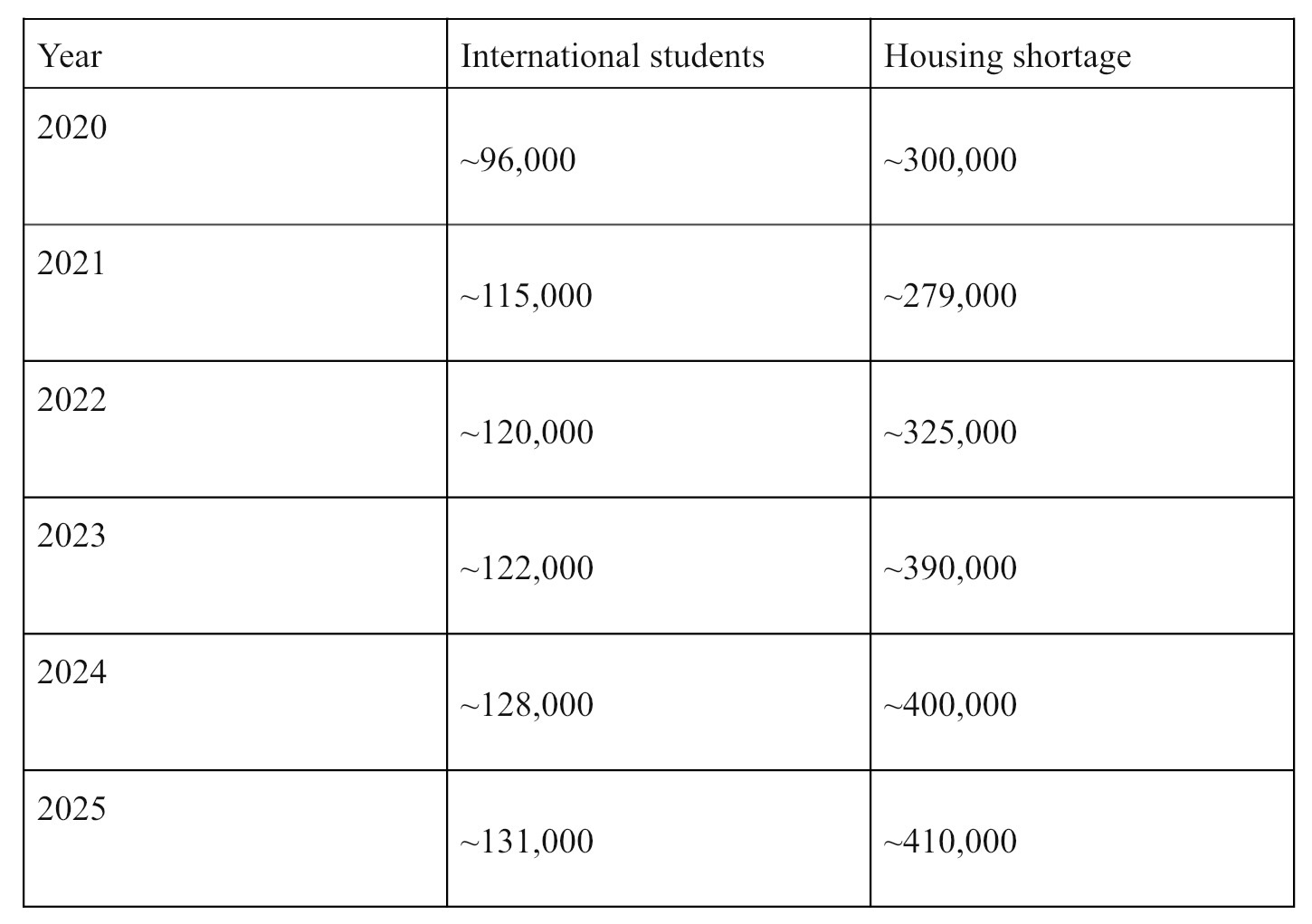
To better understand the scale and timeline of the housing crisis, it is important to compare the growth in international student numbers with the housing shortage over the same period. Data from the Dutch organisation for internationalisation in education (Nuffic) and housing shortage estimates from ABF Research, which are used by the Dutch government, allow for such a comparison.

Table 1: Growth in international student numbers and housing shortage in the Netherlands (2020–2025). Sources: Nuffic; ABF Research (housing shortage estimates used by the Dutch government).

The comparison shows that while the number of international students increased gradually over time, the housing shortage grew to a much larger scale and had already reached hundreds of thousands of homes before the most recent increase in international students. This suggests that the housing crisis is not a sudden result of international student growth, but a structural problem that has been developing for years.

Assuming that every single international student occupies one room or house, which is already an overestimation, since many share housing, the scale of the housing shortage does not match the demand created by internationals alone. Even in the hypothetical scenario, in which all international students would leave the country tomorrow, the Netherlands would still face a housing shortage of nearly 300,000 homes.

Thus, although international students have an impact on the housing market, specifically in university cities such as Eindhoven, Rotterdam and Amsterdam, the scale of the national housing shortage shows that the crisis is much larger than student inflows alone.


Society Grows Because People Move

The debate about international students also raises a deeper question about the identity of Dutch cities themselves. Take Amsterdam. Long before it became one of Europe’s most desirable places to live, it was a small fishing settlement that grew into a global trading hub largely because of migration. Merchants, craftsmen, scholars, and refugees from across Europe helped transform the city into a centre of commerce, science, and culture during the Dutch Golden Age. In many ways, the openness to newcomers is precisely what made the city successful.

Today, international students play a similar role in modern knowledge economies. Universities such as Delft University of Technology attract students from all over the world, bringing not only additional demand for housing, but also knowledge, research, innovation, and economic activity. However, not all international students remain in the Netherlands after graduation. According to research by Nuffic, around 57% of international graduates are still in the Netherlands one year after graduation, but this number drops over time, with approximately 25–30% still living in the country five years later. Those who do stay often work in sectors facing labour shortages, particularly in engineering, technology, and research. This means that while international students do increase short-term housing demand, only a minority remain in the Netherlands long-term, meaning they cannot explain the scale of a national housing shortage of over 400,000 homes.

The question therefore becomes larger than the issue of housing shortages. It becomes a question about what kind of country the Netherlands wants to be: a country that remains open, international, and knowledge-driven, or one that turns inward because infrastructure failed to keep up with growth. International students are therefore not only tenants in the housing market, but also contributors to the economy and the knowledge institutions that make Dutch cities competitive on a global scale.

More broadly, restricting mobility would challenge one of the defining features of the modern world: the movement of people and ideas. Globalisation has allowed students to access education abroad, researchers to collaborate internationally, and cities to become the center of innovation and knowledge. However, the political debate in the Netherlands is not necessarily about stopping international education entirely, but about finding a balance — maintaining Dutch as the main language of education while still attracting international talent in sectors where it is needed.

The challenge, therefore, is not whether international students should come at all, but how a country can remain internationally competitive while also managing pressure on housing and public infrastructure.

Suggesting that students should simply remain in their home countries implies a retreat from the openness that has historically driven economic and scientific progress.

Movement has always been a vital part of development. The challenge for policymakers is therefore not to stop people from moving, but to ensure that infrastructure — including housing — keeps pace with an increasingly mobile world.

As Kalina points out, the situation is more complex than simply blaming one group. She notes that international students and workers do increase housing demand, but also that more young people are moving out and living independently, which further increases pressure on the housing market.

Conclusion

Migration in the Netherlands increases housing demand, particularly in university cities. Yet focusing on international students alone risks overlooking the structural nature of the Dutch housing shortage. The Netherlands has struggled to build enough homes for years, meaning that even small increases in demand can push an already strained market to its limits. In this sense, migrants may intensify the symptoms of the crisis, but they are not its root cause.

Blaming international students for the housing crisis therefore risks oversimplifying a far more complex structural problem. The Netherlands is not facing a housing crisis because too many people came; it is facing a housing crisis because not enough homes were built.

Written by

Shape the conversation

Do you have anything to add to this story? Any ideas for interviews or angles we should explore? Let us know if you’d like to write a follow-up, a counterpoint, or share a similar story.