
Tell EU stories, develop your journalism skills, and make your voice heard!

What is ASML?

ASML is a Dutch semiconductor company that manufactures photolithography machines used to produce microchips. The company is recognized as the sole supplier of extreme ultraviolet (EUV) lithography systems, which are crucial for printing high-precision patterns on silicon wafers. Founded in 1984, ASML experienced rapid growth starting in 2019 and is now the largest technology company in Europe. As of March 2026, its market capitalization is estimated to exceed $500 billion. To put into perspective, that is more than the combined market value of Coca-Cola and Disney

This article focuses on explaining the science behind the EUV lithography technology in an understandable and accessible way. At the end, you’ll find definitions of some of the scientific terms used throughout the article.


ASML’s logo
Credit Image: Reuters


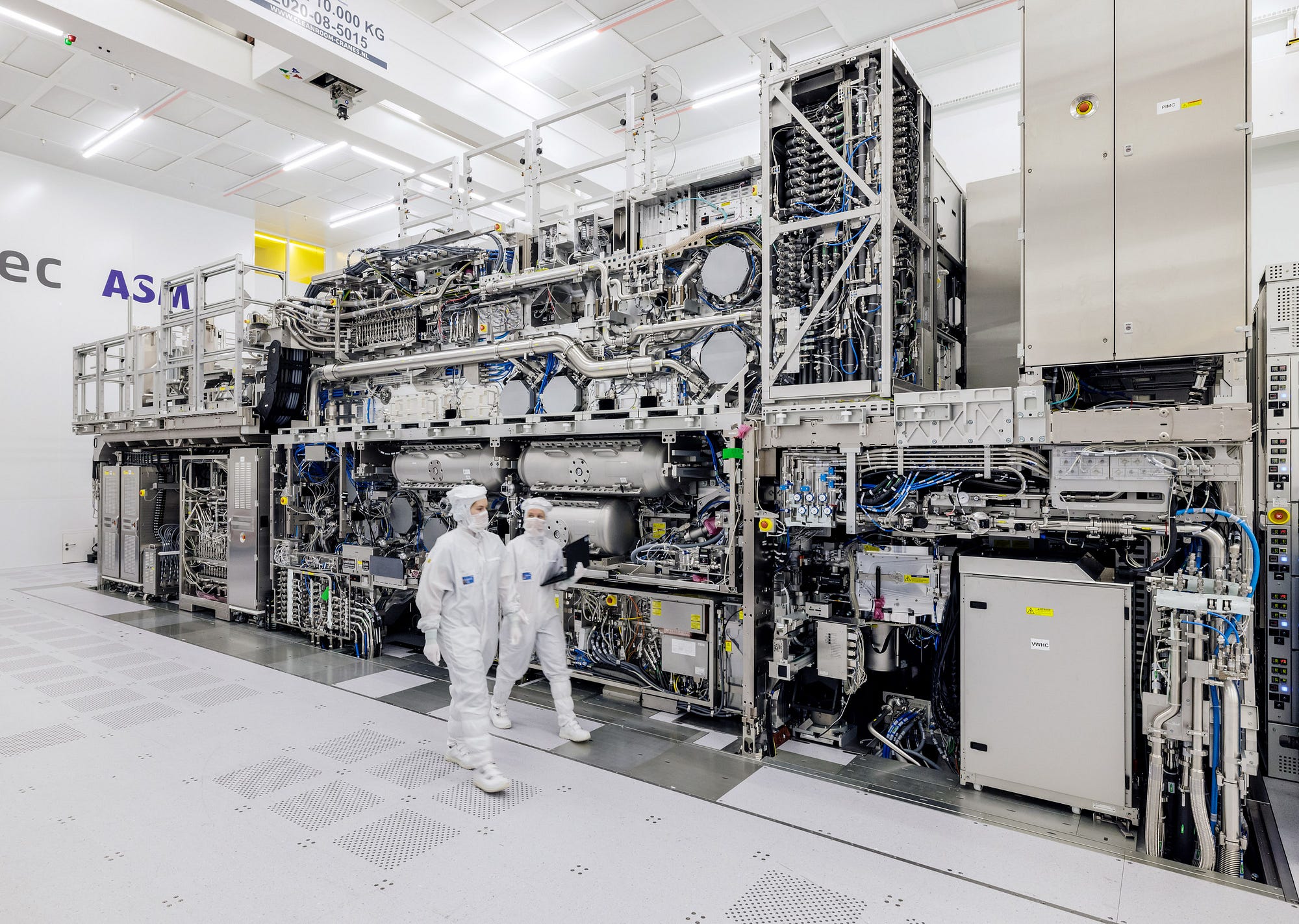
ASML’s massive lithography machine
Credit Image: MIT Technology Review

From 436 to 193 nanometers 

In pursuit of Moore’s Law, an empirical law of economics that predicts that the number of transistors on a microchip will exponentially increase, ASML began developing technologies to generate shorter wavelengths of light, as shorter wavelengths allow for more precise and dense patterns to be printed on microchips in the lithography process. 

ASML’s first lithography system used a mercury vapor lamp. When electricity passes through the mercury, light of different colors, and therefore wavelengths is produced. At first, they used blue light with a wavelength of 436 nm, which could make chip patterns about 1000 nm in size. Later, ASML started using ultraviolet light of 365 nm, which allowed them to decrease the features’ size to 220 nm.

For the next innovation in lithography technology, ASML implemented the deep ultraviolet (DUV) excimer lasers, which are pulsed gas lasers that produce high energy UV light through the reaction of a rare gas (krypton or argon) and a halogen (chlorine or fluoride). For the first DUV systems, the mixture of krypton and fluoride was used to produce light with a 248 nm wavelength. An even shorter wavelength of 193 nm, which was achieved using argon-fluoride (ArF) excimer lasers, made it possible for DUV machines to print smaller 38 nm features. 

ASML’s Generation of EUV light 

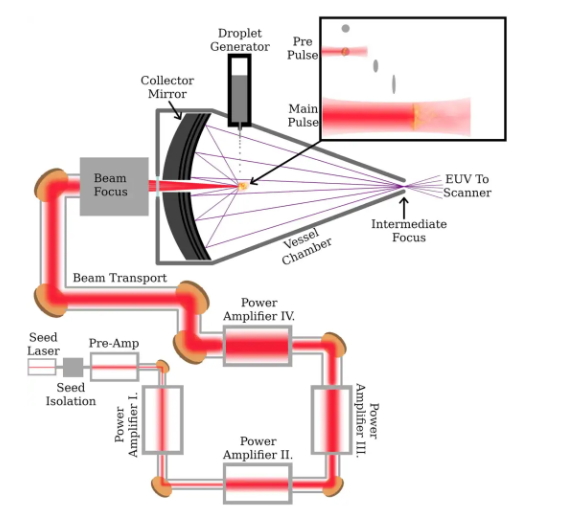
Continuing Moore’s Law, the next big step for ASML was to produce an even shorter light called EUV light (10 to 124 nm wavelength). Since EUV light only occurs naturally in space, ASML created a unique approach to generate EUV light in a lab. The process begins with a CO2 laser that is amplified to gain more power. Then, the laser pulse enters a vessel where a generator ejects microscopic droplets of molten tin at a high speed. First, a laser pulse flattens the droplet, and a stronger second pulse turns it into plasma, which produces EUV light of 13.5 nm. This technology significantly shortened the DUV light and enabled ASML to produce more complex microchip patterns with a size of 8 nm.

EUV light generation process
Credit Image: Premier Science


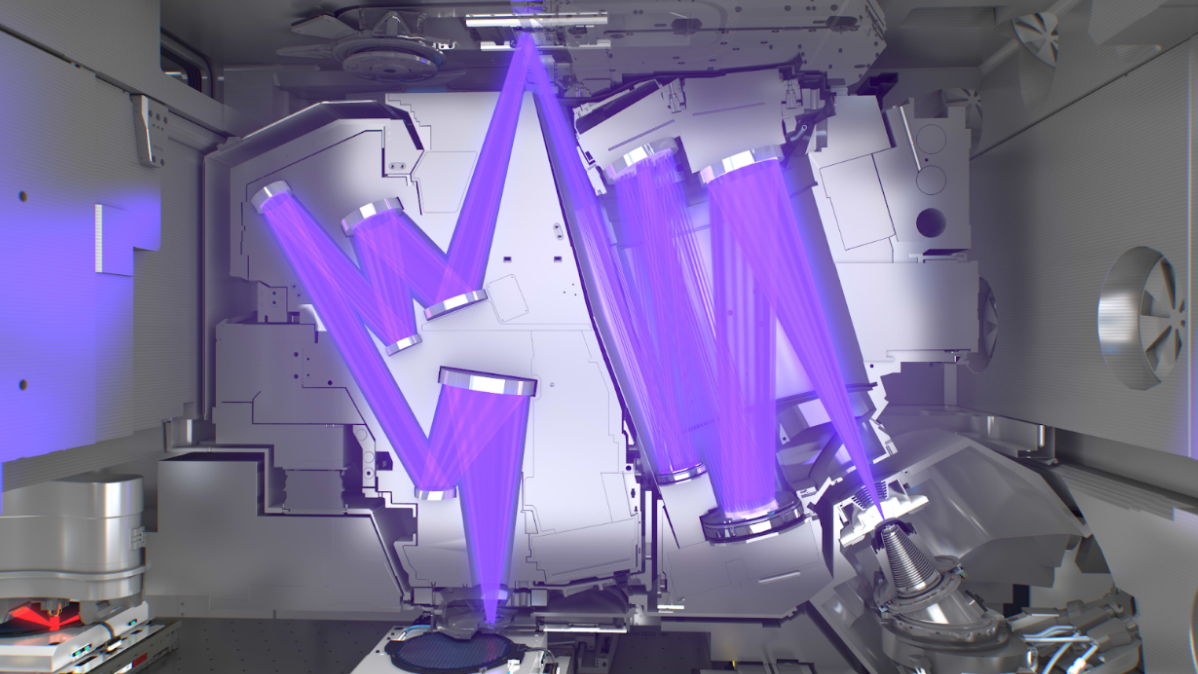
Inside ASML’s EUV lithography machine
Credit: Branch Education

How an EUV photolithography machine works

Once the EUV light is generated, a collector mirror focuses the light into the illuminator. There, the light is reflected by multiple mirrors made of over 100 microscopic layers and with surface smoothness on an atomic scale. Since EUV is absorbed by almost all matter, including air and glass, the transmission of the beam is conducted through mirrors, which are provided by Zeiss, instead of lenses. Moreover, there are vacuum pumps inside the beam transport system which remove all the air. The function of the mirrors in the illuminators is to focus and shape the beam in a complex illumination pattern before it hits a photomask. The photomask, or the reticle, contains the design of a layer of a microchip. The EUV light is then reflected from the photomask to the projection optics box, where a set of mirrors shrinks the photomask pattern four times. Finally, the patterned EUV light is projected onto a silicon wafer coated with photoresist. When the EUV light hits the photoresist, the high-energy photons trigger a chemical reaction that breaks apart the polymer chains. As a result, the areas affected by the EUV light pattern become soluble and are later washed away, transferring the design pattern onto the wafer. 

An EUV lithography machine prints the same microchip design 100 times on the wafer in just 18 seconds. To put the scale of this complex machine into perspective, it costs around $380 million and weighs about 150 tons, which is equivalent to two Airbus A320 aircraft.

Opportunities for students 

As one of the world’s most advanced high-tech companies, ASML actively supports the next generation of engineers by offering a wide range of opportunities for students. At its global headquarters in Veldhoven, many students from the local Eindhoven University of Technology (TU/e) get the chance to experience working in the industry through ASML’s internship and graduation project program.

To better understand what it’s like to work at ASML, I spoke with TU/e alumnus Alexander Ivanov, 22, who recently completed a 6-month internship at the company. He worked on software migration tasks in the DUV Methodology Stage Positioning and Grid Calibration department. About the working environment, he said, “even though an intern, I really felt as part of the team. I was fully integrated and part of all stand-ups, team meetings, and planning sessions”. He added that the environment was very welcoming and collaborative as he highlighted that, “ whenever I had difficulties, colleagues were willing to help me out”. With the other two interns in the department, they had regular meetings to update each other on their work, thus creating a space to learn from one another. He concluded, “my experience in ASML was great and a strong start to my professional career”. 

University partnerships

ASML has offices in 16 countries worldwide and is constantly working to expand and attract the best engineers. Over the past five years, there has been a 70% growth of employment. A key part of how the company continues to evolve is its partnership with over 180 research universities around the world. Through these partnerships, ASML helps create programs, courses, and curricula that teach the next generation of engineers about the semiconductor industry. In 2024, ASML and TU/e expanded their collaboration for ten more years, as ASML will invest a total of €80 million to fund a joint semiconductor research and to train a hundred PhD candidates. Although the company hasn’t published statistics on how many internship graduates later join ASML full-time, the company describes internships as “the final step to employment”.

Terminology:

lithography – the process of printing patterns on microstructures 

transistor – a semiconductor device used to switch on and off or amplify electrical current. Microchips contain billion transistors. 

wafers – thin and circular slices of semiconductor, typically made of crystalline silicon

plasma – a state of matter which results from hot ionized gas and consists of electrons and ions

pulsed lasers – lasers which produce light in the form of optical pulses, such as light flashes, and not as a continuous wave

photoresist – light-sensitive material which forms patterns on a surface when exposed to light 


Written by

Shape the conversation

Do you have anything to add to this story? Any ideas for interviews or angles we should explore? Let us know if you’d like to write a follow-up, a counterpoint, or share a similar story.