Western art history, extensive as it is, does not hide its demons. It portrays them, masterpieces depicting women in their moments of despair, statues of terror and violation. Those paintings and sculptures are wildly cherished as representations of technical and artistic brilliance, and the spectators fall prey to that idea. The composition of the humiliation, the choreography of the sexual pursuit, the drama of the abduction, instead the gruesome narrative. 

The paradox of this raises a question, we as the viewers, would prefer not to speak out loud. Why has female suffering been transformed into something to be admired? 

From mythological depictions and biblical imagery, artists repeatedly have painted women’s vulnerability into a spectacle, a show of true artistry. Western canon has been sculpted by the cultural traditions, the myths and the legends, the patronage of what modern media calls the male gaze. Investigating those ideas allows for the understanding of the brutal pattern. 

Divine Permission 

The inspiration for many of those violent famous works stems from classical mythology. Metamorphoses by Ovid, The Iliad & The Odyssey by Homer, the Bible itself, are a breeding ground for the romanticization of female suffering, providing artists with the dramas, the tragedies full of pursuit and divinity, needed for the inspiration of such masterpieces. 

Myths such as the abduction of Proserpina, the rape of Europa, the mass kidnapping of Sabine women have become some of the most famous depiction of antiquity in Western Canon.

With those stories belonging to the classical culture, which was all the rage back in the Artistic capital of the West, Rome, those stories were thought of as passion plays rather than as humiliating violations of a woman’s autonomy. They became appropriate themes in high art, and rather opportune ones, allowing artists to explore nudity, pursuit and passionate struggle, while maintaining their prestige among the intellectual society. 

Which would explain why those renderings of sensual violations can be found in churches, palaces invoking awe at the mastery of the artist, rather than moral discomfort against obvious violence. 
The Grandeur of the Female Body 

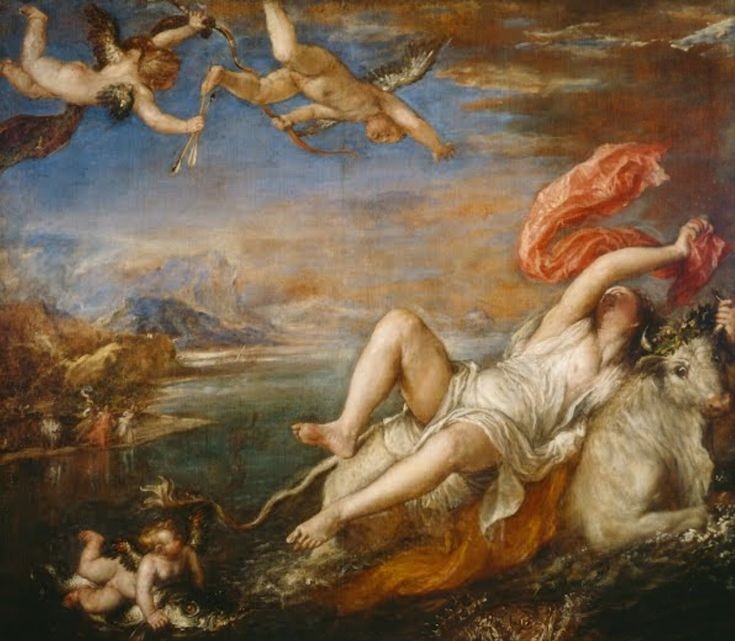
Many of those works place the female body as the central visual attraction. Bernini’s the Rape of Proserpina, sculpting Pluto’s fingers pressing into Proserpina’s thigh, turning marble into flesh. Poussin’s the Abduction of Sabine Women, where women are being kidnapped from the town’s square choreographic havoc and terror. The Rape of Europa, where Titian paints Europa’s twisted and exposed body as she is carried on the back of her abductor, Zeus, masked as a bull. Those pieces are just some examples of female figures, which are often, and more importantly famously depicted at least partially nude in moments of danger, while their assailant or male counterpart are fully clothed and more often than not armed. 

This pattern brings out more wide-spread practice, the male gaze, where women’s role is primarily for the purpose of the viewers’ visual enjoyment, exposed, restrained, the crown jewel of the composition.

The narrative then begins to get lost: even if it denounces the violence depicted, what the artwork visually portrays may still emphasize through exposure of the skin and physical or emotional vulnerability. leaving the viewer at crossroads, whether to condemn the eroticization of violence, or admire the beauty of it. 

Patronage 

The concept of the fetishized female anguish in the Western art canon does not appear simply because of myths,long forgotten that the pieces depict. The theme is tied to the moral structure of artistic patronage. Historically the majority of artists, and their patrons have been male, such as aristocrats and church officials, who controlled the circulation and the commission of such technical and time consuming works. Women, by contrast,  wouldn’t have had the resources or the ability to support and patron artistic endeavours, as in the early Renaissance, when this idea had famously taken root, they were a canvas away from their painted depictions. 

Within this context, mythological paintings depicting fetishized abuse and violation, became the crown jewels of many private male collections. They allowed male collectors to display such pieces, depicting female figures under the idealized excuse of cultural appreciation. Now, what would be considered a taboo amongst the elite society turns to be a mere intellectual respect for antiquity. 

Appreciation for classical culture became justification for the displayment of borderline scandalous elements. Artistic mastery, and mythology became the society’s alibi for voyeurism. Coercion became a splendid love story, violence — beauty.

Female Perspective 

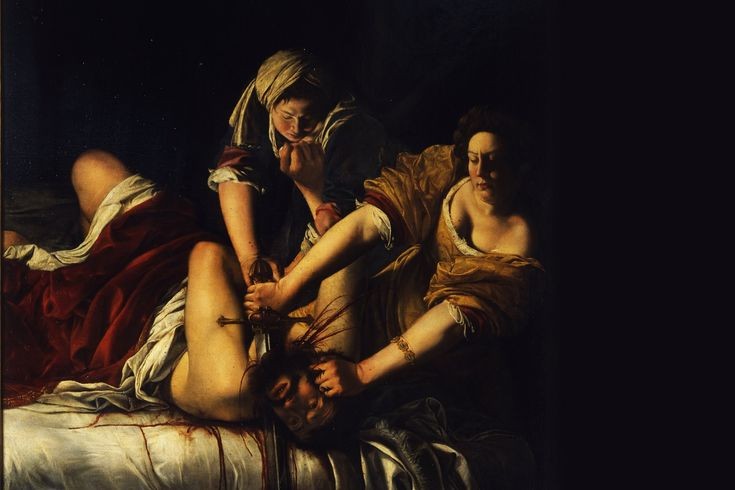
An anomaly during her time, a female painter, Artemisia Gentileschi, challenged the patriarchal traditions, dominating her field. While violence remains  a frequent theme in her works, she did not aestheticize it, as many of her male counterparts did. In her works, women are shown not just as humiliated or compliant victims, but rather as heroines who withstand, resist and act with purpose.

Judith Slaying Holofernes portrays the biblical myth about a woman protecting her people by killing the Assyrian general. She is not scared or delicate, no, all that’s shown on her face is determination to see the assination through. Judith and her maid hold Holofernes down, as Judith presses forward, slitting his throat. It is gruesome, brutal, undoubtedly artful, but not beautiful. The violence is not about the glory of the pursuit or the predator. It’s not a spectacle, it’s a necessity.

This presents a duality between men and women, portraying the same narrative through a different pair of eyes. Where many male artists distance women from violence not born of passion, painting them passive victims of it, keeping them delicate females, that would be aesthetically pleasing to the elite audiences. Gentileschi collapses the illusion, she does not allow the viewer to bask in the beauty of her female figures, leaving them with no choice but to confront the brutal reality of her work. 

Despite her keeping the themes of violence and vulnerability, their meaning, their portrayal is viewed through a different lens. The one of a woman. Violence is not to be admired, but something needed to be confronted. 

The Canon 

The looming themes of violence, recurring in those pieces, does not diminish their artistic achievement. Artists such as Gian Lorenzo Bernini and Titian shall remain extraordinary examples of technical and visual innovation. 

Nevertheless, behind the virtuoso brushstrokes and composition, the canvas portrays the unsettling fruits of Western intellectualism. Sensual violence veiled underneath classical culture. That authority has historically camouflaged the troublesome narratives shown, painting them exquisite.

Nowadays, scholars and critics have begun to raise the veil, interrogating our artistic legacy. They meet the ancient myths and their representations headfirst, urging the audience to grasp the history of the art, the values and the ideas it represents, while admiring the beauty of the masterpieces. To gaze upon those masterpieces, is to recognise the historical influences of power and perspective over what has been celebrated as timeless elegance.

Conclusion

The aestheticization of women’s suffering in the Western art canon confesses possibly uncomfortable truths about patriarchal structures and artistic traditions. Female vulnerability becomes a recurring theme. A theme born of the influence of male perspectives and patronages, one considering faith and myths as a permission to be something adored. 

Acknowledging the harsh undertones of those works does not diminish the mastery of them, but rather makes us confront the morbid fascination causing us to admire them, and the traditions that birthed them. 

Gazing upon those images, paired with artistic appreciation, modern viewers can ask History about the traditional ideas, the pieces reflect. And decide her answer themselves. 

Most upsettingly, beauty as we have begun to perceive it, has become inseparable from violence.

Shape the conversation

Do you have anything to add to this story? Any ideas for interviews or angles we should explore? Let us know if you’d like to write a follow-up, a counterpoint, or share a similar story.