



Public opposition intensifies over Noma Island amid political questions and environmental concerns
Public concern surrounding the “Noma Island” floating entertainment platform is continuing to grow, as local authorities, environmental organisations and members of the public raise alarm over its potential impact, regulatory uncertainty and alleged political connections.
The St Paul’s Bay Local Council has taken a precautionary approach, warning that key operational and legal details remain unclear. Following a meeting held on 12 March, the council stated it had formally requested clarification from Transport Malta, the Malta Tourism Authority (MTA), and the Environment and Resources Authority (ERA) regarding permits, environmental safeguards and logistical implications.
However, no official response had been received by the council at the time of its statement. The council stressed that current information is based largely on media reports and promotional material, which “cannot be considered official or verified.”
Licence confirmed, but uncertainty persists
The vessel reportedly has a Commercial Vessel Operator Licence and is planned to operate as a stationary venue at anchor, with guests brought in by smaller boats. However, it is still unclear whether it has all the necessary permits. Transport Malta has confirmed that the vessel has a provisional certificate of registry and meets standard licensing requirements.
Nonetheless, authorities have yet to clarify key aspects of its operation, leaving questions around enforcement, oversight and environmental impact unanswered.
Mayors issue strong warnings
Local mayors have been among the most vocal critics of the project, warning that it could place unsustainable pressure on already crowded coastal areas.
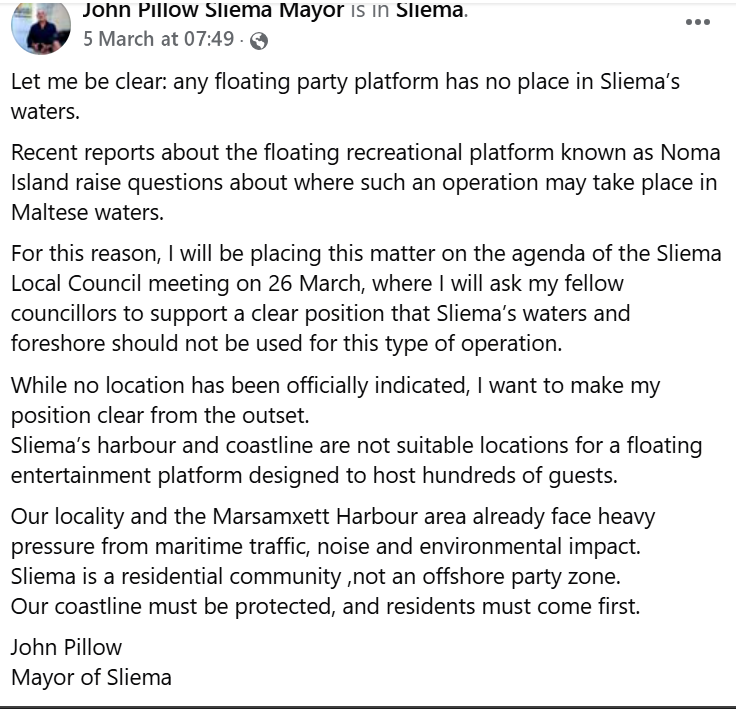
Sliema mayor John Pillow stated: “Let me be clear: any floating party platform has no place in Sliema’s waters. Sliema’s harbour and coastline are not suitable locations for a floating entertainment platform designed to host hundreds of guests.”
Mellieħa mayor Gabriel Micallef also expressed concern, highlighting the strain already placed on his locality during peak season. “Introducing a large entertainment structure in an environment that is already so busy raises serious concerns regarding safety, noise, environmental impact and enforcement,” he said.
He added that the area’s proximity to ecologically sensitive sites, including the Għadira Nature Reserve and Foresta 2000, makes the proposal particularly problematic. “The interests of residents, safety and the environment must always come first,” Micallef stressed.
Other localities have echoed similar opposition, with Għajnsielem mayor Kevin Cauchi describing the platform as “a very unwelcome addition” to waters already struggling with noise and waste issues.
NGOs warn of serious environmental impact
A coalition of nine environmental and heritage organisations has strongly condemned the project, particularly amid reports that the vessel may be stationed near Comino, a Natura 2000 protected site.
The NGOs warned that the platform could result in noise and light pollution, littering, sewage contamination, air pollution and seabed damage. They also cautioned that the presence of such a structure could disrupt marine ecosystems, including sea turtle nesting and the movement of seabirds and marine mammals.
They urged authorities to prioritise environmental protection and warned against further commercialisation of Malta’s already strained marine environment.
Petition reflects growing public concern
Public opposition has also taken the form of a parliamentary petition, which has gathered more than 1,200 signatures.
The petition calls for:
- The immediate suspension of all operations pending full legal and environmental compliance
- Full disclosure of permits, licences and the identities of operators and beneficiaries
- Independent environmental and noise impact assessments
- A transparent public consultation process
- Safeguarding Malta’s marine environment as a shared public good
Campaigners argue that allowing the project to proceed without full scrutiny risks setting a precedent that could undermine the protection of Malta’s territorial waters.
Zammit Tabona link raises political questions
Momentum is a small centrist political party in Malta that focuses on governance reform, transparency, and environmental protection. Its leader, Arnold Cassola, has raised concerns about the political and financial background of the project.
Additional controversy has arisen , claims by Cassola, who alleged that the project may be linked to the Zammit Tabona family through 356 Entertainment, the company promoting the platform. He stated that the promotional website for Noma Island is owned by Live Nation, which is connected to 356 Entertainment, where members of the Zammit Tabona family reportedly hold shares. Malta’s business registry confirms that family members are involved in companies tied to the project.
Cassola also highlighted that the Zammit Tabona family are known donors to the Labour Party and have had links to senior figures within it. According to him, individuals connected to the family have previously provided employment to high-profile figures, including former prime minister Joseph Muscat, former Labour Party CEO Clayton Bartolo, and Amanda Muscat.
These alleged connections have raised broader concerns about possible political lobbying and conflicts of interest. Critics argue that the family’s history of political donations and links to senior officials warrant closer scrutiny, particularly in a project that appears to have progressed without clear public oversight. Claims that individuals connected to the family have employed prominent political figures have further fuelled perceptions of overlap between business interests and political networks.
While no formal evidence of wrongdoing has been established, critics say that the lack of transparency around permits, ownership structures, and decision-making risks undermining public trust. It also reinforces ongoing concerns in Malta about governance, accountability, and how large-scale commercial projects involving public resources are approved.
Another case frequently cited by critics is the Fortina agreement, a long-standing and controversial concession involving prime public land in Sliema. Opponents argue that the land was granted on terms significantly below market value, raising concerns about how public assets are managed.
Arnold Cassola has pointed to this case as part of a wider pattern, arguing that such decisions should not be attributed solely to individual officials but must also involve political responsibility at the highest levels. He has suggested that if political donations coincided with favourable treatment in agreements involving public land, it could indicate a broader system of clientelism and undue influence.
While no wrongdoing has been formally established, the case continues to be referenced in debates about transparency, lobbying, and the integrity of decision-making processes in Malta.
Enforcement concerns highlighted
Momentum has also raised broader concerns about the enforcement of maritime regulations, arguing that existing rules are already inadequately applied during the summer months.
Referring to frequent disturbances caused by party boats, Cassola warned that regulations are ineffective without proper enforcement. The party has insisted that no new licences for floating entertainment venues should be issued unless authorities can demonstrate the ability to enforce current laws.
A project under mounting scrutiny
As scrutiny intensifies, the Noma Island controversy is no longer just about a floating entertainment platform—it has become a test case for governance, transparency and accountability in Malta. With unanswered questions surrounding permits, environmental impact and political connections, public trust now hinges on whether authorities act decisively and openly. For many, the issue cuts deeper than one project: it raises a fundamental question of whether Malta’s seas are being managed in the public interest—or quietly opened up to private ventures shaped by influence, access and power.