
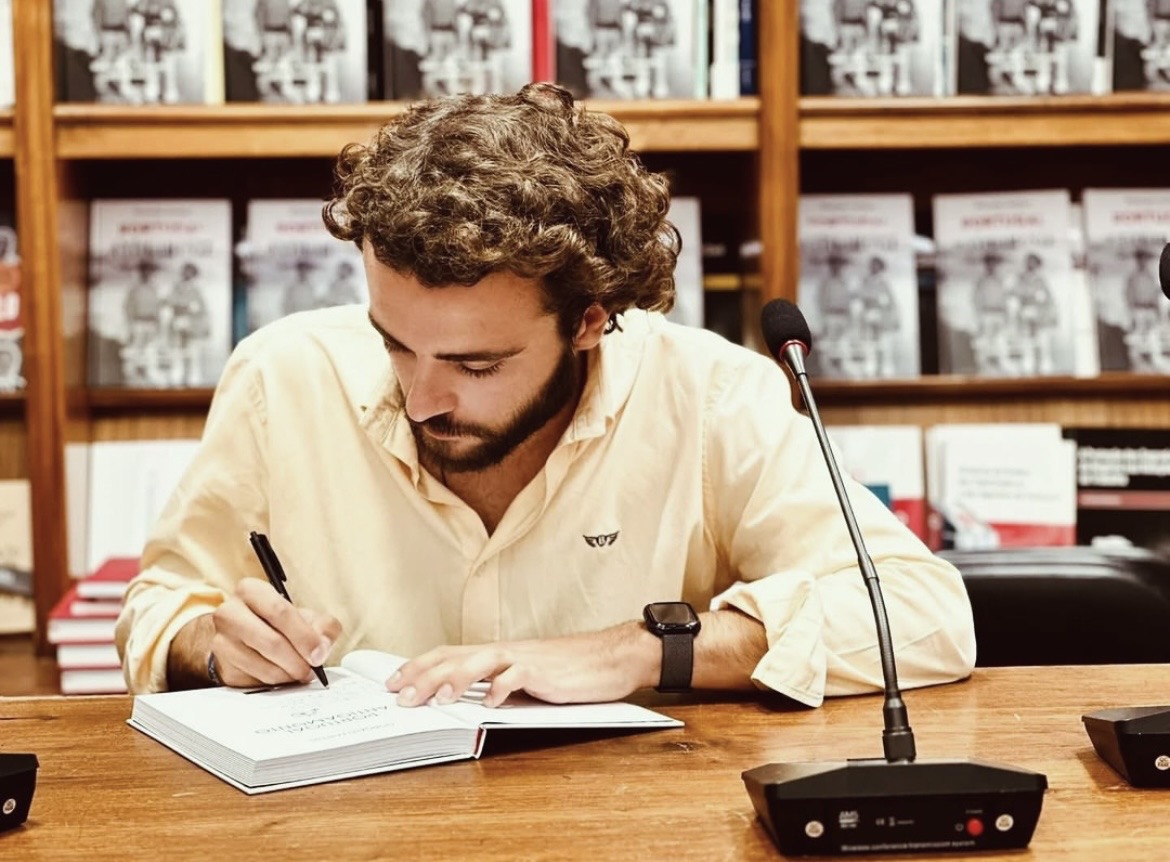
Gonçalo Farlens signs his book Portugal Antigamente

Farlens is an author and historian by passion and profession. Source: Instagram.


Born in 2002 and trained as a historian, Gonçalo Farlens spends much of his time in a Portugal he never lived through. He is the mastermind behind “Portugal Antigamente” (Portugal in the Past, in English), a social media project that grew during the Covid‑19 pandemic into one of the country’s most influential digital history platforms, amassing millions of views. In his work, Farlens often reflects on how history sharpens our political judgement and why the way we deal with controversial narratives is important.

Why does history matter, especially for young people?

The obvious answer is that history helps us avoid repeating past mistakes, but for me it’s also about critical thinking. Someone who understands history will usually understand politics better than someone who only studies politics, because almost everything we see now has happened in some form before. The names change, the technologies change, but the behaviours and patterns are often similar.​

For young people, history is the field that invites questions: the why, how, when, where. You walk down a street, look at a building and wonder what it looked like 50 years ago, what events took place there, how the city has changed. That curiosity then spills over into other areas, from philosophy to languages, and it gives you a deeper perspective on whatever is happening around you.


How did your social media presence begin?

It started during the pandemic. I had always liked looking at old photos and videos, but it was a private taste and I didn’t talk about it with my family.​ I was in several Facebook groups where people shared historical images, and I thought: maybe I’ll create a page and post things I find interesting; there must be people like me out there. I launched “Portugal Antigamente” (Portugal in the past, in English) spontaneously and began sharing photos, without any big intellectual plan. At first there was no proper source work, I didn’t even indicate which archive a picture came from.​

Over time the page grew, but the turning point came on 25 April’s celebration (Portugal’s Freedom Day) in 2024, when it went from around 8,000 followers to nearly 100,000 in a month. That was when I realised this was no longer a hobby and that it had become one of the most visible history pages in the country, which carried real public responsibility.


What does public responsibility mean in practice here?

We are dealing with a country’s history, which is politically divisive, so every image and caption can be read through different lenses. I began receiving messages from across the political spectrum, and I understood that what I posted could influence how people see the past.​

As a historian, I don’t believe in total impartiality. We are shaped by our experiences, our readings, our context, and that inevitably affects interpretation. But we can still aim for rigour. Instead of relying on a single authoritative book, I try to read different historians; for example, on the Estado Novo period I will put interpretations from the right and the left side by side and then build my own synthesis.​ For me, the key skill is historiographical critique: knowing how to analyse sources and convey not just what others wrote, but what you have understood and tested against other work. My platform reflects my perspective, but it is grounded in a critical process rather than in nostalgia or party lines.
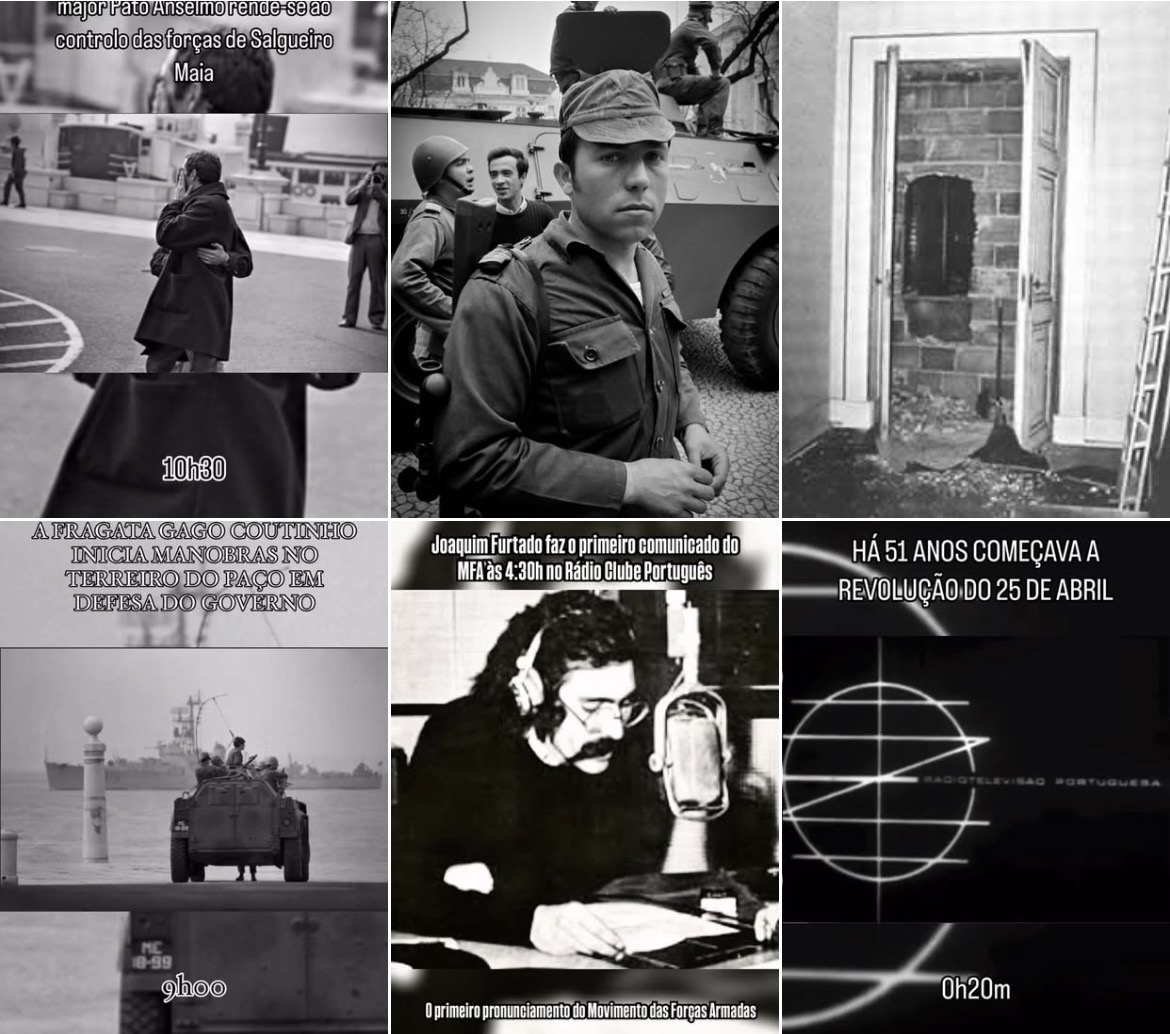
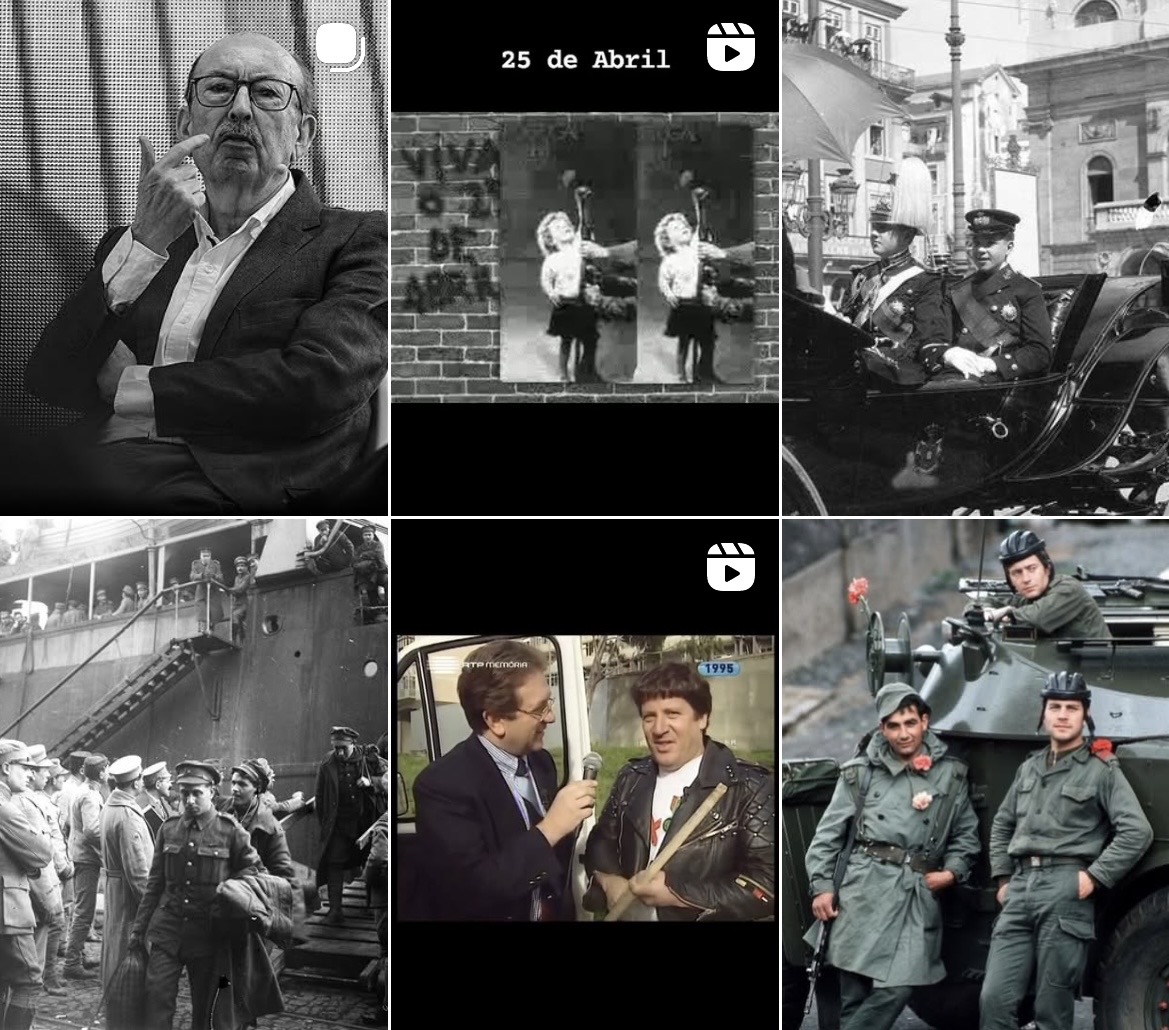
«Portugal Antigamente» has become a phenomenon on social media, where Farlens shares excerpts from his country’s history. Source: Instagram.

What are you trying to convey through this project?

I often say there are several versions of Portugal in the book and on the Instagram page: the constitutional monarchy, the First Republic, the Estado Novo, then democracy. In that sense, you see different worlds. At the same time, I try to present one Portugal in terms of method: a country seen through an effort to balance sources, avoid easy ideological shortcuts and be as fair as possible to the complexity of each period.​

My work doesn’t aim to reopen big historiographical debates. It’s more of a bridge between what is produced at universities and what reaches the general public. Academic work in Portugal is often written in very dense language that is inaccessible to most readers, even to many students. My project tries to take that knowledge and translate it into images and captions that invite people in instead of pushing them away.


Do you sense genuine curiosity in your audience, especially among students?

Yes. I’m teaching history now, and I remember what it felt like to sit in classes where the subject was interesting but the teaching was not. Often it’s not history that is “bad”; it’s the way it is transmitted. I try to be the opposite of the teachers my students complain about.​ Many of them follow my work on social media.

What matters to me is that the project works as a starting point. Someone sees a photograph, checks the source, and then goes off to find more. One reader, for instance, saw a photo of Manuel Buíça, one of the men involved in the assassination of King Carlos I and Prince Luís Filipe, and then tracked down images of his children and started reading about the Carbonari and Freemasonry in Portugal and in Europe. That is exactly the chain reaction I hope to trigger.​


You’ve said history is mistreated. What do you mean?

I think it is mistreated in two senses. First, it is not discussed enough in mainstream spaces in Portugal, namely on television, online, in public debate. That leaves a vacuum where almost any statement about the past can circulate unchallenged and be taken as truth.​

Second, when history does surface, especially on topics like the colonial war or slavery, we often judge events from 500 years ago with today’s eyes only. That doesn’t mean we should excuse injustice, but it does mean we need to understand the political and social context of each period before deciding what to do with statues, names or symbols. Without that critical step, debates become more about present anger than about learning from the past.​

The most iconic and frequently shared images of Portugal’s Carnation Revolution depict soldiers with red carnations placed in the barrels of rifles and on their uniforms. Source: Instagram.

You were born in 2002. Does that short distance from historical events make your work easier or harder?

In some ways it helps. I didn’t live through the dictatorship, the Carnation Revolution or the colonial war, so I can’t simply say “it was like this because I was there”. Instead, I have to talk to people who lived those moments (my grandparents, for instance, who have very different views of 25 April) and then go back to the sources. That forces me to consider multiple perspectives before forming an opinion.​

I’m aware that events happening now, while I’m alive, will be harder to treat with the same distance. We all tend to absolutise our own experiences. But because I have already trained myself to look backwards critically, I hope I can apply the same discipline to the present and future when I eventually work on them as history.​


Is there one photograph or moment that truly captures Portugal in the past?

A few have stayed with me. One is a 1993 image of António Costa (former PM of Portugal and current President of the European Council), then a young socialist politician running for mayor of Loures, racing between a donkey and a Ferrari to argue for a metro extension to Odivelas. It’s visually striking and says a lot about how recent some of our infrastructure and political debates are.

​Another is Salazar at his desk during the Second World War with a portrait of Mussolini behind him. I’m fascinated by diplomacy in that period, and that photograph raises questions about neutrality, alliances and self‑image that are relevant for understanding how small states position themselves in Europe.​


Where can we see the “europeanisation” of Portugal in old images?

The most symbolic moment is, of course, 1986 and the images of Mário Soares signing Portugal’s accession to the European Communities at Jerónimos Monastery. You can see in those photos how entering European institutions represented a new idea of what the country wanted to be.​

But visual traces of Europeanisation appear earlier: in photos from the First World War, when Portugal is directly involved in a continental conflict; in scenes of British influence and trade; in post‑war images that show similar consumption patterns emerging across Western Europe. Later, having joined organisations like EFTA and NATO under Salazar, when the rhetoric was very inward‑looking, images of foreign visitors on Portuguese beaches capture that cultural cross‑pollination.​


What legacy do you hope your social media work will leave?

I would like future followers and readers to see a consistent attempt to preserve and value our history, and to bring people closer to it. We live in a world of constant stimuli, where we consume so much information that, in the end, we retain very little.​

My hope is that the project encourages people not just to have a citizen card, but to act as citizens: to know what they want, to know their country’s history (whether they like all of it or not) and to keep asking questions. “Portugal Antigamente” is not meant to give final answers. It is meant to show enough to make people curious, so that they go on to build their own paths as informed Europeans.​

Shape the conversation

Do you have anything to add to this story? Any ideas for interviews or angles we should explore? Let us know if you’d like to write a follow-up, a counterpoint, or share a similar story.