


The Mind Behind the Medal: How Mental Health Influences the Performance of Top Athletes
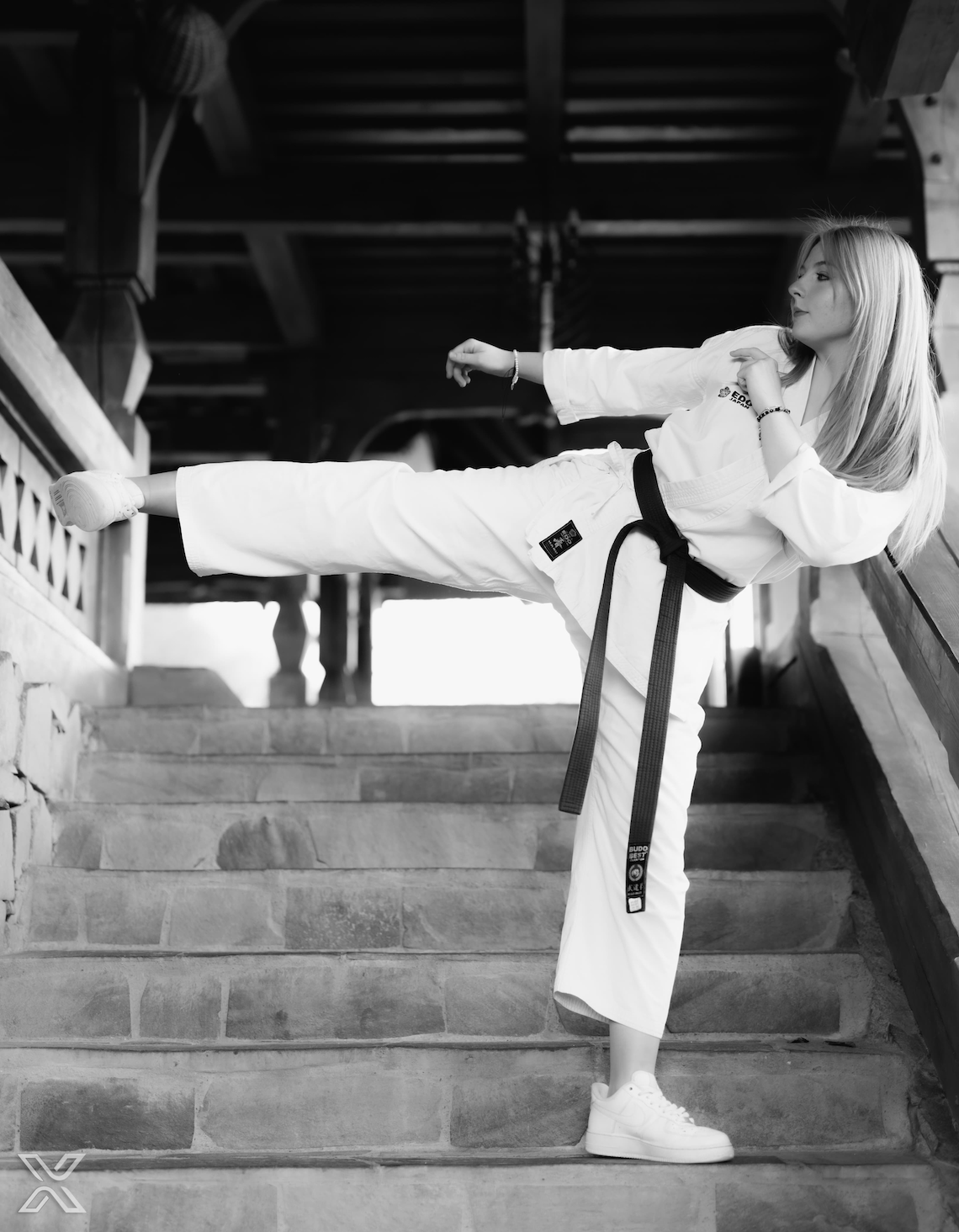
A young woman dressed in martial arts gear (kimono) with a black belt stands on a stone staircase in a traditional wooden building and performs a side kick with her right leg. The image is in black and white, highlighting her concentrated expression and strong posture. Source: author’s archive.
I was talking to a friend of mine the other day about the sport we practice; more precisely, we were discussing the transition I’m making now that I’m in college and can no longer train at my club. The conversation quickly turned to more serious topics and we realized that we’ve both had similar experiences and faced the same difficulties – more psychological than physical.
Maia Pop (the friend I was talking to – a 10-year-old Shotokan Karate practitioner, since the age of 5, at the “Omega” club in Șimleul Silvaniei) told me that her father was her coach from the beginning, and that brought with it a lot of challenges. Unlike her other colleagues at the club, she did not receive special treatment. On the contrary, her father was much more demanding of her. Why? Because, being her father, he allowed himself to be more direct and raise the bar much higher. This dynamic had a strong impact on her mental health. On the one hand, it helped her become stronger, more confident and more resilient. On the other hand, however, it sometimes created doubts and insecurities about her value, both as an athlete and as a person. But, looking back now, she admits that all these experiences contributed to the formation of her character. He learned to manage pressure, face doubts, and continue to grow, even in difficult times – challenges, no matter how tough, can transform us into stronger versions of ourselves.
More and more often we can observe around us that the term “mental health” or “mental health” is associated with many topics of discussion – this term has moved from an area of taboos to an area of understanding and empathy – finally people have started to “open up” and talk freely about the problems they are going through and how they affect their well-being. This phenomenon is also seen in the area of performance sports, where, just a few years ago, a few brave voices decided to assert themselves.
Mental health is extremely important – an essential pillar of overall well-being without which an individual cannot keep up with the fast pace of modern life.
The main difficulties faced by young people are depression and anxiety.
Mental health and performance sports
Although the general tendency is to believe that sport only brings benefits to the body and mind, in recent years, elite athletes have decided to raise their voices and talk about the social and emotional pressure they face when all they see around them are expectations and opinions coming from people who don’t even know 5% of what it means to be part of a group of high-performance athletes. The huge sacrifices that elite athletes have to make to reach the highest level of performance often exceed the public’s perception, shedding light on a lesser-known reality of the life of an athlete.
“We can see that very often we tend to look at athletes as heroes, who do not face difficulties, who do not have problems, and if a difficult situation arises in their lives, they face it very easily. However, the reality is different, and lately more and more successful athletes have admitted that they face difficulties, such as depression, alcohol, etc. (for example Simone Biles, Michael Phelps, Adam Peaty).
Among the personality disorders, the most common among athletes is narcissistic personality disorder. The pressure is very high, and athletes try, in different ways, to find solutions to manage these situations. Some solutions are beneficial, but it can happen that they develop certain superstitions to relieve their anxiety, and the exaggeration of these superstitions can become compulsive. Due to the pressure, athletes experience anxiety, and if this overwhelms them and the athlete does not receive help, their performance will be affected, and failures can even push them towards depression.
It is important to note that not all athletes experience these issues. It is essential to be mindful, to remember that athletes are human too, and to provide them with the necessary support when they need it.”
Emőke Roseti-Karikás – psychologist and Member of the Association for Sports Psychology
I have been a performance practitioner of Shotokan Karate since 2018, since the age of 12, at the “Umbra” club in Baia Sprie; I was lucky to have a wonderful coach around me – Sensei Demyen Geza Csaba – who did not pressure me or impose any kind of aesthetic standard or any expectation of victories or awards; however, I felt pressure to fit into the social standards of being considered a true performance athlete. I asked myself far too often questions like “why am I not good enough?”, “why doesn’t my body look like the girls on social media?”, why can’t I fight like other athletes do?”, “why is it so easy for others and not for me?”, guess what – other athletes were also facing these questions, we all have weak moments when we are vulnerable, we all think too much about our performance, about all the things we have to do to reach that ideal, about what we could have done better. My dream, like that of any other performance practitioner, is to become an “elite athlete” , to have titles after titles, medals after medals, consecutive podium climbs and without stopping – lack of defeats and lack of guilt for not doing enough. But, sometimes, even victory is not enough because a lack of satisfaction and self-criticism about my own performance appears. However, despite all these worries, I keep moving forward. Shotokan Karate is not just a sport for me; it is a way to always learn something new about myself, about my limits and how to overcome them. Every training, every competition, every victory or defeat helps me to develop not only as an athlete, but also as a person.
I realized that all athletes go through such moments and I started asking more people about their experiences. Ștefan Miclăuș (a 9-year-old Shotokan Karate practitioner, since the age of 7, at the “Condor” club in Baia Mare), told me that over time, he learned that in every competition, regardless of the result, there is a much greater internal struggle than the one with his opponents; especially during a championship, when
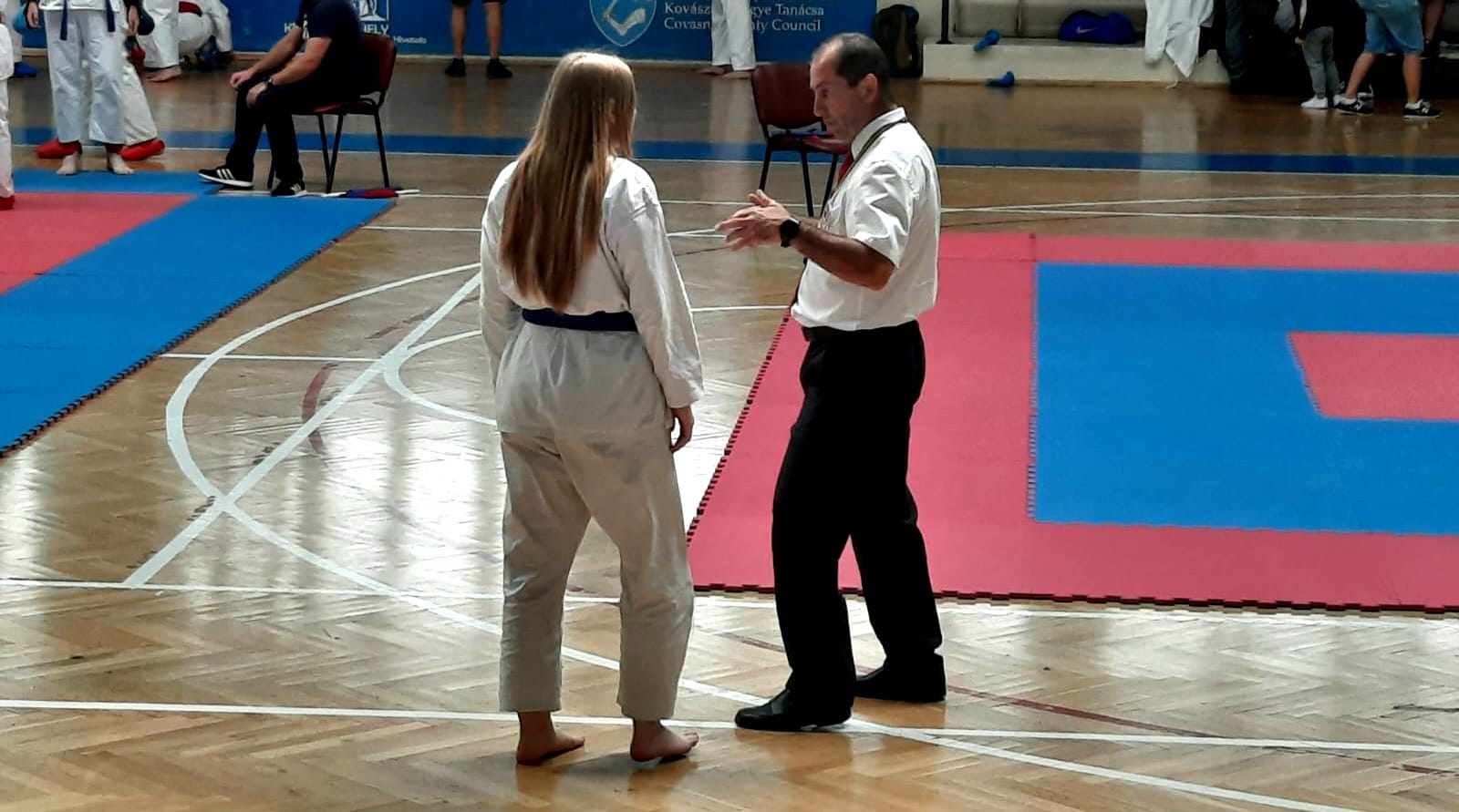
Sensei while giving me instructions before a fighting match at the national competition. (Source – Author’s archive)
When he loses or wins at the hantei (referee decision), the frustration is overwhelming. If he loses, he feels like he hasn’t prepared enough and that his performance on the tatami (fighting area) wasn’t good enough. He also told me that it’s even more frustrating when he knows that he’s trained far more than enough and given his all, but still lost; he often wonders if he’s wasted his time or if he’s trained for nothing, but is this healthy for us? Do those social standards really exist or are we making them up in our heads?
“But it’s never easy, even when I win. Even then, the thought that I can always do better weighs me down. I realize that I could have played better or more beautiful matches. In those moments, I don’t feel like I’ve reached my full potential, even if I’ve won. Many times I’ve thought about quitting, at least from competitions, because it’s an immense mental fatigue. The constant struggle with my expectations, but also with the pressure they put on me to evolve and be better, exhausts me. It’s hard to maintain your motivation when you know that, no matter how much you train, in front of the referees and the audience, sometimes you can’t control everything,” says Ștefan.
Body dysmorphic disorder – obsession or exaggerated concern about a minor or nonexistent physical defect
To fit into the aesthetic “social standards” regarding the sport you practice, you must, first of all, have a suitable physique that will lead the viewer’s mind to the appropriate sport – broad shoulders if you want to represent a good swimmer, a worked body with fibrous legs to be a good runner, lean and worked out in the gym, but not too much to look like a legit karate fighter.
I created and imposed these standards on myself and when I felt like I wasn’t meeting them I would turn on myself and suddenly, the annual visit to the sports medicine (to get my annual competition visa) became a preoccupation of mine that made me look in the mirror, analyze every part of my body, looking for any change or thickening of the fat layer with the thought that the people there would notice and comment on this aspect. My world spun 180 degrees and, for the next two months, I drastically reduced the number of calories I consumed daily, increased the number of calories I burned and the number of hours I spent doing sports, just to be seen as a proper performance athlete. The fact that I lost a kilogram did not mean that I was going to have a better performance in competitions or just in practicing sports, it never did.
Emőke Roseti-Karikás – psychologist and Member of the Association for Sport Psychology spoke to me about the challenges athletes face, emphasizing that although we should not think of extreme cases, they often encounter difficulties in various aspects of their lives. In her experience, a key aspect to work on is self-esteem, which is often low. Athletes lack confidence in their own strengths, and this can influence their performance. It is also important to learn how to manage stress, overcome failures or moments of poor performance, and maintain motivation. Another crucial aspect is effective communication between the athlete and the coach, as well as relationships with teammates. Burnout is a real problem, and the psychologist mentions that many of these challenges are frequently encountered among female athletes, especially in sports such as gymnastics or figure skating, where the pressure related to physical appearance can be high. However, this problem is not only found in girls; In reality, it can also occur among boys, sometimes even more often than we might think.
Thus, the psychologist emphasizes that for both female and male athletes, it is essential to address these aspects to ensure mental health and optimal performance.
Academic life – sports life balance
For athletes, balancing personal life with sports is something mandatory and requires an enormous amount of dedication, perseverance, patience, but especially mental, psychic and emotional strength. We, athletes, are placed under some social aspects that manage to tear down our entire personality if we have a vulnerable moment in our lives – and believe me – we do.
“If a child wants to become a high-performance athlete, they have to follow a very strict (and busy) schedule from a young age, and this schedule “isolates” them from “normal” life. Most of their time is spent in training, with coaches and teammates. This lifestyle can be overwhelming for the personality and personality distortions can occur,” says Emőke Roseti-Karikás – psychologist and Member of the Association for Sports Psychology.
She also says that coaches and parents play a very important role in maintaining emotional balance; parents do not have an easy job and, unfortunately, often, from the great desire to help and give everything for their child’s chance to progress and perform at their best, it turns into pressure. She also adds that the main role of parents should be one of support, acceptance and unconditional love, and the coach, knowing the athlete best, can communicate effectively and motivate him/her appropriately, offering support when he/she needs it.
A big challenge I faced was balancing my academic and personal life with my sports life. People have all kinds of expectations from you – your coach wants to push you to your limits and bring out the best in you, your teachers see your potential and convince you to take part in all kinds of extracurricular activities, when for you it is more than enough to be a normal high school student. Your parents… well, they want your best, they are the ones who are closest to you and understand you the best – for me, at least, that was the case – and this created a “seed” deep in my subconscious that blossomed into a constant need, obligation and desire – “to make them proud!”.
Considering all these expectations of the people around you, where do you find the time and what energy do you have left to think about what you want to do, what you like to do, what happens if sports can’t become your career, and what do you choose to do if all you did as a child was sports, training, learning, discipline.
Tips – Emőke Roseti-Karikás – performance athlete for 10 years, psychologist and Member of the Association for Sports Psychology
“For athletes to manage to maintain a healthy balance, in my opinion, they need to be very aware. To have a well-established plan and to have rituals that help them stick to this plan. And the most important thing is for the athlete to learn to rest and recover. It may be easier to rest physically. A nap or a massage can do wonders, but mentally it is harder. I often encourage athletes to try new things in their free time, to take up a hobby or to do something unrelated to sports. And the techniques they can learn from a sports psychologist to deal with stress and pressure situations can help them maintain this balance.
It is important for the athlete to use a relaxation technique, to have well and correctly (!) set goals, to have a predominantly positive inner speech, to know how to formulate their tasks, to have a training diary with which they can track their performance. I think these are the techniques and exercises that we do and teach with each athlete we work with. It is very important to mention that we work differently with each athlete, depending on the needs and situations they are going through.”
Retirement from sports. Trauma? Identity crisis?
Ms. Emőke Roseti-Karikás also emphasizes that retirement from sports can be an extremely difficult time for any athlete, and the reactions they have are often similar to those of mourning. How this reaction manifests itself depends largely on the reason for the retirement. In the best of circumstances, retirement is a conscious decision of the athlete, but in less favorable cases, it can be imposed by external factors, such as a serious injury. Regardless of the circumstances of retirement, it is essential for the athlete to prepare for life after sports. The psychologist recommends that they have a clear plan for what they will do after leaving competitions, in order to avoid feelings of loss and confusion. She also draws attention to the importance of mental preparation in the careers of athletes today. The difference between a good athlete and a very good one is no longer just physical abilities, but also the ability to cope with pressure, make quick and correct decisions and focus effectively in critical moments. Seeking the help of a professional in this field can be crucial for the athlete’s mental health, and this support can help them reach their full potential, both in sports and in their personal life.
“The athlete’s reaction also depends on the reason that made him retire from sports. In the best case, it is the athlete’s decision to retire, and in the worst case, the retirement is due to an external situation, such as, for example, an injury. In any case, it is important for the athlete to prepare in advance for life after sports. To have a plan about what he wants to do after. In recent years, we can say that the difference between a good athlete and a very good one is mental preparation. Who resists pressure better, who can make a decision as quickly and as well as possible, who manages to concentrate better, etc. Asking for the support of a professional in this field can help, first of all, the athlete’s mental health, and in this way, the athlete can reach his maximum potential.”
My connection between body and soul – how did I open my eyes to reality?
With hard work and effort, I realized who I am and how good I am.
“How?” you may be asking. Well, by letting go of the idea that I was capable of doing everything perfectly, by letting go of the constant pressure I felt because I didn’t fit the standards, by accepting that, first and foremost – I am human, not a machine that performs at 10 in every area. I accepted that I needed to slow down a bit, relax, take a break from self-criticism and evaluation so harshly, and start a period of pride in who I am and what I have accomplished so far.
My experience with competitive sports changed me; I wouldn’t be who I am today if I hadn’t gone through this stage of my life, I will remain an active person because now, sports are a part of me – they made me stronger, they matured me and showed me every chance I had that I can do more than I ever imagined I could. I no longer do things just to facilitate my performance, but I do things to prioritize myself and my health, and this has brought me many more benefits and even a higher sports performance than ever before. I am proud of myself and who I am, and all of this is thanks to sports.
Throughout my career as an athlete, I realized that at times, I need to be stronger mentally than physically. I have been practicing martial arts for almost 7 years, and every day I feel like it was the best choice I made. Training and physical preparation motivate me to become stronger, but sometimes, before championships or exams, a multitude of questions pop up in my mind. Have I prepared enough? Am I good enough? What if I lose? And then, I look around and see my loved ones, who support me and are by my side regardless of the result. By learning to manage my emotions and thoughts, I cope and move on, thus building a strong character, disciplining myself day by day. No athlete, regardless of the sport they practice, should let themselves be brought down by negative thoughts, but should look around and make sure that in any situation, they will continue and progress.
Petra Ciurte – Shotokan Karate practitioner for almost 7 years (since the age of 8) at the “Heian Delta” Jibou club